No, this post is not about drinking. Not yet, anyway. I’ve been researching a new novel, MacMillan Judge, Privateer. Set in 1815, this is the story of a young American who gets involved in a ransom parlay with Barbary Pirates. Through a series of vicious events he’s left stuck in a sailing launch with nothing but a Pennsylvania Long Rifle, some rations, and $20,000 in gold. So what does he do? Well, he’s an American first and foremost, and he missed his chances at glory through the war of 1812. He’s not going to sail into the sunset. Instead, he’s going to get himself to Spain, find a ship, hire a crew, and go back and rescue the person who was to be rightly ransomed.
This is easier said than done, both for our man MacMillan Judge, and yours truly, the writer. In the first place, I’ve never sailed a boat in my life. I prefer horsepower (the diesel kind) to wind power. Nonetheless, sailing ships are fascinating creatures. Much like steam engines, they show you their guts on the outside. They’re unwieldy, complicated, and still handsome the way they carry themselves with dignity.
Here’s a page from Lever’s book:
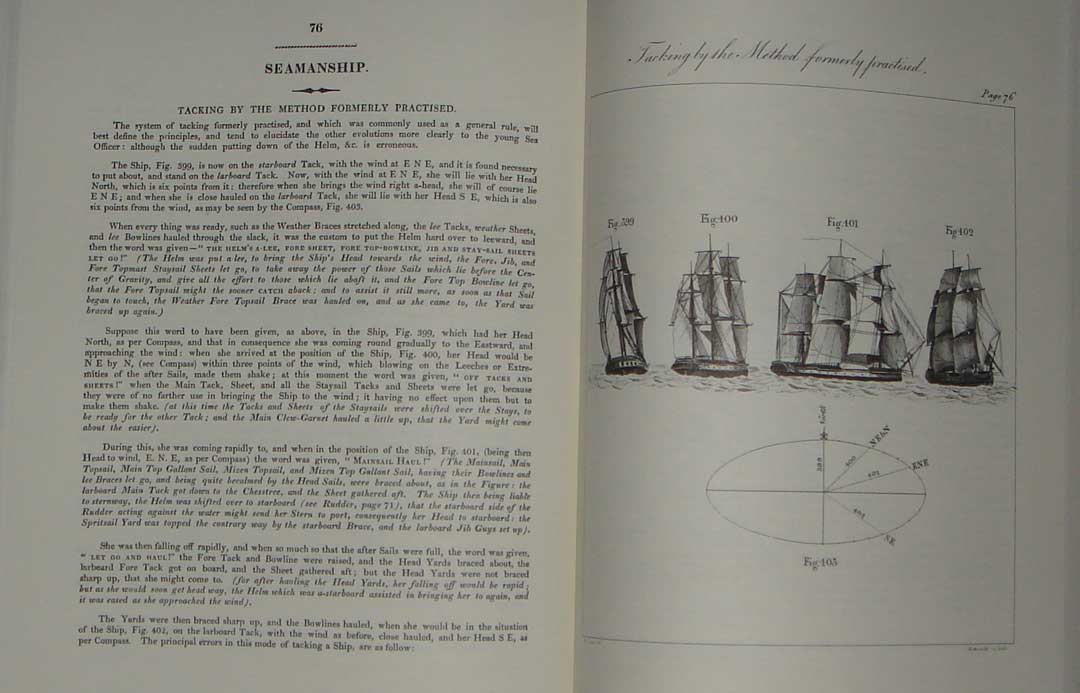
So I visited all sorts of ship museums, spoke to the people there, practically earned a degree in this sort of stuff. Then I found a book called The Young Sea Officer’s Sheet Anchor by one Darcy Lever. Mr. Lever learned all his sailing skills the hard way, as in aboard a ship in the East India Company back in the day. We’re talking about the late 1700’s here when ships were wood and men had few teeth and sometimes less brains. But they knew how to get from one side of the world to the other with nothing but the wind and the strength of their muscles. Lever starts with rope and goes all the way to how to maneuver a fully rigged ship in all conditions. It can be dry but with the illustrations it is amazing to contemplate just what it took to sail a square rigger. Utterly amazing that it worked at all!
Luckily this book has survived and has been reprinted in an economical paperback edition. I’ll be sure to credit it in the acknowledgments of my novel. If you ever get pressed into service, be sure you have this book with you. You’ll be captain in no time!
To further my education in the sailing world I’ll be traveling to various places, including Baltimore, MD, USA where they have a replica of a topsail schooner named the Pride of Baltimore II. I’ll be spending time aboard this vessel as schedules permit. Similarly, I’ll be checking out sailing vessels in Philadelphia, Mystic Connecticut and the coast of Maine. This will be a completely new experience for me. As mentioned above, I like diesel power, having spent more than 15 years working around tugboats. Nonetheless, there’s always something to be learned and that’s the fun of being a writer. You come up with a story and teach yourself all about the subject. If you’re really lucky, you get paid to share that story with others.


 The Bent Page
You must be logged in to post a comment.