The Romans Built This

The Romans built plenty of things that are still standing. They must have known what they were doing. Plus, they built with stone, big blocks of stone. It’s one of the few materials that lasts thousands of years. In Segovia, Spain, it is impossible to miss the aqueduct. It passes through the middle of the city. I took this photo from the top:

The blocks of stone are massive enough to have their own gravity. Each one has a divot cut into it, which is where archeologists figure a giant metal tongs fit when lifting the stones into space. It must have been an incredible effort to build such things. And just think, this aqueduct carried water for more than 1,500 years. Can you think of any modern systems that last even 10% of that time? Amazing.

Here’s another view, this one taken from the bell tower of an old church.

That’s the boom of a modern crane sticking out across the frame. If the Romans had such equipment, they might still rule the known world. Nonetheless, they didn’t, so like all empires, things fell apart. Still, they left behind some brilliant feats of engineering. Any visit to Spain treats the visitor to a number of Roman sites. I visited one called Italica, which was a Roman city near present-day Seville. I’ll post a photo from there, too.

Segovia has relics from many eras, including romanesque churches, a medieval castle, a massive cathedral, not to mention various other attractions for the historically interested. And the food, well, bring your appetite.

Published in: on June 20, 2008 at 11:02 am  Comments (2)  
Tags: , , , ,

A Flag

Where I come from…

… this says it all.

Published in: on June 19, 2008 at 4:58 pm  Comments (1)  
Tags: ,

Cuenca’s Gorge

No doubt you’ve seen many great photos of the “hanging houses” of Cuenca, Spain. Here is a look into the gorge above which those famous houses hang.

It’s a long way down; that’s for sure. What’s interesting is the way the land on that narrow valley floor is being used. Not one square inch is wasted. After touring about town, we went down there. The patchwork fields were more like large gardens, the soil black and lush. No crops were in season, but you can bet that whatever was planted was sure to yield a bountiful harvest. There was also the church on the bluff to the right side of the frame. It was another imposing structure, standing out to the very edge, it’s walls rising up from the rock below.

Landscapes and structures like these are one of the things I like about Spain. Each one is a series of surprises and unexpected revelations. At times it is hard to grasp all of them. It takes practice to seek them out and not be overwhelmed by the major attractions. We were driving from Cuenca to Granada and along the way came to a small town. After filling the tank at a gas station, I noticed a series of walls about five or six blocks away. I motored over only to discover the remains of what must have been a small cathedral. No one was around, not even a stray dog. We walked among the ruins, undisturbed for the better part of an hour. There was no roof and several walls appeared to be only half their original height. And yet the feeling of what had been there remained.

I imagine there are many such places not only in Spain but around the world. There are too many for all of them to be restored or even preserved as they are. I was thrilled to take my own little tour through the past, now wishing I had taken some photos to have for the future. Given the very good digital cameras today and the low prices of memory cards, I won’t make that mistake again.

Published in: on June 19, 2008 at 9:47 am  Comments (2)  
Tags: , , ,

New Fountain Pen

Couldn’t help myself. I was invited to a Mont Blanc event, the opening of a new boutique. Of course, while I was there, they put the press on me to augment the fountain pen collection. Could have been the whiskey they foisted on me. Maybe, maybe not. Either way, I’m not sorry. This pen is part of their Writer Series. I’m not a big fan of William Faulkner. (Nothing against him. He was a master, no doubt about it, just not my flavor.) However, the pen Mont Blanc designed for his name is exceptional. Here’s a first look:

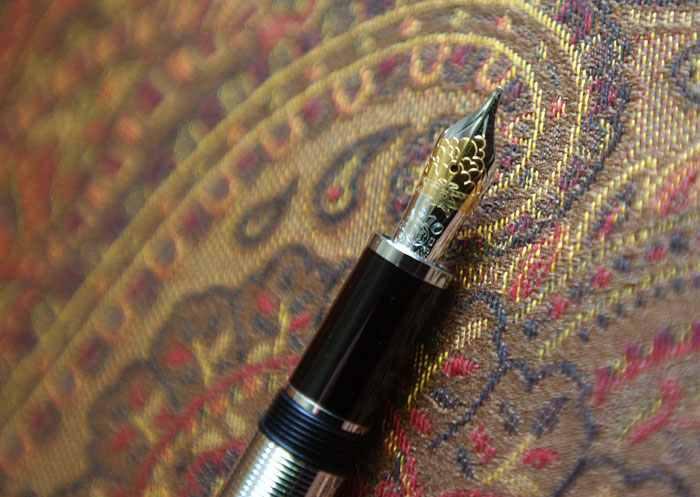
The pen is heavier than my model 149’s. I like a heavy pen because I’m a clumsy, left-handed scribbler with a tendency to press. You don’t have to press with a fountain pen. It glides over the paper. So weight is like back pressure; it keeps you off the throttle. Here’s a close up of the nib:

Faulkner was a big fan of aerobatics. That’s why the airplane is cut into the nib. There’s clouds there, too. Each pen in this series draws something from the author’s life that is subsequently designed into the form of the unit. You should see the one for Jules Verne. (I’m secretly saving for it.) One more shot:

Fountain pens aren’t for everyone. I use them in the course of writing because I find long handed writing more productive than typing into the computer. For this silly reality, I offer no explanation. It works and I don’t mess with it. Ah, one more piece of eye candy:

This pen has been inked up and tested fully. Trust me, it writes like a dream. You can crank through twenty pages a day with no cramps, no crying. Paper selection is a key part of the solution as well and we’ll get into that later. I’ll also post a few shots of my older pens. (They’re shamefully dirty, but I don’t have them to look at. They’re the tools of the trade.) By the way, all these photos were taken by my wife, who I think did an excellent job.

What’s your favorite writing device? Let me know.

Published in: on June 18, 2008 at 9:22 pm  Comments (6)  
Tags: , , ,