Cuenca’s Gorge

No doubt you’ve seen many great photos of the “hanging houses” of Cuenca, Spain. Here is a look into the gorge above which those famous houses hang.

It’s a long way down; that’s for sure. What’s interesting is the way the land on that narrow valley floor is being used. Not one square inch is wasted. After touring about town, we went down there. The patchwork fields were more like large gardens, the soil black and lush. No crops were in season, but you can bet that whatever was planted was sure to yield a bountiful harvest. There was also the church on the bluff to the right side of the frame. It was another imposing structure, standing out to the very edge, it’s walls rising up from the rock below.

Landscapes and structures like these are one of the things I like about Spain. Each one is a series of surprises and unexpected revelations. At times it is hard to grasp all of them. It takes practice to seek them out and not be overwhelmed by the major attractions. We were driving from Cuenca to Granada and along the way came to a small town. After filling the tank at a gas station, I noticed a series of walls about five or six blocks away. I motored over only to discover the remains of what must have been a small cathedral. No one was around, not even a stray dog. We walked among the ruins, undisturbed for the better part of an hour. There was no roof and several walls appeared to be only half their original height. And yet the feeling of what had been there remained.

I imagine there are many such places not only in Spain but around the world. There are too many for all of them to be restored or even preserved as they are. I was thrilled to take my own little tour through the past, now wishing I had taken some photos to have for the future. Given the very good digital cameras today and the low prices of memory cards, I won’t make that mistake again.

Published in: on June 19, 2008 at 9:47 am  Comments (2)  
Tags: , , ,

New Fountain Pen

Couldn’t help myself. I was invited to a Mont Blanc event, the opening of a new boutique. Of course, while I was there, they put the press on me to augment the fountain pen collection. Could have been the whiskey they foisted on me. Maybe, maybe not. Either way, I’m not sorry. This pen is part of their Writer Series. I’m not a big fan of William Faulkner. (Nothing against him. He was a master, no doubt about it, just not my flavor.) However, the pen Mont Blanc designed for his name is exceptional. Here’s a first look:

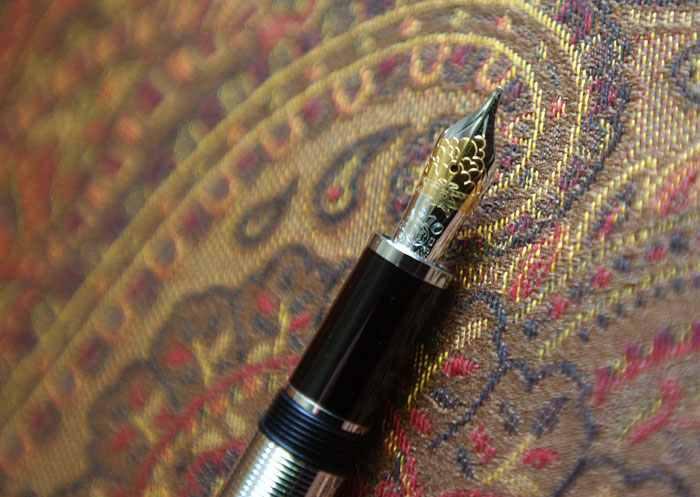
The pen is heavier than my model 149’s. I like a heavy pen because I’m a clumsy, left-handed scribbler with a tendency to press. You don’t have to press with a fountain pen. It glides over the paper. So weight is like back pressure; it keeps you off the throttle. Here’s a close up of the nib:

Faulkner was a big fan of aerobatics. That’s why the airplane is cut into the nib. There’s clouds there, too. Each pen in this series draws something from the author’s life that is subsequently designed into the form of the unit. You should see the one for Jules Verne. (I’m secretly saving for it.) One more shot:

Fountain pens aren’t for everyone. I use them in the course of writing because I find long handed writing more productive than typing into the computer. For this silly reality, I offer no explanation. It works and I don’t mess with it. Ah, one more piece of eye candy:

This pen has been inked up and tested fully. Trust me, it writes like a dream. You can crank through twenty pages a day with no cramps, no crying. Paper selection is a key part of the solution as well and we’ll get into that later. I’ll also post a few shots of my older pens. (They’re shamefully dirty, but I don’t have them to look at. They’re the tools of the trade.) By the way, all these photos were taken by my wife, who I think did an excellent job.

What’s your favorite writing device? Let me know.

Published in: on June 18, 2008 at 9:22 pm  Comments (6)  
Tags: , , ,

All That Junk

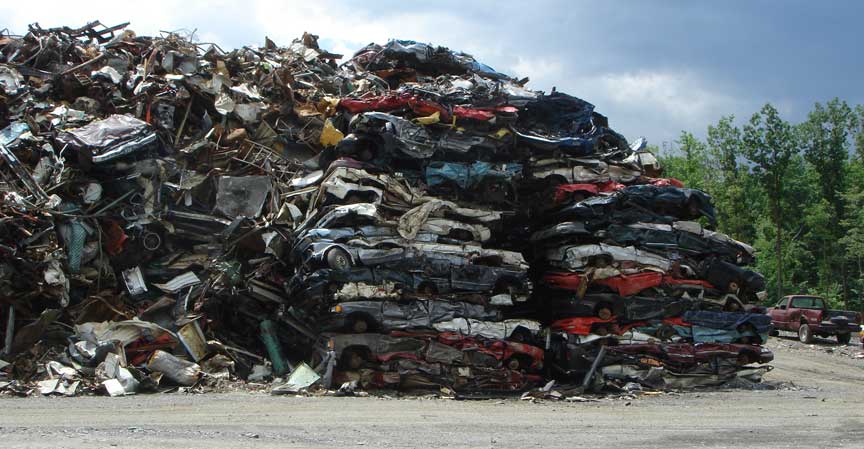
Did you ever wonder what happens to all that junk? Your old car, broken appliances, maybe an ancient lawn mower? Well here’s what happens to the vast majority of it. Actually this is Phase 2. Phase 1 is the local scrap metal hauler, be it the trash collector or another individual, picks it up from you or your recycling center or some such place. Then it travels to a place where it ends up looking like this:

You can see flattened cars in the pile as well as a jumble of other things. From this pile, the material is fed into what is known as a “shredder.” This machine is technically a hammer mill. Just imagine a long shaft with huge hammers hanging from it. Now spin that shaft with a 2,000 horsepower electric motor. Whatever those hammers strike is shattered into little pieces. Below is a photo of your junk being fed into the machine.

Here’s another one. This time the claw of the machine is beside the throat of the shredder.

Notice the steam coming off the shredder. Plenty of heat is generated by those hammers pulverizing all that material. Water is sprayed in to keep things cool. The pieces fall onto a conveyor belt system. These belts pass through various sorting devices including magnets to separate the ferrous (iron) from the non-ferrous (copper, aluminum, etc.). That system looks like this:

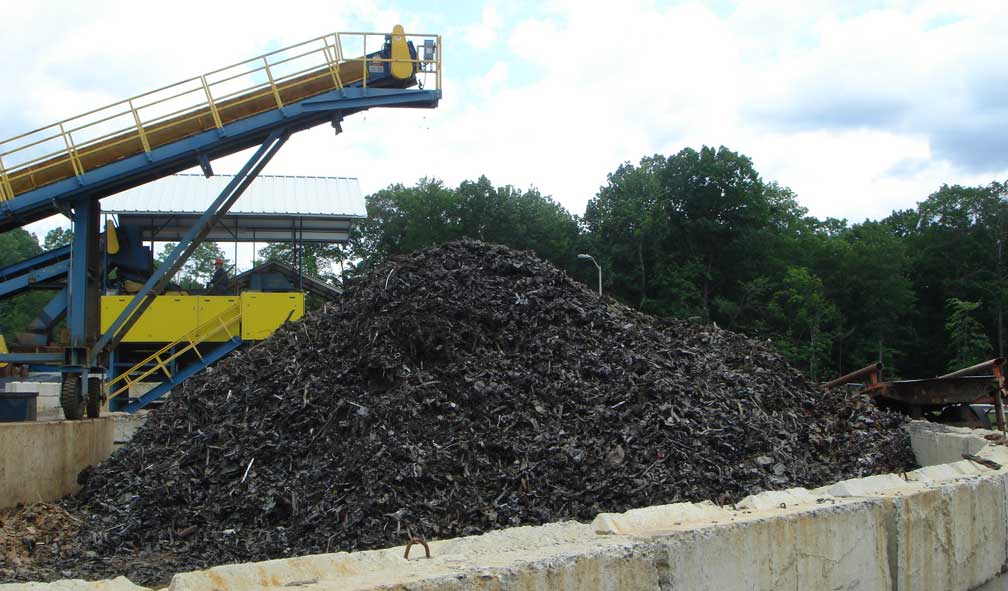
Ultimately some of the material is separated by hand. At the end of the line, there are individual piles of ferrous scrap, non-ferrous, and “fluff.” Fluff is all the plastic, foam rubber, paper, and miscellaneous garbage that is not metallic. Believe it or not, fluff has many uses including landfill cover and fuel stock. This pile is of the ferrous scrap or “frag” as it is called.

In Phase 3, this will be sent to a steel mill and converted into new steel. Scrap iron is the most recycled commodity in the United States. Every year, millions of tons of junk are converted into new products. There is also a massive export market for this and the non-ferrous scrap.

So what’s this got to do with a guy who writes books and travels? Well, a friend of mine owns the plant shown above. He’s quite the entrepreneur. It’s people like him and the guys who work in scrap yards that sometimes form the basis of the characters in my books. Besides, there’s never a dull moment around this kind of action. It sure beats the office.

Published in: on June 18, 2008 at 7:42 pm  Leave a Comment  
Tags: , , ,

A Brief Reminder

Here’s a photo of a fading Coca-Cola sign, this one taken in Aruba.

People ask me why I’m such a big fan of Coca-Cola. Well, it goes back a long way, my whole life actually. You see, my grandfather worked for Coca-Cola Bottling of New York. They owned the local bottling works in the next town over from where I grew up. He drove a delivery truck, hauling various products to stores and restaurants located around the area. The company treated my grandfather very well. When he finally retired they gave him an expensive clock, which I only learned much later was powered by the changes in atmospheric pressure. It’s a long explanation exactly how. Suffice it to say it works with a barometer that acts as a winding device so you don’t have to wind it. For the company to give him such an expensive gift was a remarkable gesture. Sadly, my grandfather died young, as many of his generation did, a victim of cancer. I remember going a few places with him, the local fire house where he liked to meet his friends was one in particular.

But it’s more than just loyalty to my grandfather. I like the taste of the product. Some people may not like it, but Coke is a universal symbol of Americana. I’ve been many places in this world and buying a stranger a Coke is not a bad way to break the ice or start a friendship. It doesn’t have to be complicated. It’s simple. A properly chilled and served Coke goes a long way to refresh and inspire. I can’t pour one without being reminded of my grandfather. Funny how things remind us of people, isn’t it?

As always, ENJOY Coca-Cola, ICE COLD.

Published in: on June 18, 2008 at 12:24 pm  Comments (2)  
Tags: , ,