Tugboat Anatomy, Part I

One of the main characters in my novel, An Island Away, is a tugboat captain named Nathan Beck. Captain Beck washes ashore on the island of Aruba after his boat sinks in a storm. During my seventeen years working on the Philadelphia waterfront and beyond, I had the pleasure of knowing several tugboat captains very well, not to mention the others that I sailed with every now and then. My friend Harry owns the High Roller, which is shown below.

The High Roller is your typical general purpose tugboat built about 40 or so years ago. Yes, when well cared for, these boats last a long time. I worked with this boat for about six years, towing barges down the Delaware River, into the Atlantic Ocean, and some other places (most times I found my way back). One thing you’ll notice is the bow fender on the front of the boat. Tugboats push as much as they pull. The fender protects both the tug and whatever it happens to be pushing against. It took me a long time to get used to the idea that you actually bump into things when you’re working on tugs as opposed to land vehicles where touching is usually a bad thing. In the center of the bow you’ll see the bull ring where a line can be passed through before leading to a pier, barge, or ship. It is made fast on the front bit by turning figure eights. That first level of deckhouse is bunkrooms and the next level is the wheelhouse. All the way at the top is another steering station used to see over the top of tall barges.

Let’s go inside.

Above you’ll see the two throttles, one for each engine. The view from the wheelhouse is actually pretty good when looking forward. There are windows all the way around but plenty of blind spots to the stern. There is a stern steering station outside, but from there, of course, it is hard to see forward. You have to learn to anticipate your moves, judge how far something will move, and how fast it will move there. Anyway, push the throttle forward one notch to engage the wheels (propellers). Further than the first notch increases the speed of the propeller (not necessarily the boat). Steering is accomplished with a small lever. Sorry, no big, wooden ship’s wheel here. Above the windows is a panel that is shown below.

The two dials show your engine rpm and the center needle is an indicator for the position of your rudder. That’s Harry in the reflection on the computer screen. (He just turned 79. He and his father performed some heroic deeds when a tanker burned at the dock back in the day). If the screen were on, you would see a chart plotter image that ties into the GPS system to show where you are. Comes in handy, especially in the fog. Here is the view down onto the foredeck.
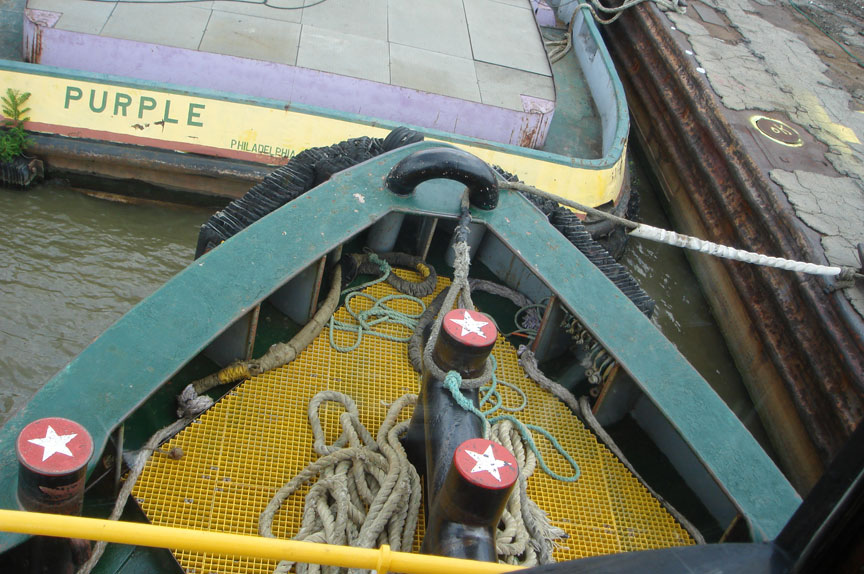
In the center, you see the bit, which is shaped like an H. The bit on the left (port side) is a single bit with a horn that you could also use for making a line fast. These bits are used to lead lines in different directions depending on your purpose. (By the way, Harry’s other boat in the frame there is called the Purple Hays. He has a sense of humor when it comes to naming boats.)

In An Island Away, Nathan Beck is the captain of a much larger tug, but the anatomy is the same. Beck’s grandfather was in the merchant marine during the Second World War, serving as a cook on ships that were torpedoed and sunk on Atlantic Convoy duty. Thus, the older Beck opened a restaurant with a view of the waterfront in Philadelphia. Well, Nathan Beck was raised by this grandfather because his own father abandoned him there at the restaurant. He grew up with a view of the river and the tugboats roaming about. Captivated by these stout vessels he made them his career, ultimately becoming the man who would wash ashore in Aruba, encounter Sam, Luz, and Charlie (yes, of Charlie’s Bar mentioned earlier in my blog).

Part II will take a look at the main deck and what goes on there.

Three Sheets to the Wind

No, this post is not about drinking. Not yet, anyway. I’ve been researching a new novel, MacMillan Judge, Privateer. Set in 1815, this is the story of a young American who gets involved in a ransom parlay with Barbary Pirates. Through a series of vicious events he’s left stuck in a sailing launch with nothing but a Pennsylvania Long Rifle, some rations, and $20,000 in gold. So what does he do? Well, he’s an American first and foremost, and he missed his chances at glory through the war of 1812. He’s not going to sail into the sunset. Instead, he’s going to get himself to Spain, find a ship, hire a crew, and go back and rescue the person who was to be rightly ransomed.

This is easier said than done, both for our man MacMillan Judge, and yours truly, the writer. In the first place, I’ve never sailed a boat in my life. I prefer horsepower (the diesel kind) to wind power. Nonetheless, sailing ships are fascinating creatures. Much like steam engines, they show you their guts on the outside. They’re unwieldy, complicated, and still handsome the way they carry themselves with dignity.

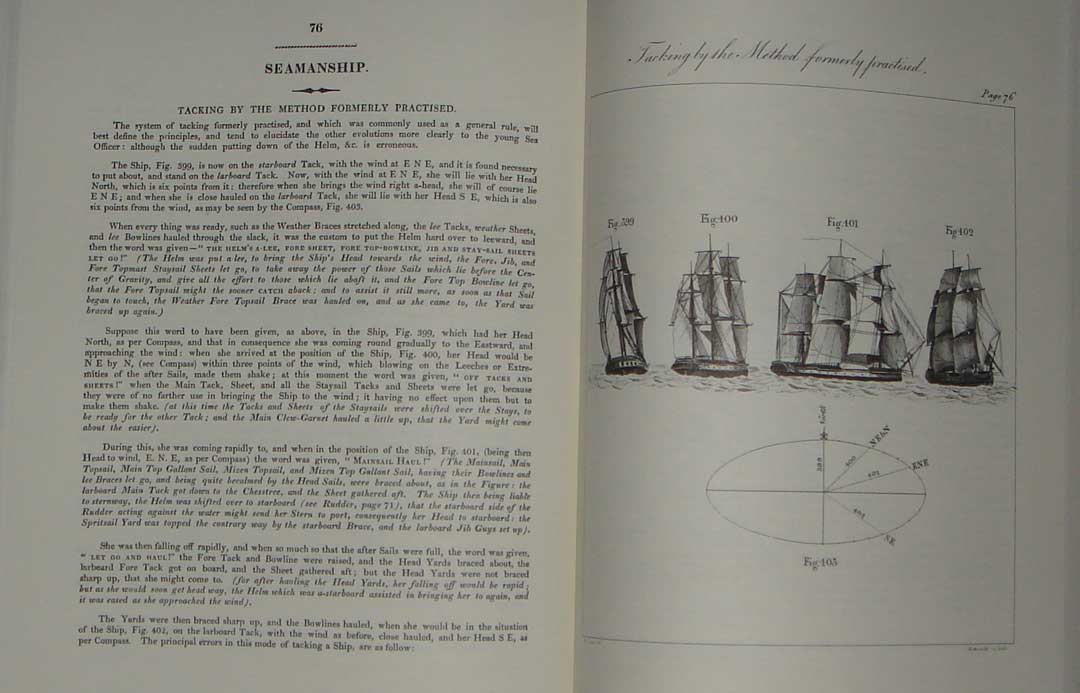
Here’s a page from Lever’s book:

So I visited all sorts of ship museums, spoke to the people there, practically earned a degree in this sort of stuff. Then I found a book called The Young Sea Officer’s Sheet Anchor by one Darcy Lever. Mr. Lever learned all his sailing skills the hard way, as in aboard a ship in the East India Company back in the day. We’re talking about the late 1700’s here when ships were wood and men had few teeth and sometimes less brains. But they knew how to get from one side of the world to the other with nothing but the wind and the strength of their muscles. Lever starts with rope and goes all the way to how to maneuver a fully rigged ship in all conditions. It can be dry but with the illustrations it is amazing to contemplate just what it took to sail a square rigger. Utterly amazing that it worked at all!

Luckily this book has survived and has been reprinted in an economical paperback edition. I’ll be sure to credit it in the acknowledgments of my novel. If you ever get pressed into service, be sure you have this book with you. You’ll be captain in no time!

To further my education in the sailing world I’ll be traveling to various places, including Baltimore, MD, USA where they have a replica of a topsail schooner named the Pride of Baltimore II. I’ll be spending time aboard this vessel as schedules permit. Similarly, I’ll be checking out sailing vessels in Philadelphia, Mystic Connecticut and the coast of Maine. This will be a completely new experience for me. As mentioned above, I like diesel power, having spent more than 15 years working around tugboats. Nonetheless, there’s always something to be learned and that’s the fun of being a writer. You come up with a story and teach yourself all about the subject. If you’re really lucky, you get paid to share that story with others.

Published in: on June 14, 2008 at 9:08 pm  Leave a Comment  
Tags: , ,

One Tough School Teacher

I just finished reading The Collaborator of Bethlehem by Matt Beynon Rees. I don’t read much detective or mystery fiction these days but this one caught my eye. It’s set in present day Palestine and the protagonist is a hard-luck school teacher named Omar Yussef. One of his former students from years ago is accused of collaboration and Yussef sets off to clear his name. There are very few good guys in this book, only people with more or less evil in their hearts. Yussef is much better drawn than any of the Marlowe-type characters I’ve read. The bad guys don’t have much good in them but they have complicated motives that keeps them interesting and multi-dimensional.

The best part about this book is the way Rees weaves the plot through the looming presence of the Israeli-Palestinian conflict. His character Yussef is not so much stuck on one side or the other as he is caught in the middle. The book never preaches, nor does it come down against anything but the debilitating violence that never lets up.

The book also peers into the darker side of the various factions, how they operate businesses Mafia-style, how they intimidate everyone. Yussef sticks up for himself and others when he can. Sometimes he succeeds, most times he does not. And that brings me to the toughest part, there is no happy ending as much as there is a bit of justice.

Rees deserves all the accolades he received for this book. He writes better than the top-sellers in the genre. I only wish the book was a little longer with a bit more detail.

Published in: on June 9, 2008 at 10:39 pm  Leave a Comment  
Tags:

The Brevity Cult

I first learned the term “brevity cult” from author Neal Stephenson. He writes long books with enough detail to not only put you in the scene but to saturate every one of the five senses. Then he interlinks historical context with story elements. If that’s not enough he gets into all types of other factors from the hard sciences to sociology. These are the types of books I like to read and they are the type of books I write. (The first draft of my novel, An Island Away, was 1200 pages.) Ken Follet’s Pillars of the Earth is another example of a long book that is stunningly good. There are plenty more examples to be found, just search the shelves of your local bookstore.

The brevity cult, on the other hand, prefers short novels. There are plenty of these out there, too. I’ve read a few. They’re all broth, no meat, no vegetables, no flavor. Someone went somewhere, something happened, it’s over. The sentence structures are pared down to the bare bones with no variety, no winding paths, nothing to tickle the brain. They feature tons of dialog, as if a book and a play are the same thing. If I only want to hear people talk, I’ll go to the local bar and eavesdrop.

I’m not sure what publishers see in these short books. The public buys them in some numbers but they also rave about plenty of long books. I’m a bit insulted by a 197 page novel. That’s a short story where I come from. If three of them were put together in a collection it would be worth the cover price. However, I’m not plunking down righteous coin for so few pages.

Furthermore, I wonder if some authors are simply lazy. Often enough they don’t even label who’s speaking, which is fine until there are ten pages of dialog or four characters speaking. What’s the point of putting together a story and not fully developing it? If you’re going to ask the reader to spend some time between the covers, make it worth their while. Work hard, spin those plot threads among characters that are loved and hated, cherished or despised. If not, write magazine articles or shopping lists for that matter.

Oh, there is a name for these short books. They’re called “slender gems.” Well, if you think a lump of quartz is the same as a diamond, just try giving it to your wife. No, really honey, I mean it.

Published in: on June 9, 2008 at 7:39 pm  Comments (3)  
Tags: ,