Cuenca’s Gorge

No doubt you’ve seen many great photos of the “hanging houses” of Cuenca, Spain. Here is a look into the gorge above which those famous houses hang.

It’s a long way down; that’s for sure. What’s interesting is the way the land on that narrow valley floor is being used. Not one square inch is wasted. After touring about town, we went down there. The patchwork fields were more like large gardens, the soil black and lush. No crops were in season, but you can bet that whatever was planted was sure to yield a bountiful harvest. There was also the church on the bluff to the right side of the frame. It was another imposing structure, standing out to the very edge, it’s walls rising up from the rock below.

Landscapes and structures like these are one of the things I like about Spain. Each one is a series of surprises and unexpected revelations. At times it is hard to grasp all of them. It takes practice to seek them out and not be overwhelmed by the major attractions. We were driving from Cuenca to Granada and along the way came to a small town. After filling the tank at a gas station, I noticed a series of walls about five or six blocks away. I motored over only to discover the remains of what must have been a small cathedral. No one was around, not even a stray dog. We walked among the ruins, undisturbed for the better part of an hour. There was no roof and several walls appeared to be only half their original height. And yet the feeling of what had been there remained.

I imagine there are many such places not only in Spain but around the world. There are too many for all of them to be restored or even preserved as they are. I was thrilled to take my own little tour through the past, now wishing I had taken some photos to have for the future. Given the very good digital cameras today and the low prices of memory cards, I won’t make that mistake again.

Published in: on June 19, 2008 at 9:47 am  Comments (2)  
Tags: , , ,

Wind Power

With the price of oil what it is today, there are all kinds of people talking about alternative energy. In Spain there are windmills all over the place. The ones in the photo below happen to be the modern kind that make electricity but there are also the old ones that mill grain or pump water.

These magnificent machines go a long way to provide for Spain’s electricity needs. The amazing part is they make very little noise. From where I was standing in this photo, you could barely hear them. At another location, there were literally hundreds of windmills and barely a sound came from them. I thought this can’t be true; they have to make noise. I spoke with an engineer who specializes in windmills and he explained that the windmills are not “loud” per se. He added that the ambient noise produced by the wind itself also disguises the noise of the machine.

At the time of this writing, there are no commercial sized windmills on my beloved island of Aruba. This is unbelievable given that the trade winds, the prevailing westerly of yore, blow across the island day in and day out. There are very few times in Aruba when the wind is not blowing with enough force to turn a giant windmill. Naturally, energy prices on the island have gone into the stratosphere with the price of oil. A string of large windmills would go a long way to alleviate this problem, not to mention how it would help the environment. Similarly, it would benefit the Aruban economy by reducing the cost of energy, giving the island a competitive edge against less fortunate locales. I’ll be doing some politicking to bring this issue to the fore with my friends on the island. It makes economic sense, is good for the planet, and won’t hurt a bit. Why delay?

I decided not to delay by having a system designed for my home there. It incorporates a 1kW turbine and an 800 watt solar array. This is not very much generating capacity. However, given the constant winds and reliable sunshine it will produce enough power to generate more than 75% of my energy needs. From January through April it will most likely supply 100%. There is a battery bank which keeps the power on during times of low wind and/or sun. I’m working on a deal with my neighbor to use the power when I’m not there, which will make the system that much more affordable for both of us. As soon as these pieces are in place I’ll ship the parts to the island and start getting a nice return on the investment.

Published in: on June 16, 2008 at 12:01 pm  Comments (1)  
Tags: , , , , ,

Three Sheets to the Wind

No, this post is not about drinking. Not yet, anyway. I’ve been researching a new novel, MacMillan Judge, Privateer. Set in 1815, this is the story of a young American who gets involved in a ransom parlay with Barbary Pirates. Through a series of vicious events he’s left stuck in a sailing launch with nothing but a Pennsylvania Long Rifle, some rations, and $20,000 in gold. So what does he do? Well, he’s an American first and foremost, and he missed his chances at glory through the war of 1812. He’s not going to sail into the sunset. Instead, he’s going to get himself to Spain, find a ship, hire a crew, and go back and rescue the person who was to be rightly ransomed.

This is easier said than done, both for our man MacMillan Judge, and yours truly, the writer. In the first place, I’ve never sailed a boat in my life. I prefer horsepower (the diesel kind) to wind power. Nonetheless, sailing ships are fascinating creatures. Much like steam engines, they show you their guts on the outside. They’re unwieldy, complicated, and still handsome the way they carry themselves with dignity.

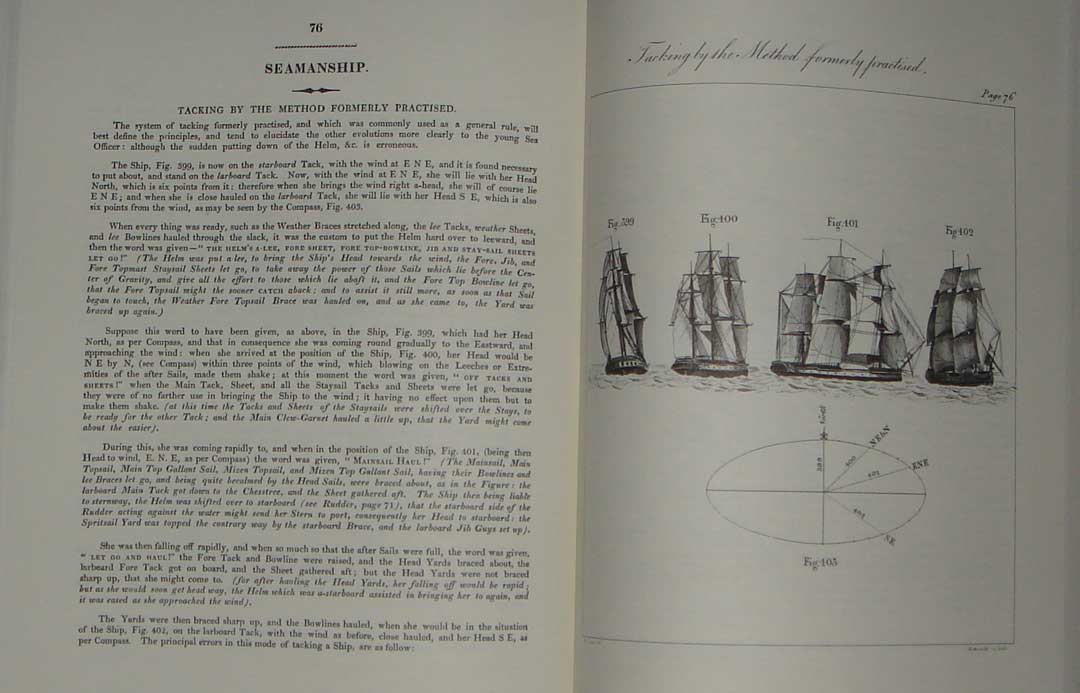
Here’s a page from Lever’s book:

So I visited all sorts of ship museums, spoke to the people there, practically earned a degree in this sort of stuff. Then I found a book called The Young Sea Officer’s Sheet Anchor by one Darcy Lever. Mr. Lever learned all his sailing skills the hard way, as in aboard a ship in the East India Company back in the day. We’re talking about the late 1700’s here when ships were wood and men had few teeth and sometimes less brains. But they knew how to get from one side of the world to the other with nothing but the wind and the strength of their muscles. Lever starts with rope and goes all the way to how to maneuver a fully rigged ship in all conditions. It can be dry but with the illustrations it is amazing to contemplate just what it took to sail a square rigger. Utterly amazing that it worked at all!

Luckily this book has survived and has been reprinted in an economical paperback edition. I’ll be sure to credit it in the acknowledgments of my novel. If you ever get pressed into service, be sure you have this book with you. You’ll be captain in no time!

To further my education in the sailing world I’ll be traveling to various places, including Baltimore, MD, USA where they have a replica of a topsail schooner named the Pride of Baltimore II. I’ll be spending time aboard this vessel as schedules permit. Similarly, I’ll be checking out sailing vessels in Philadelphia, Mystic Connecticut and the coast of Maine. This will be a completely new experience for me. As mentioned above, I like diesel power, having spent more than 15 years working around tugboats. Nonetheless, there’s always something to be learned and that’s the fun of being a writer. You come up with a story and teach yourself all about the subject. If you’re really lucky, you get paid to share that story with others.

Published in: on June 14, 2008 at 9:08 pm  Leave a Comment  
Tags: , ,

The Alhambra

The Alhambra is one of those mythical sites that is a must-see. Here’s a photo of your author, taken from across the valley with the palace/fortress in the background.

Washington Irving is the American given credit for saving much of what we see today when visiting the Alhambra. Irving traveled to Seville by ship and then overland to Granada. He documented this trip and various other adventures in his Tales of the Alhambra. These stories are fantastic in the true sense of the word. More interesting is the vivid accounts of the Spanish character which I found very accurate during my visit. Some of the people I met might have stepped directly from Irving’s pages despite more than 170 years between the two encounters.

It should also be noted that when Irving visited the Alhambra it was a much abused site. French troops retreating from Spain nearly blew up large portions of it. Looters stole pieces from every possible place. Thanks to Irving, conservations efforts began and the site was ultimately preserved and refurbished for all of us to see.

When visiting the Alhambra it is best to have tickets in advance. The regular tours are not simple cattle calls. My group’s guide had grown up in Granada but spent his summers in Germany. He spoke Spanish, English, and German with brilliant fluency, switching between the three for different people in the group. He never missed a beat and his enthusiasm was irresistible. As he said, “I love my job. Everyday I come to work in a magnificent palace.” And magnificent the Alhambra is. I remember seeing glossy photos of it in my childhood but nothing could have prepared me for the atmosphere of the place. If you have the good fortune to go to Spain, don’t miss it.

While you’re in Granada, the tapas are worthy of their looming neighbor on the cliff. But we’ll get into that later. Buen provecho!

Published in: on June 14, 2008 at 12:01 pm  Comments (3)  
Tags: ,