Kite Surfing

With the steady tradewinds blowing, Aruba is among the best places in the world to kite surf. When I first visited the island, wind surfing was all the rage. This is done with a board and a sail fixed to mast that is attached to the board. Kite surfing on the other hand is done with a kite that flies well above the surfer, who stands on the board with his feet in special loops. Here’s a photo taken near the Malmok area of Aruba.
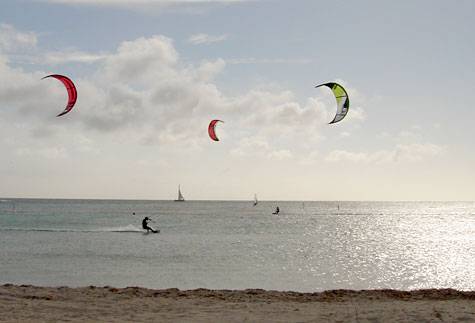
These guys move fast, fast enough to jump waves, do stunts, and actually travel for miles if they want to. That guy in the frame is shooting a rooster tail!

Using two handles that control the lines up to the kite they’re able to maneuver the kite itself and increase or decrease the amount of power derived from the wind. I’ve seen some surfers just cruise along, while others go full blast.

The kite is actually shaped like a wing. This is what allows it to “fly” above the surfer. The lines change the shape of the wing, just like the control surfaces on an airplane. So, if you’re kite surfing, you’re sort of flying. Someday I have to give this a try. It has to be incredible fun.


Published in: on June 20, 2008 at 9:38 pm  Comments (3)  
Tags: , , , ,

A Mission

While traveling about Spain, I invariably encounter pairs of older women out and about. Usually they give the appearance that they’re on a mission of great importance. Arm in arm, up the streets they go, toting oversized handbags and parcels to their critical destination. For all I know, they’re simply going home or to visit friends. Ah, but it’s fun to spin a little story. Maybe they’re delivering critical supplies needed for clandestine research that will save the world. Like these two in Cuenca:

I was on the easy part of this street. That is on the way down. Looking over the wall, I saw them coming up the lower part, before the corner at the right of the frame. They chugged up, one foot after the other, undeterred by the steep grade. I managed to snap this picture before they saw me, then quickly turned the camera away so as not to be offensive. But there was no foul. I touched my hat, they smiled, and went inside to complete their mission, whatever it happened to be.

Published in: on June 20, 2008 at 6:58 pm  Comments (2)  
Tags: , , , ,

The Romans Built This

The Romans built plenty of things that are still standing. They must have known what they were doing. Plus, they built with stone, big blocks of stone. It’s one of the few materials that lasts thousands of years. In Segovia, Spain, it is impossible to miss the aqueduct. It passes through the middle of the city. I took this photo from the top:

The blocks of stone are massive enough to have their own gravity. Each one has a divot cut into it, which is where archeologists figure a giant metal tongs fit when lifting the stones into space. It must have been an incredible effort to build such things. And just think, this aqueduct carried water for more than 1,500 years. Can you think of any modern systems that last even 10% of that time? Amazing.

Here’s another view, this one taken from the bell tower of an old church.

That’s the boom of a modern crane sticking out across the frame. If the Romans had such equipment, they might still rule the known world. Nonetheless, they didn’t, so like all empires, things fell apart. Still, they left behind some brilliant feats of engineering. Any visit to Spain treats the visitor to a number of Roman sites. I visited one called Italica, which was a Roman city near present-day Seville. I’ll post a photo from there, too.

Segovia has relics from many eras, including romanesque churches, a medieval castle, a massive cathedral, not to mention various other attractions for the historically interested. And the food, well, bring your appetite.

Published in: on June 20, 2008 at 11:02 am  Comments (2)  
Tags: , , , ,