Tugboat Anatomy, Part II

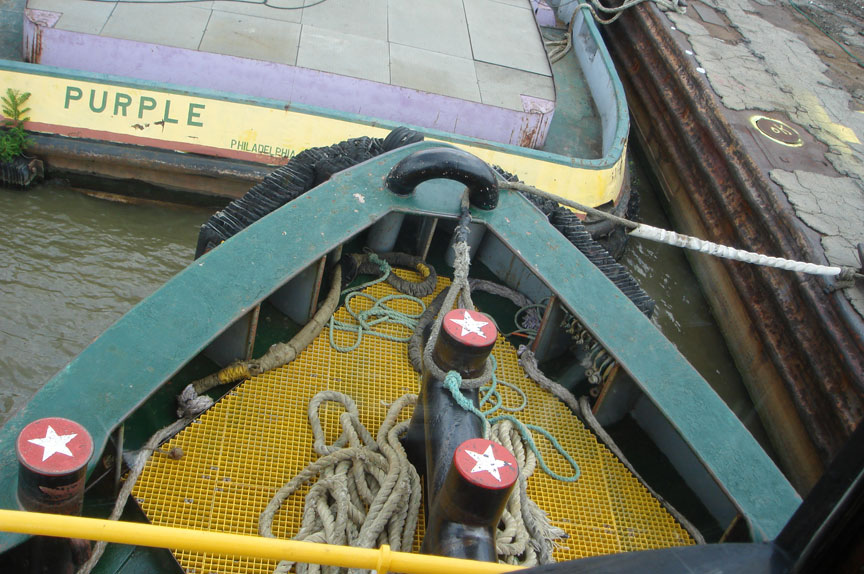
Having seen some of the basics, let’s stop on deck for a few minutes to talk about what goes on there. Here is a photo of the foredeck, directly below the front of the wheelhouse.

The H bit is used to make lines fast. They can be led through the bull ring at the very bow of the boat or off to either side through the single bits that stand against the gunwale. The ropes lying there will be tidied up. Harry’s crew was sorting through things, figuring out what’s good and what’s not, otherwise they would be hanging on pegs or stowed in lockers. The work of a deckhand is truly the case of hurry up and wait. He has to be ready to catch a line, toss one to someone else, or loose one at the command of the captain. The lines aren’t heavy until you’ve hauled them around for a couple of hours straight or pulled with all your might to get that last turn around a bit. (Well, actually they are quite heavy but you don’t notice that right away.) You also have to know when to let go. If you hold onto the line and it starts to run, it will pull you through the bit, twisting your arm and whatever other body part follows through the bit. This is not pretty and you’ll be lucky if you only go to the hospital.

Here’s a look at the stern deck.

Surprise! There stands another H bit. Beside it, painted red, white, and blue, is the capstan. This capstan is hydraulically powered. It is used to wind in the towing rope, which the deck hands must then “flake” or lay out in a neat pile atop a pallet that would normally be here, but was taken up to allow for painting of the deck. That rope which is used to tow barges is called a hawser and the High Roller carries one that’s more than a thousand feet long. It is slowly let out through the stern H bit until the captain thinks he has enough out to allow for safe towing. Then it is made fast as describe earlier. The hawser takes up the shock created by the difference in movement between the tug and the barge (or whatever else is being towed). One vessel may be riding up a wave while the other is on its way down. The hawser stretches between the two. It also moves from side to side and you don’t want to get caught between it and the gunwale or a bit or anything else. It will crush you. Again, a good deckhand has to anticipate what’s going to happen, be ready, and act accordingly.

Here’s a view over the stern.

That steel fixture in the middle is called a cleat. You can tie off to that or use it to lead a rope, again depending on the operation. When this photo was taken, the boat was sitting in the Delaware River, so there isn’t much to see. Often times you’ll be looking at a ship coming up from astern or a sunset or a lighthouse, all of which have their own drama.

My character, Nathan Beck, and his crew do the jobs I described here. An Island Away is not a sailing adventure, but there are a few scenes which take place aboard tugboats, including one dramatic event in the Delaware River when another tug catches on fire. Beck and his men have to jump into the fray in order to rescue the other guys on the river. One thing I’d like the reader to take away from these photos is the compactness of the space on deck. There isn’t much room to do anything. Thus, everyone has to work together. One person out of synch creates a big problem that may be dangerous or make for back breaking extra work. However, when a crew works together, it is a choreographed operation that’s a thrill to be a part of. Remember, these objects are big an heavy. The High Roller weighs hundreds of tons. The barges it tows and pushes weigh thousands of tons. Ships weigh tens of thousands of tons. It is this type of work, and more importantly this type of responsibility for other men’s lives and equipment, that forms the character who is Captain Nathan Beck.

In Part III, we’ll go inside to see the engine room and living quarters. Want a job?

Tugboat Anatomy, Part I

One of the main characters in my novel, An Island Away, is a tugboat captain named Nathan Beck. Captain Beck washes ashore on the island of Aruba after his boat sinks in a storm. During my seventeen years working on the Philadelphia waterfront and beyond, I had the pleasure of knowing several tugboat captains very well, not to mention the others that I sailed with every now and then. My friend Harry owns the High Roller, which is shown below.

The High Roller is your typical general purpose tugboat built about 40 or so years ago. Yes, when well cared for, these boats last a long time. I worked with this boat for about six years, towing barges down the Delaware River, into the Atlantic Ocean, and some other places (most times I found my way back). One thing you’ll notice is the bow fender on the front of the boat. Tugboats push as much as they pull. The fender protects both the tug and whatever it happens to be pushing against. It took me a long time to get used to the idea that you actually bump into things when you’re working on tugs as opposed to land vehicles where touching is usually a bad thing. In the center of the bow you’ll see the bull ring where a line can be passed through before leading to a pier, barge, or ship. It is made fast on the front bit by turning figure eights. That first level of deckhouse is bunkrooms and the next level is the wheelhouse. All the way at the top is another steering station used to see over the top of tall barges.

Let’s go inside.

Above you’ll see the two throttles, one for each engine. The view from the wheelhouse is actually pretty good when looking forward. There are windows all the way around but plenty of blind spots to the stern. There is a stern steering station outside, but from there, of course, it is hard to see forward. You have to learn to anticipate your moves, judge how far something will move, and how fast it will move there. Anyway, push the throttle forward one notch to engage the wheels (propellers). Further than the first notch increases the speed of the propeller (not necessarily the boat). Steering is accomplished with a small lever. Sorry, no big, wooden ship’s wheel here. Above the windows is a panel that is shown below.

The two dials show your engine rpm and the center needle is an indicator for the position of your rudder. That’s Harry in the reflection on the computer screen. (He just turned 79. He and his father performed some heroic deeds when a tanker burned at the dock back in the day). If the screen were on, you would see a chart plotter image that ties into the GPS system to show where you are. Comes in handy, especially in the fog. Here is the view down onto the foredeck.

In the center, you see the bit, which is shaped like an H. The bit on the left (port side) is a single bit with a horn that you could also use for making a line fast. These bits are used to lead lines in different directions depending on your purpose. (By the way, Harry’s other boat in the frame there is called the Purple Hays. He has a sense of humor when it comes to naming boats.)

In An Island Away, Nathan Beck is the captain of a much larger tug, but the anatomy is the same. Beck’s grandfather was in the merchant marine during the Second World War, serving as a cook on ships that were torpedoed and sunk on Atlantic Convoy duty. Thus, the older Beck opened a restaurant with a view of the waterfront in Philadelphia. Well, Nathan Beck was raised by this grandfather because his own father abandoned him there at the restaurant. He grew up with a view of the river and the tugboats roaming about. Captivated by these stout vessels he made them his career, ultimately becoming the man who would wash ashore in Aruba, encounter Sam, Luz, and Charlie (yes, of Charlie’s Bar mentioned earlier in my blog).

Part II will take a look at the main deck and what goes on there.

Time To Reload!

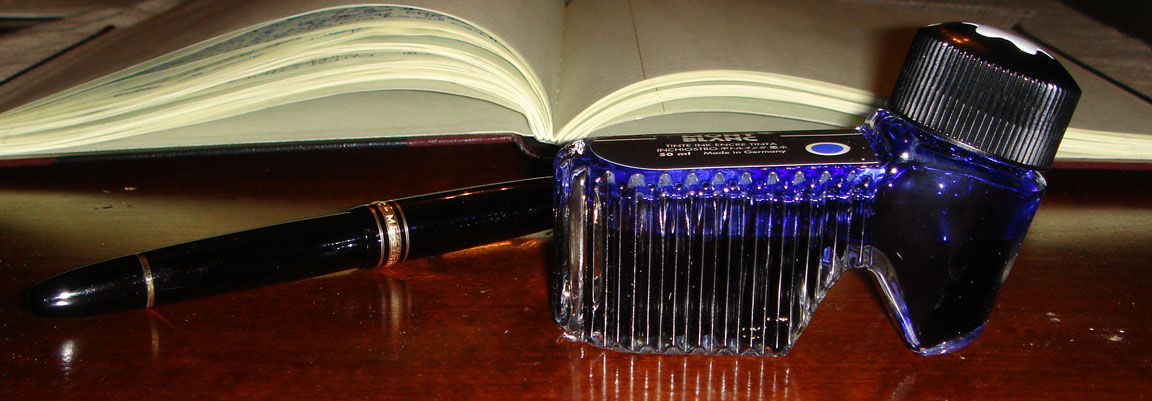
Time to reload the fountain pen. These photos aren’t the greatest, and I apologize in advance to my friends who are into fountain pens in a big way. (Their photographs are professional quality.) Anyway, I wanted to give a brief glimpse of the process by which ink is drawn into the pen, especially for my readers who asked about my writing habits.

You start out with the ink, in this case it is from Mont Blanc and comes in this cleverly shaped bottle.

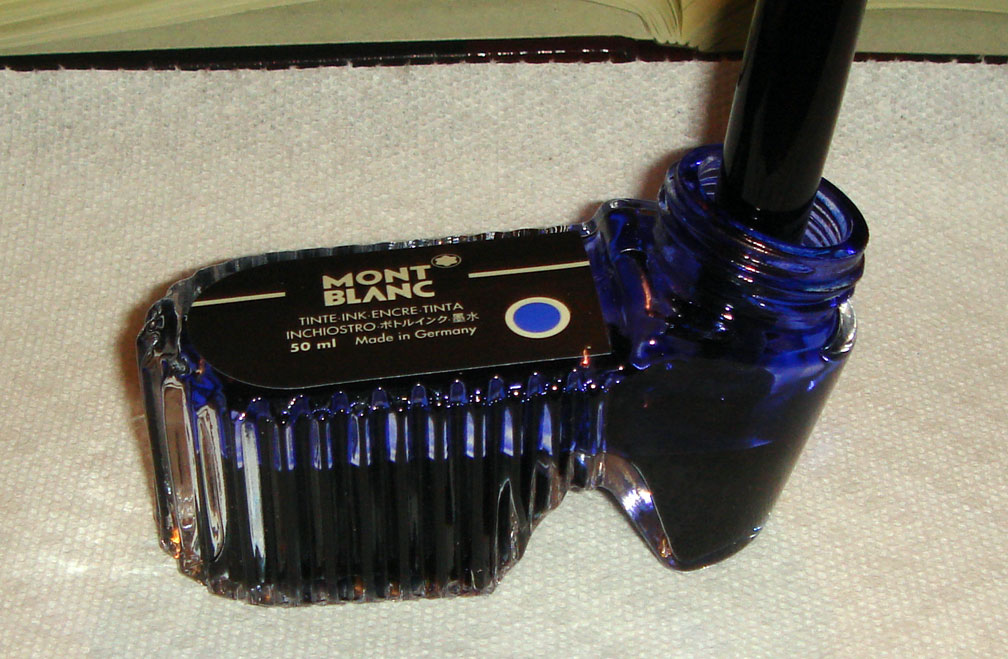
The bottle allows you to keep more ink on the well side so that you can always immerse the nib in enough ink to draw it into the pen. The end of the pen turns. By turning it, you move a plunger inside the body of the pen. Before getting into the ink, the plunger is screwed down so that it is closest to the nib end of the pen. The next step:

Note the introduction of the paper towels beneath the well. This is for emergency purposes only, such as when your cat decides to get nosy. The pen is lowered into the well until the nib is completely surrounded by ink. Then the back of the pen is turned in the opposite direction, which causes the plunger to retract, thereby drawing ink into the pen. One more time, the end is turned, this time to force a few drops out. Then the pen is turned with the nib up and the end is turned for the last time to draw a bit of air in. After wiping off any excess ink, you’re ready to write.

To some this may seem like a ridiculous procedure that has long been replaced by the convenience of ball point devices. All I can say is, “To each his own.” I write with these pens all day, day after day. They work perfectly, with less drag than any other I’ve tried. Therefore, until something comes along that’s better, I’ll stick with this. What’s your favorite writing implement? Let me know.

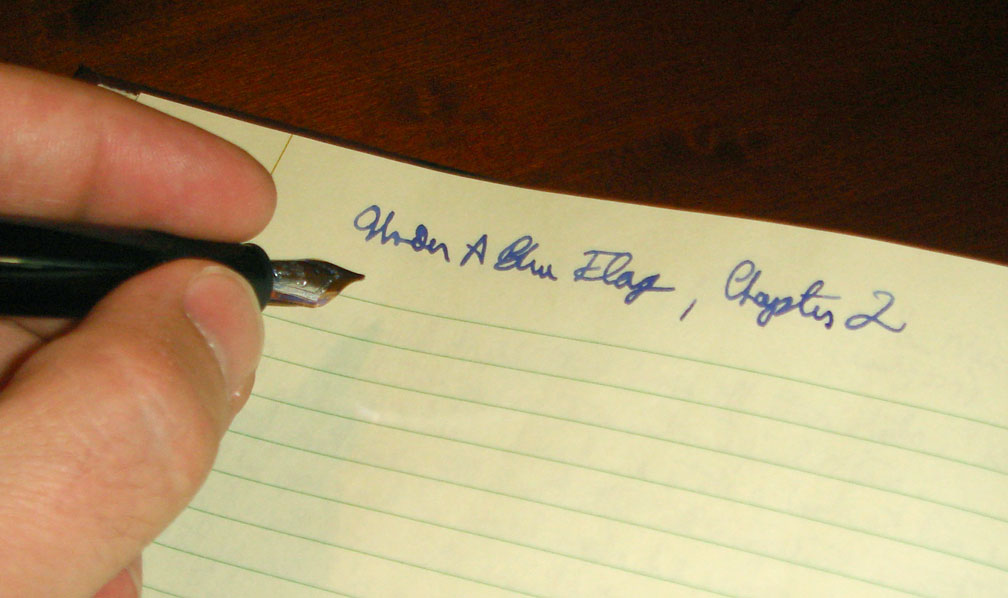
As you can see from the last photo, I’m working on Under A Blue Flag, which is the sequel to An Island Away. Writing a sequel is an opportunity to continue with characters that have room to grow. At the same time, the plot has more twists and turns to iron out. Where did Captain Beck go? What’s going to happen to Hernán? What about Charlie and Luz? These questions and more will be answered. Similarly, I’ve outlined a book titled In Dangerous Company, that in story time comes between An Island Away and Under A Blue Flag. It focuses in on just a few characters and the specifics of their adventures.

Writing is never a linear process for me. I’ll bounce back and forth from one story to another or one section of a single story to another. Stitching it all together is a challenge, sometimes better performed by an editor than the author. We’ll get into that later.

So, I have plenty of material to work with. Time to get back to work.

Published in: on June 25, 2008 at 8:26 pm  Comments (1)  
Tags: , , , , ,

The Best Philadelphia Cheesesteak

This post actually continues where the one about the best roast pork sandwich left off. As mentioned previously, John’s Roast Pork in Philadelphia is the oracle of the griddle, the mecca of artery mashing food. And so, we come to THE BEST PHILADELPHIA CHEESESTEAK, and again, bar none, John’s produces it. Don’t even entertain the idea of going to those other joints you’ve seen on the Travel Channel or some other half-baked joint written up in a lame journal of culinary culpitude.

Here it is, in all it’s glory:

This is a better photo than the one I had from the pork sandwich. (Rest assured, that pork sandwich is drop dead good and just as loaded as the one above. Trust me and my heart surgeon. I am not kidding.) Notice the fullness, the lean beef, the melted-in provolone. Is this thing just the greatest or what? Yeah, I put some sauce on it, too. There’s hot peppers and fried onions integrated into the mix while on the grill. The flavor permeates the first layer of that handsome roll. The crust stands firm, yielding the subtlety of sesame seeds on the outside and meaty freshness on the inside.

Here’s a closer shot:

I mowed this down one bite at a time. My wife, to my astonishment, managed to finish one of her own. Impressive. However, no one beats my cousin. He was working with me on the pier one day and we came here for lunch. He ate two (yeah, that’s double, dos, a two-fer) on that day. This was something to behold and he nearly blacked out. The guy knows what he likes and likes what he knows.

Anyway, always enjoy your cheesesteak with ICE COLD Coca-Cola. Everything is better that way.

Published in: on June 25, 2008 at 12:49 pm  Comments (4)  
Tags: , , , , ,