Charlie’s Bar

Charlie Brouns, Jr. was the type of person books are written about. He was born in San Nicolaas, Aruba, bounced around Europe a little, then went to Colombia for a number of years before returning to Aruba for good. His father, Charlie, Sr., took over a bar on Main Street in San Nicolaas in 1941. The bar was a haven for sailors and refinery workers as well as the townspeople. With the changing fortunes of the local refinery this clientele declined over the years until Charlie, Jr (hence simply Charlie) decided to turn his father’s bar into a “tourist trap.” He succeeded better than anyone anticipated.
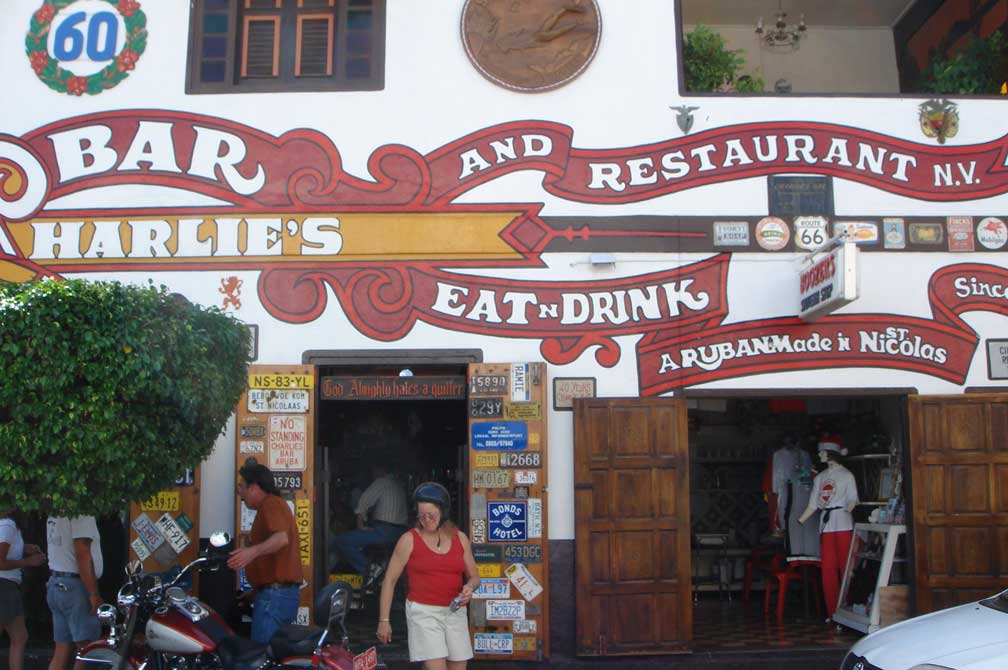
The above photo of the exterior that faces Main Street shows the entrance to the bar and gift shop. Note the motorcycles parked on the sidewalk. There is a Harley Davidson dealership on the island and visitors rent bikes to take a private tour. Ultimately they end up at Charlie’s for some refreshment at the end. It’s common for five to ten bikes to roll into town, loud as an invading army. But it’s all in good fun! In the upper right corner of the photo is a small balcony. This is where Charlie used to sit and watch the town at night. He usually had the company of his dogs or a cat named Screwball.

The interior of the bar is something else. You won’t find more junk per square foot anywhere (at least that I know of). Charlie took trinkets from those original sailors and refinery workers and began hanging them up. Tourists leave behind everything from expired driver’s licenses to old cameras. The following photo shows the evidence.
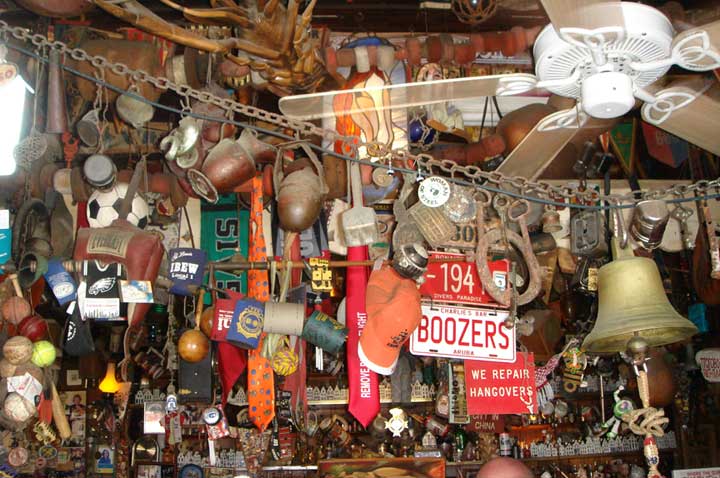
The bell at the right side of the frame above figures prominently in An Island Away. Anyone who rings the bell has just bought those at the bar a free drink. So be careful, unless you’re in a jovial mood and want to be generous to those of us who would appreciate such a gesture and most likely reward you with the same. Another interesting item in the photo are the small, blue and white liquor bottles shaped like houses. There’s a line of them on the sagging shelf beyond the bell. These were given out by KLM Airlines. If they still contain the original liquor they can be worth up to $1,000. Each one is a replica of a real house in Holland. (My personal favorite is the “WE REPAIR HANGOVERS” sign.)

In September of 2004, Charlie and his friends (including me) were all having a fun afternoon at the bar. He went upstairs to his living quarters to change his shirt. Something happened on the way back as Charlie took a tragic fall that cost his life. Heroic efforts were made on the part of a physician who happened to be with us at the time. To no avail. Our dear friend and host had left this world for the next. We all miss Charlie, his quick wit, friendly teasing, and infinite capacity to improvise to make a regular good time so much better. He always said, “You have to improvise!”

Published in: on June 15, 2008 at 11:25 am  Leave a Comment  
Tags: , ,

The Flip Side

My novel, An Island Away, takes place in San Nicolaas, Aruba. San Nicolaas was actually the second capital of Aruba, the town of Savaneta being the first and currently Oranjestaad is the seat of government. San Nicolaas experienced a massive boom when an oil refinery was built there in order to process crude oil from the Lake Maracaibo area of Venezuela. Originally known as Lago Oil, the refinery was soon purchased by Esso, (aka Exxon, formerly Standard Oil of New Jersey). Today, the refinery is a shadow of what it once was. During World War II, it was the largest oil refinery in the world. Winston Churchill’s strategic world maps featured Aruba prominently because of this.

Here is a view of the refinery as seen from Roger’s Beach.

This was the photo used on the back cover of the first printing of An Island Away. The view is not only the flip side of the book but also the flip side of paradise. Aruba is one of the most popular tourist destinations in the Caribbean. The island has more repeat visitors than any other. And they deserve the fine reputation they have for excellent hospitality, great beaches, and good restaurants that every tourist can enjoy.

Yet, there is more to Aruba than umbrella drinks and sunshine. Thanks to the refinery, San Nicolaas was once a thriving boomtown. Due to the many small ships calling at the port, as well as the thousands of workers at the refinery, the town had more than thirty barrooms in six square blocks These bars doubled as brothels. I’ve seen photos and heard stories of those days, when it was more like the Wild West than what we think of as the Caribbean. These adventures were described to me by people who grew up there in the 1950’s and 60’s. First-hand accounts are the best.

At first I thought these accounts were exaggerations. However, as I spent more and more time in San Nicolaas, I learned that, if anything, they were diminished to protect the innocent. And the San Nicolaas that I first experienced was about 20% of what my friends were talking about. Still, it was a bawdy good time that led to a great story. One of the reasons I wrote An Island Away was to put down permanently what it was like to run the town the way these people did. Keeps the exaggeration to a minimum as we get older.

And so, if you get to Aruba, or another popular destination, take an afternooon or at least a couple of hours to check out the other side. You might be surprised what you find. In a later post I will have photos of Charlie’s Bar, and talk about Charlie Brouns, Jr., the man who introduced me to the ways of San Nicolaas. Don’t forget, excerpts from the book and other info are on my website, www.danielputkowski.com.

Published in: on June 15, 2008 at 10:07 am  Leave a Comment  
Tags: , , , ,

Three Sheets to the Wind

No, this post is not about drinking. Not yet, anyway. I’ve been researching a new novel, MacMillan Judge, Privateer. Set in 1815, this is the story of a young American who gets involved in a ransom parlay with Barbary Pirates. Through a series of vicious events he’s left stuck in a sailing launch with nothing but a Pennsylvania Long Rifle, some rations, and $20,000 in gold. So what does he do? Well, he’s an American first and foremost, and he missed his chances at glory through the war of 1812. He’s not going to sail into the sunset. Instead, he’s going to get himself to Spain, find a ship, hire a crew, and go back and rescue the person who was to be rightly ransomed.

This is easier said than done, both for our man MacMillan Judge, and yours truly, the writer. In the first place, I’ve never sailed a boat in my life. I prefer horsepower (the diesel kind) to wind power. Nonetheless, sailing ships are fascinating creatures. Much like steam engines, they show you their guts on the outside. They’re unwieldy, complicated, and still handsome the way they carry themselves with dignity.

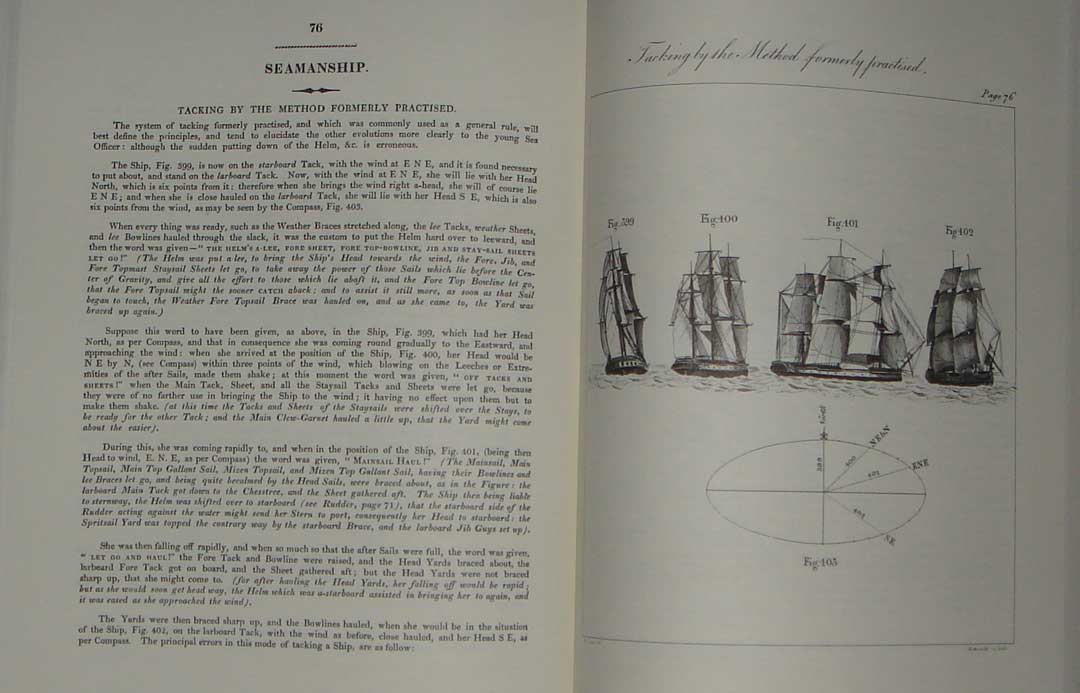
Here’s a page from Lever’s book:

So I visited all sorts of ship museums, spoke to the people there, practically earned a degree in this sort of stuff. Then I found a book called The Young Sea Officer’s Sheet Anchor by one Darcy Lever. Mr. Lever learned all his sailing skills the hard way, as in aboard a ship in the East India Company back in the day. We’re talking about the late 1700’s here when ships were wood and men had few teeth and sometimes less brains. But they knew how to get from one side of the world to the other with nothing but the wind and the strength of their muscles. Lever starts with rope and goes all the way to how to maneuver a fully rigged ship in all conditions. It can be dry but with the illustrations it is amazing to contemplate just what it took to sail a square rigger. Utterly amazing that it worked at all!

Luckily this book has survived and has been reprinted in an economical paperback edition. I’ll be sure to credit it in the acknowledgments of my novel. If you ever get pressed into service, be sure you have this book with you. You’ll be captain in no time!

To further my education in the sailing world I’ll be traveling to various places, including Baltimore, MD, USA where they have a replica of a topsail schooner named the Pride of Baltimore II. I’ll be spending time aboard this vessel as schedules permit. Similarly, I’ll be checking out sailing vessels in Philadelphia, Mystic Connecticut and the coast of Maine. This will be a completely new experience for me. As mentioned above, I like diesel power, having spent more than 15 years working around tugboats. Nonetheless, there’s always something to be learned and that’s the fun of being a writer. You come up with a story and teach yourself all about the subject. If you’re really lucky, you get paid to share that story with others.

Published in: on June 14, 2008 at 9:08 pm  Leave a Comment  
Tags: , ,

The Alhambra

The Alhambra is one of those mythical sites that is a must-see. Here’s a photo of your author, taken from across the valley with the palace/fortress in the background.

Washington Irving is the American given credit for saving much of what we see today when visiting the Alhambra. Irving traveled to Seville by ship and then overland to Granada. He documented this trip and various other adventures in his Tales of the Alhambra. These stories are fantastic in the true sense of the word. More interesting is the vivid accounts of the Spanish character which I found very accurate during my visit. Some of the people I met might have stepped directly from Irving’s pages despite more than 170 years between the two encounters.

It should also be noted that when Irving visited the Alhambra it was a much abused site. French troops retreating from Spain nearly blew up large portions of it. Looters stole pieces from every possible place. Thanks to Irving, conservations efforts began and the site was ultimately preserved and refurbished for all of us to see.

When visiting the Alhambra it is best to have tickets in advance. The regular tours are not simple cattle calls. My group’s guide had grown up in Granada but spent his summers in Germany. He spoke Spanish, English, and German with brilliant fluency, switching between the three for different people in the group. He never missed a beat and his enthusiasm was irresistible. As he said, “I love my job. Everyday I come to work in a magnificent palace.” And magnificent the Alhambra is. I remember seeing glossy photos of it in my childhood but nothing could have prepared me for the atmosphere of the place. If you have the good fortune to go to Spain, don’t miss it.

While you’re in Granada, the tapas are worthy of their looming neighbor on the cliff. But we’ll get into that later. Buen provecho!

Published in: on June 14, 2008 at 12:01 pm  Comments (3)  
Tags: ,