Consistent with my use of fountain pens is my affection for written correspondence. Thus, there is the need for postage and lately I’ve found the stamps produced by the United States Postal Service to be less than inspired. They’re just in a rut; sooner or later they’ll deliver some good ones. In the mean time I have a source for great stamps. Here’s a shot of just a few of them:
 Of course, my favorite is the Gadsden Flag in the upper left corner. (That’s the one that says, “Don’t Tread On Me.”) Don’t miss the George S. Patton one in the upper right, either. There are the ones with the American Revolution theme, space exploration, and nautical history. My supplier must have a deep well of these because I send approximately 50-60 pieces of mail to both US and international destinations each month. He’s never run out and I’m grateful.
These stamps are works of art and a sort of time capsule that capture history and the mood of the age. Compared to anemic email with it’s slang, shortcuts, silly animations, these stamps stand tall. And they should. The recipients of my letters and cards frequently comment on how they like the stamps. Drop someone a handwritten note once in a while to show your affection and appreciation. After all, that’s what friends are for.

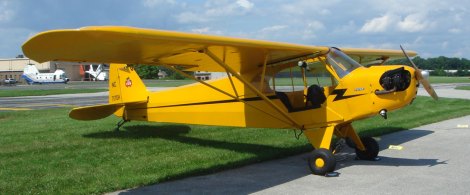 The proven design still flies, which is testament to Piper’s philosophy. Today, most people refer to planes of this configuration as “tail draggers,” meaning that there is a small wheel at the tail which sits lower than the nose. Truthfully, the correct term is “conventional” gear as opposed to “tricycle” gear. Well, this may be an esoteric digression here at The Bent Page, but I just wanted to set the record straight. And here’s a look at the power plant that pulls this craft through the sky.
 It only takes four, air-cooled cylinders to do the job as this is a very light airplane. The cylinders are exposed from the cowling to promote cooling. These engines typically operate for about 2000 hours before requiring an overhaul. Then there is the cockpit.
 As you can see, only the basics are here. You have an airspeed indicator and an altimeter, a tachometer for the engines along with oil temp and pressure. There’s a compass to point the way and a turn and slip indicator which is that curved, clear tube in the center with the black ball in it. The turn and slip indicator lets the pilot know that he’s flying in a coordinated fashion (or not) and this is an important concept in flight. If the aircraft is uncoordinated, it is slipping or skidding just like a car on ice. The problem is, in certain adverse conditions a slip or skid can lead to a spin and spins can end in tragedy. Hence the simple yet highly effective device.
 The Bent Page
You must be logged in to post a comment.