San Nicolaas, Aruba

Let’s go back to Aruba for a minute. In this post I have a few pictures of San Nicolaas, the town where most of my novel, An Island Away, takes place. These photos aren’t the greatest but they show an authentic Caribbean town that has yet to be taken over by huge resorts mobbed by trinket trollers. It’s tough to put tourist infrastructure here given the presence of the oil refinery that stands shoulder to shoulder with the town. I don’t mind oil refineries. I used to work on tugboats and much of our work was done around the tankers and docks at refining facilities.

This first photo was taken on Rogersstraat looking to the south, southeast.
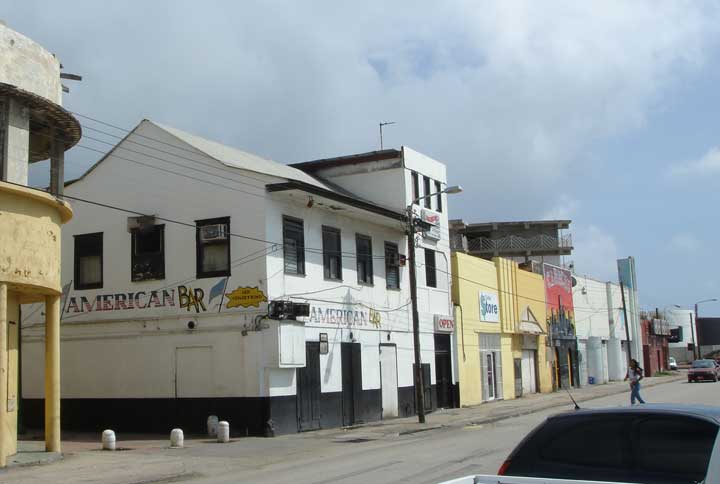
There’s no glamor here but plenty of character. I first came to this street in 1994. At the end, just out of the frame, is the main gate to the refinery. On the left are a series of bars. There is a Chinese restaurant in American Bar. The old guy that used to cook there (he passed away in 2007) would make “anything soup” for my pals and I at about three in the morning. Further down was another bar called Tropicana. A guy I knew only as Mikey used to own it. My friend Rob caught some fish during one of our trips. We fried up the fish, fed Mikey, his wife, and everyone in the bar that night. What a good time!

Here’s another shot, this one of Main Street, looking south. It was taken in December; that’s why the Christmas decorations are up.
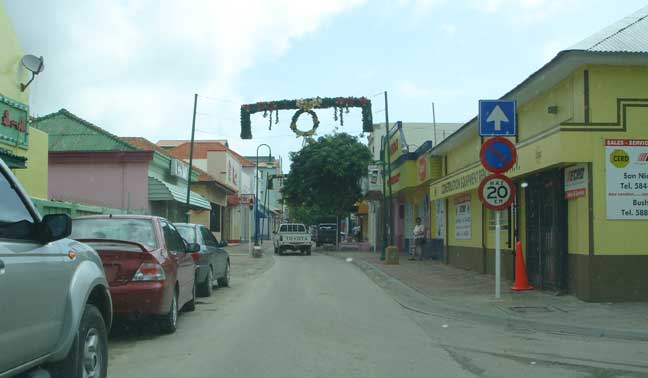
Again, you may be thinking that there is nothing remarkable in the frame. The fact that there isn’t is testament to the authenticity of this town. So many places in the Caribbean have been sterilized, as if a tourist sees an equipment rental shop or a repair garage or a bottling works they’ll go screaming back to the cruise ship. I don’t believe that. I find daily life interesting. It’s not the same the world over. There are different customs, different beliefs, different ways of doing what we all need done. Seeing the mechanics of a society doesn’t turn me off from exploring their cultural triumphs. I appreciate that we all have to get our hands dirty. (Mea cupla here: Charlie’s Bar is just past that tree, but it was a sailor bar before becoming tourist shrine, so that doesn’t count.)

Here’s on more, further down Main Street:

The tall pastel colored building on the left used to be the Hotel Marchena. On a website called Lago-Colony.com I found a travel brochure for Aruba from 1954. It advertised rates at the Marchena for $8 -$10 single and $15 – $17 double. It also mentioned that Aruba was only “four hours from Miami.” Today, travel time from Miami is a little more than two hours fifteen minutes. From New York City, a flight lasts a little more than four hours. My, how times have changed.

In future posts, I’ll be documenting the people and businesses I frequently visit in Aruba. Without exception, I have been welcomed to these places with gracious hospitality, and I’m grateful to everyone for doing so. They allow me into their lives, providing a never ending stream of story material. My only wish is that I live long enough to write it all down.

I’d like to hear about the places you’ve been and experiences you had there. Please leave comments, links, or both.

Published in: on June 16, 2008 at 6:16 pm  Leave a Comment  
Tags: , ,

The Flip Side

My novel, An Island Away, takes place in San Nicolaas, Aruba. San Nicolaas was actually the second capital of Aruba, the town of Savaneta being the first and currently Oranjestaad is the seat of government. San Nicolaas experienced a massive boom when an oil refinery was built there in order to process crude oil from the Lake Maracaibo area of Venezuela. Originally known as Lago Oil, the refinery was soon purchased by Esso, (aka Exxon, formerly Standard Oil of New Jersey). Today, the refinery is a shadow of what it once was. During World War II, it was the largest oil refinery in the world. Winston Churchill’s strategic world maps featured Aruba prominently because of this.

Here is a view of the refinery as seen from Roger’s Beach.

This was the photo used on the back cover of the first printing of An Island Away. The view is not only the flip side of the book but also the flip side of paradise. Aruba is one of the most popular tourist destinations in the Caribbean. The island has more repeat visitors than any other. And they deserve the fine reputation they have for excellent hospitality, great beaches, and good restaurants that every tourist can enjoy.

Yet, there is more to Aruba than umbrella drinks and sunshine. Thanks to the refinery, San Nicolaas was once a thriving boomtown. Due to the many small ships calling at the port, as well as the thousands of workers at the refinery, the town had more than thirty barrooms in six square blocks These bars doubled as brothels. I’ve seen photos and heard stories of those days, when it was more like the Wild West than what we think of as the Caribbean. These adventures were described to me by people who grew up there in the 1950’s and 60’s. First-hand accounts are the best.

At first I thought these accounts were exaggerations. However, as I spent more and more time in San Nicolaas, I learned that, if anything, they were diminished to protect the innocent. And the San Nicolaas that I first experienced was about 20% of what my friends were talking about. Still, it was a bawdy good time that led to a great story. One of the reasons I wrote An Island Away was to put down permanently what it was like to run the town the way these people did. Keeps the exaggeration to a minimum as we get older.

And so, if you get to Aruba, or another popular destination, take an afternooon or at least a couple of hours to check out the other side. You might be surprised what you find. In a later post I will have photos of Charlie’s Bar, and talk about Charlie Brouns, Jr., the man who introduced me to the ways of San Nicolaas. Don’t forget, excerpts from the book and other info are on my website, www.danielputkowski.com.

Published in: on June 15, 2008 at 10:07 am  Leave a Comment  
Tags: , , , ,

Three Sheets to the Wind

No, this post is not about drinking. Not yet, anyway. I’ve been researching a new novel, MacMillan Judge, Privateer. Set in 1815, this is the story of a young American who gets involved in a ransom parlay with Barbary Pirates. Through a series of vicious events he’s left stuck in a sailing launch with nothing but a Pennsylvania Long Rifle, some rations, and $20,000 in gold. So what does he do? Well, he’s an American first and foremost, and he missed his chances at glory through the war of 1812. He’s not going to sail into the sunset. Instead, he’s going to get himself to Spain, find a ship, hire a crew, and go back and rescue the person who was to be rightly ransomed.

This is easier said than done, both for our man MacMillan Judge, and yours truly, the writer. In the first place, I’ve never sailed a boat in my life. I prefer horsepower (the diesel kind) to wind power. Nonetheless, sailing ships are fascinating creatures. Much like steam engines, they show you their guts on the outside. They’re unwieldy, complicated, and still handsome the way they carry themselves with dignity.

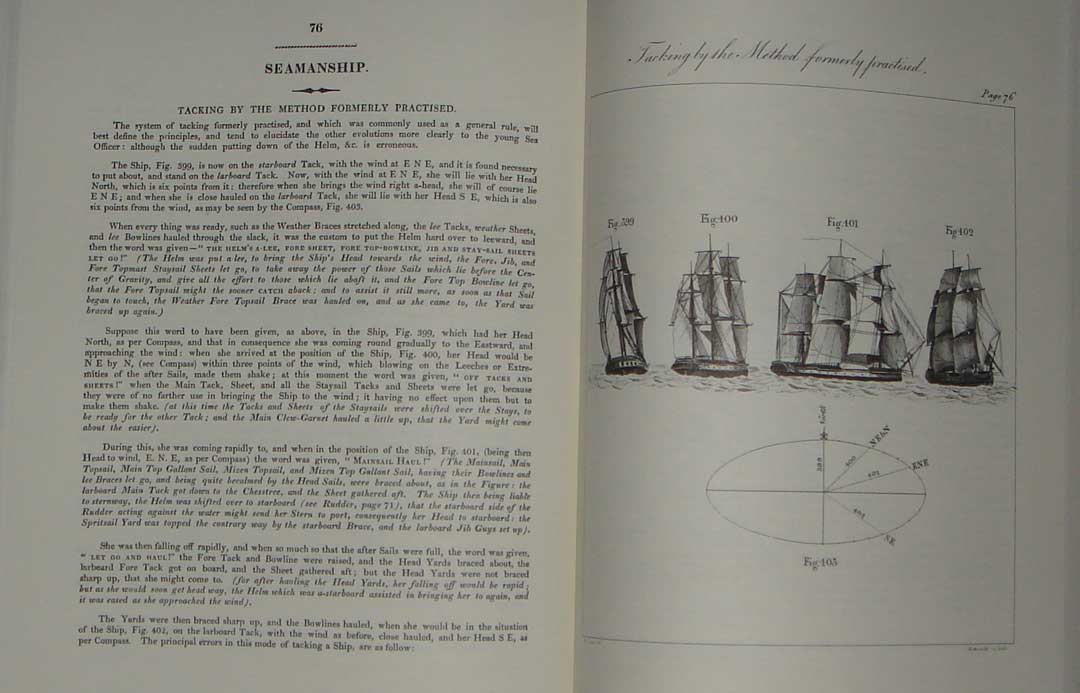
Here’s a page from Lever’s book:

So I visited all sorts of ship museums, spoke to the people there, practically earned a degree in this sort of stuff. Then I found a book called The Young Sea Officer’s Sheet Anchor by one Darcy Lever. Mr. Lever learned all his sailing skills the hard way, as in aboard a ship in the East India Company back in the day. We’re talking about the late 1700’s here when ships were wood and men had few teeth and sometimes less brains. But they knew how to get from one side of the world to the other with nothing but the wind and the strength of their muscles. Lever starts with rope and goes all the way to how to maneuver a fully rigged ship in all conditions. It can be dry but with the illustrations it is amazing to contemplate just what it took to sail a square rigger. Utterly amazing that it worked at all!

Luckily this book has survived and has been reprinted in an economical paperback edition. I’ll be sure to credit it in the acknowledgments of my novel. If you ever get pressed into service, be sure you have this book with you. You’ll be captain in no time!

To further my education in the sailing world I’ll be traveling to various places, including Baltimore, MD, USA where they have a replica of a topsail schooner named the Pride of Baltimore II. I’ll be spending time aboard this vessel as schedules permit. Similarly, I’ll be checking out sailing vessels in Philadelphia, Mystic Connecticut and the coast of Maine. This will be a completely new experience for me. As mentioned above, I like diesel power, having spent more than 15 years working around tugboats. Nonetheless, there’s always something to be learned and that’s the fun of being a writer. You come up with a story and teach yourself all about the subject. If you’re really lucky, you get paid to share that story with others.

Published in: on June 14, 2008 at 9:08 pm  Leave a Comment  
Tags: , ,

A Story Begins

Story ideas come from all kinds of sources. I use a small Moleskine notebook to jot most of these down.

On another message board I read a great post that said keeping a notebook was good for creative people because you can only keep so many ideas in your head at one time. So, if you put them in a notebook, you free up space for more. I thought that was brilliant insight into the creative process.

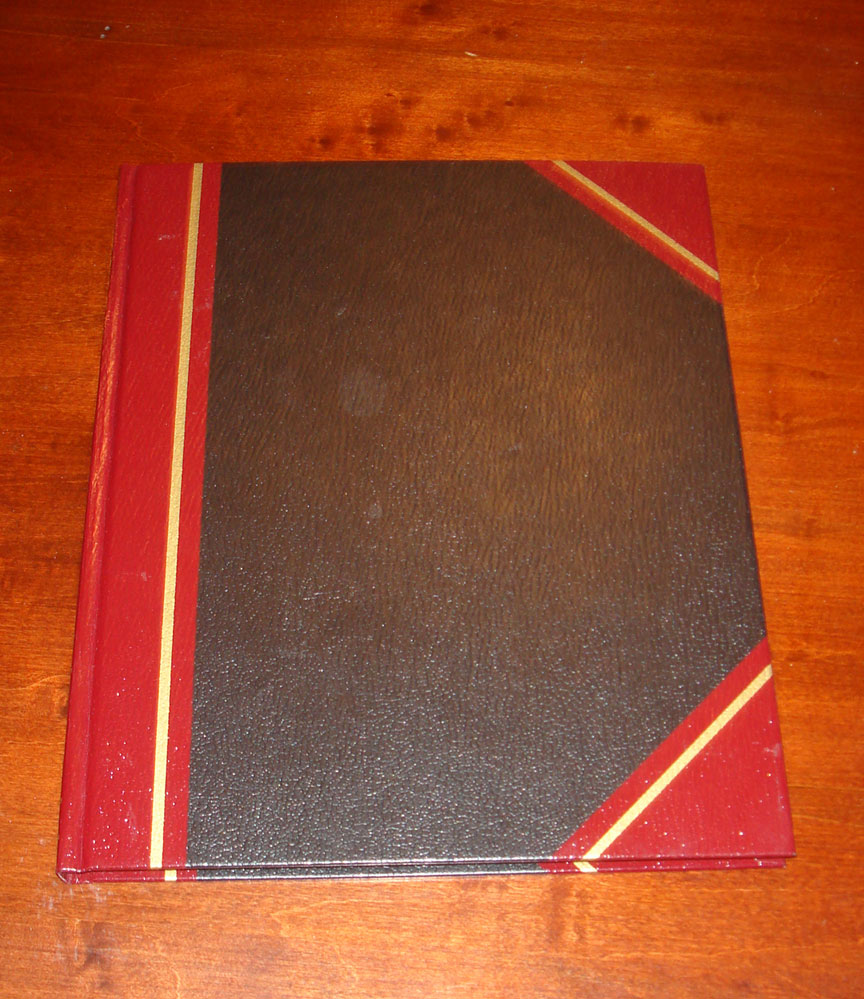
But what’s to be done with these ideas? Well, once I settle in to write a book, I crack open a new, larger sized notebook like this one:

Inside, I write a rambling description of the story that is basically a collection of the embellished ideas from the small Moleskine. I cross reference this first description with the Moleskines so that if I ever want to go back to the original source, I can find it. This gets to be a difficult problem when the story ideas show up in several of the Moleskines. When the general description is finished, I’ll start sketching major scenes, characters, and locations. From these blocks I start building up the story with outlines. Sometimes an outline is unnecessary, especially when the characters are at critical moments. Still, an outline keeps the writing on track and the writer out of trouble. If you don’t know where you’re going in the story, you’re stuck. Some people call this writer’s block and perhaps they’re right. However, with a decent outline, there’s always work to be done.

And that’s how I start a story. Finishing it is another matter. People often ask me if it’s difficult to write a book. My answer is this: It’s easy to start a book. It’s tremendously difficult to finish one. But we’ll talk about that later.

Published in: on June 13, 2008 at 4:49 pm  Comments (1)  
Tags: