San Nicolaas, Aruba

Let’s go back to Aruba for a minute. In this post I have a few pictures of San Nicolaas, the town where most of my novel, An Island Away, takes place. These photos aren’t the greatest but they show an authentic Caribbean town that has yet to be taken over by huge resorts mobbed by trinket trollers. It’s tough to put tourist infrastructure here given the presence of the oil refinery that stands shoulder to shoulder with the town. I don’t mind oil refineries. I used to work on tugboats and much of our work was done around the tankers and docks at refining facilities.

This first photo was taken on Rogersstraat looking to the south, southeast.
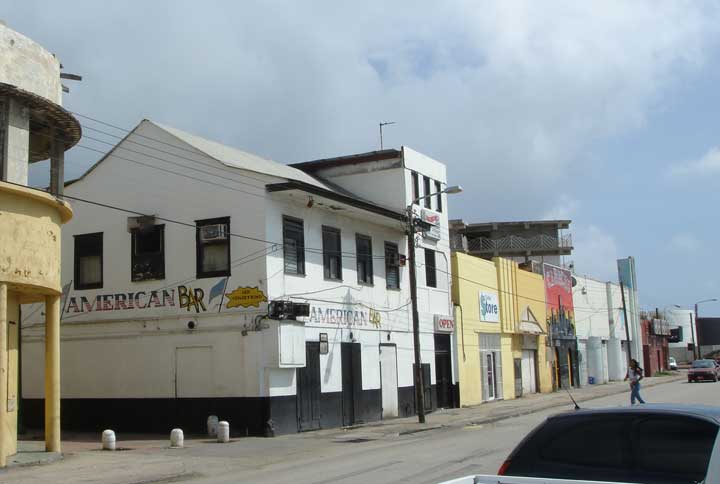
There’s no glamor here but plenty of character. I first came to this street in 1994. At the end, just out of the frame, is the main gate to the refinery. On the left are a series of bars. There is a Chinese restaurant in American Bar. The old guy that used to cook there (he passed away in 2007) would make “anything soup” for my pals and I at about three in the morning. Further down was another bar called Tropicana. A guy I knew only as Mikey used to own it. My friend Rob caught some fish during one of our trips. We fried up the fish, fed Mikey, his wife, and everyone in the bar that night. What a good time!

Here’s another shot, this one of Main Street, looking south. It was taken in December; that’s why the Christmas decorations are up.
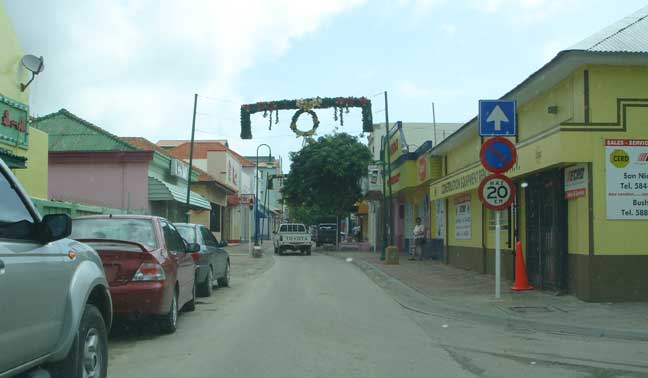
Again, you may be thinking that there is nothing remarkable in the frame. The fact that there isn’t is testament to the authenticity of this town. So many places in the Caribbean have been sterilized, as if a tourist sees an equipment rental shop or a repair garage or a bottling works they’ll go screaming back to the cruise ship. I don’t believe that. I find daily life interesting. It’s not the same the world over. There are different customs, different beliefs, different ways of doing what we all need done. Seeing the mechanics of a society doesn’t turn me off from exploring their cultural triumphs. I appreciate that we all have to get our hands dirty. (Mea cupla here: Charlie’s Bar is just past that tree, but it was a sailor bar before becoming tourist shrine, so that doesn’t count.)

Here’s on more, further down Main Street:

The tall pastel colored building on the left used to be the Hotel Marchena. On a website called Lago-Colony.com I found a travel brochure for Aruba from 1954. It advertised rates at the Marchena for $8 -$10 single and $15 – $17 double. It also mentioned that Aruba was only “four hours from Miami.” Today, travel time from Miami is a little more than two hours fifteen minutes. From New York City, a flight lasts a little more than four hours. My, how times have changed.

In future posts, I’ll be documenting the people and businesses I frequently visit in Aruba. Without exception, I have been welcomed to these places with gracious hospitality, and I’m grateful to everyone for doing so. They allow me into their lives, providing a never ending stream of story material. My only wish is that I live long enough to write it all down.

I’d like to hear about the places you’ve been and experiences you had there. Please leave comments, links, or both.

Published in: on June 16, 2008 at 6:16 pm  Leave a Comment  
Tags: , ,

Wind Power

With the price of oil what it is today, there are all kinds of people talking about alternative energy. In Spain there are windmills all over the place. The ones in the photo below happen to be the modern kind that make electricity but there are also the old ones that mill grain or pump water.

These magnificent machines go a long way to provide for Spain’s electricity needs. The amazing part is they make very little noise. From where I was standing in this photo, you could barely hear them. At another location, there were literally hundreds of windmills and barely a sound came from them. I thought this can’t be true; they have to make noise. I spoke with an engineer who specializes in windmills and he explained that the windmills are not “loud” per se. He added that the ambient noise produced by the wind itself also disguises the noise of the machine.

At the time of this writing, there are no commercial sized windmills on my beloved island of Aruba. This is unbelievable given that the trade winds, the prevailing westerly of yore, blow across the island day in and day out. There are very few times in Aruba when the wind is not blowing with enough force to turn a giant windmill. Naturally, energy prices on the island have gone into the stratosphere with the price of oil. A string of large windmills would go a long way to alleviate this problem, not to mention how it would help the environment. Similarly, it would benefit the Aruban economy by reducing the cost of energy, giving the island a competitive edge against less fortunate locales. I’ll be doing some politicking to bring this issue to the fore with my friends on the island. It makes economic sense, is good for the planet, and won’t hurt a bit. Why delay?

I decided not to delay by having a system designed for my home there. It incorporates a 1kW turbine and an 800 watt solar array. This is not very much generating capacity. However, given the constant winds and reliable sunshine it will produce enough power to generate more than 75% of my energy needs. From January through April it will most likely supply 100%. There is a battery bank which keeps the power on during times of low wind and/or sun. I’m working on a deal with my neighbor to use the power when I’m not there, which will make the system that much more affordable for both of us. As soon as these pieces are in place I’ll ship the parts to the island and start getting a nice return on the investment.

Published in: on June 16, 2008 at 12:01 pm  Comments (1)  
Tags: , , , , ,

Charlie’s Bar (supplemental)

I should have posted this first but didn’t think of it until later in the day. Charlie’s hobby was painting pictures. He had a tiny studio on the grounds of his “country manor” as he referred to the old Cunuco house by the beach in Savaneta. There he would paint using acrylic automobile paint in an abstract way. He did portraits and landscapes, decorated totem poles and common chairs. To his friends and some of the tourists he would give these works of art as tokens of his appreciation. Here is the one he gave me.

During my tugboat days, I would often times put this little picture in the wheelhouse, beside the compass. It was a welcome sight on cold or gloomy days. It also reminded me of all the good times I’d had with Charlie and my other pals in Aruba. Now it sits on a little stand beside my bed. It may not be a Rembrandt, but it was a personal gift from a man who had style.

Life isn’t so much short as it is precious. Don’t waste a single moment.

Published in: on June 15, 2008 at 7:08 pm  Leave a Comment  
Tags: , ,

Charlie’s Bar

Charlie Brouns, Jr. was the type of person books are written about. He was born in San Nicolaas, Aruba, bounced around Europe a little, then went to Colombia for a number of years before returning to Aruba for good. His father, Charlie, Sr., took over a bar on Main Street in San Nicolaas in 1941. The bar was a haven for sailors and refinery workers as well as the townspeople. With the changing fortunes of the local refinery this clientele declined over the years until Charlie, Jr (hence simply Charlie) decided to turn his father’s bar into a “tourist trap.” He succeeded better than anyone anticipated.

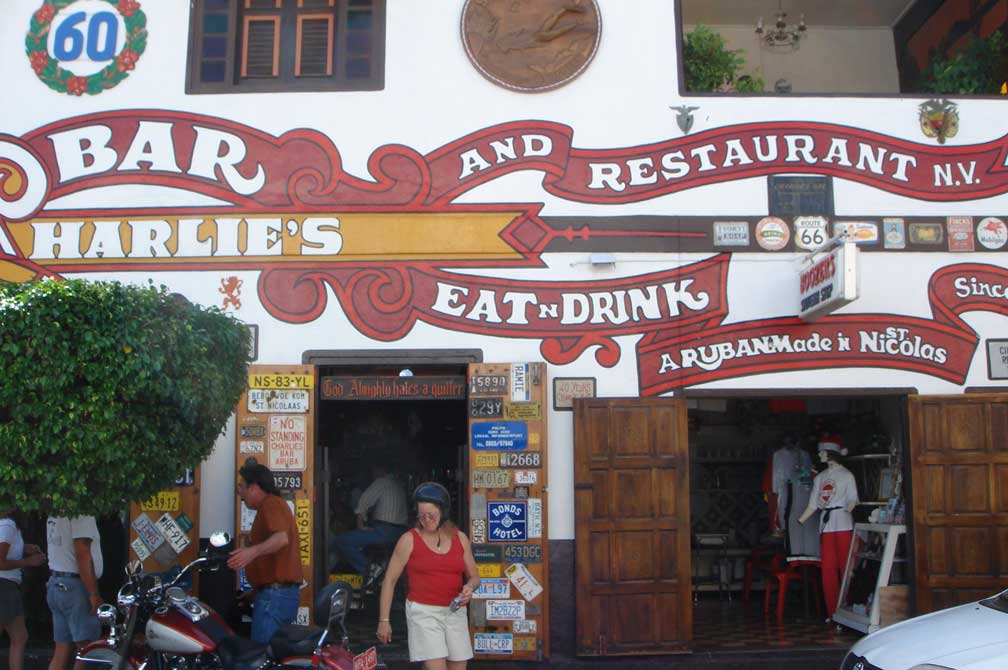
The above photo of the exterior that faces Main Street shows the entrance to the bar and gift shop. Note the motorcycles parked on the sidewalk. There is a Harley Davidson dealership on the island and visitors rent bikes to take a private tour. Ultimately they end up at Charlie’s for some refreshment at the end. It’s common for five to ten bikes to roll into town, loud as an invading army. But it’s all in good fun! In the upper right corner of the photo is a small balcony. This is where Charlie used to sit and watch the town at night. He usually had the company of his dogs or a cat named Screwball.

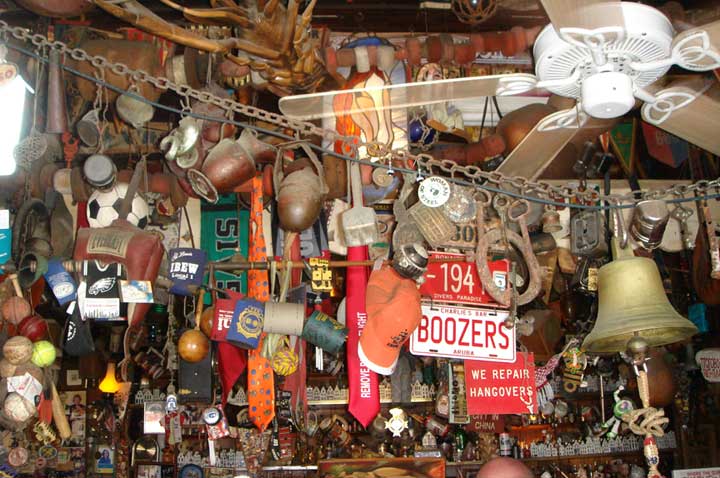
The interior of the bar is something else. You won’t find more junk per square foot anywhere (at least that I know of). Charlie took trinkets from those original sailors and refinery workers and began hanging them up. Tourists leave behind everything from expired driver’s licenses to old cameras. The following photo shows the evidence.

The bell at the right side of the frame above figures prominently in An Island Away. Anyone who rings the bell has just bought those at the bar a free drink. So be careful, unless you’re in a jovial mood and want to be generous to those of us who would appreciate such a gesture and most likely reward you with the same. Another interesting item in the photo are the small, blue and white liquor bottles shaped like houses. There’s a line of them on the sagging shelf beyond the bell. These were given out by KLM Airlines. If they still contain the original liquor they can be worth up to $1,000. Each one is a replica of a real house in Holland. (My personal favorite is the “WE REPAIR HANGOVERS” sign.)

In September of 2004, Charlie and his friends (including me) were all having a fun afternoon at the bar. He went upstairs to his living quarters to change his shirt. Something happened on the way back as Charlie took a tragic fall that cost his life. Heroic efforts were made on the part of a physician who happened to be with us at the time. To no avail. Our dear friend and host had left this world for the next. We all miss Charlie, his quick wit, friendly teasing, and infinite capacity to improvise to make a regular good time so much better. He always said, “You have to improvise!”

Published in: on June 15, 2008 at 11:25 am  Leave a Comment  
Tags: , ,