An Island Away, Excerpt 2

The second excerpt from my novel, An Island Away, posted here for those who would like a peek. A synopsis and more info is available at my website. The book is available at Amazon.com.

Chapter 5: Captain Nathan Beck has been adrift for more than five days. At last he has come ashore in Aruba…

Finally, he was head and shoulders out of the ocean. Only a few inches of water skirted the sand. The place he wanted to go was amidst a grove of low trees. He took another rest. It felt wonderful to be on solid ground. Looking at his bare feet, he wondered what the other parts of his body looked like. He had to be a fright for whoever was going to see him first.

He sat up and stared in the direction of the music. Between the trees he saw shapes dancing. A man leaned over a bar. Beer bottles clanked as two guys toasted one another. Just a few more feet and he would be there among them. He would be safe, alive to tell the tale.

Forgetting his previous failure at walking, he tried to get up again. He heard voices, a man and a woman, very close. He looked up and there they were, a couple dancing on the beach. They stopped and the man turned the young lady to face him. He kissed her. They were so close Beck could hear their lips smack. Why couldn’t they see him?

He wanted to find out. He struggled against the all-powerful force of exhaustion that pressed down on his shoulders. His vision blurred as he wobbled upright. A screeching roar filled his ears. The distorted view before him tilted one way, then the other. He went light-headed, dizzy to the point of retching. He put his arms out to break the coming fall.

He collapsed on the beach with his feet in the water. He caught a glimpse of the moon before it went black and took all the stars with it.

“I didn’t drown,” he whispered into the darkness.

An Island Away, Excerpt 1

Chapter 1: Charlie and his cat, Screwball, are on his balcony, looking over the town of San Nicolaas, Aruba, the principal setting for my novel, An Island Away.

Charlie lived in a place where the illegal was legal, where the immoral was moral, and where some people’s fantasies were other people’s realities. So, he lived every day in anticipation of the fantastic. And why not? It was the night before his birthday, the start of another year in a place where anything could happen.

…a little further on….

A car rolled beneath his balcony, flashed its signal, and turned right. Charlie watched his lifelong friend Sam park at the end of the block. He couldn’t help but smile at the man’s reliability and persistence. No one but Sam took the time to make his birthday a grand affair. Unfortunately, and despite Charlie’s constant warnings, Sam fell prey to indomitable emotions with regard to the girls working in San Nicolaas and frequently found himself miserably heartbroken, a condition Charlie studiously avoided.

“Thanks to Sam, we’re in for a nice time,” Charlie said to Screwball. “Unless something else comes up. You never know. Eh? Let’s hope we have a party and something else.”

The cat shifted on the parapet, licked his forepaw, and once again put his head upon it.

Something else? Charlie asked himself. What could it be? Well, this town was named San Nicolaas and not for the Jolly Old Saint Nicolas the Americans called Santa Claus. Nonetheless, the town gave its gifts (such as they were) to one and all, Charlie included. Christmas was every night of the week, every day of the year, with the exception of the actual Christmas Day, New Year’s, Carnival Saturday, and Easter Sunday. And on those days, too, an enterprising man need only walk the lane known as Rembrandtstraat, peek into the caged halls leading to the rooms upstaris, and call out. Someone would unlock the door, lead the man  inside, and provide the service of the oldest profession. The experience could be another meaningless act, or it might change somebody’s life. As he knew, the outcome depended on the man, the woman, and the people in between.

Charlie stubbed out his cigarette and looked over the street one more time. “Welcome to San Nicolaas,” he said, “We’re open for business.”

The Greatest Travel Writer

In my humble opinion, the greatest travel writer I’ve read is Mr. H.V. Morton. Morton’s original claim to fame was as the journalist who broke the story of King Tut’s tomb back when Howard Carter was poking around the Egyptian desert. He went on to write an entire shelf of books about various countries, cities, and regions, all in the context of a travelogue.

Before discussing Morton’s work further, I’d like to say that most other travel books I’ve read are either the romp-through-a-place-kind, or the guidebooks that have about twenty words for each stop. Both of these serve a purpose. The first type are vicarious fun. The second give practical information and pointers in the right direction when assembling an itinerary. Almost without exception I’ve found these books quite thin on the type of information I’m looking for.

Thus, H.V. Morton. Morton synthesizes history, culture, geography, all sorts of things into an integrated travel experience. In the course of his books, he relates these facts through a series of encounters with whatever subject matter is at hand. It might be a hidden gem of a church in a back street in Rome or a pawnshop in Venice. Each gives an opportunity to inform the reader of an incredible array of details, each more fascinating than the one before it. It is this type of presentation that offers the reader a sense of “knowing” a place. Morton sleeps in monasteries and run-down hotels. He eats meals that give him stomach troubles. He rides on mules when he has to. And he doesn’t hesitate to let the reader know that all does not go well when traveling, a reality that too many other writers ignore.

I read A Stranger In Spain between my second and third trips to that country. Upon my third and several trips thereafter, I found myself recalling much of what Morton had written. Astonishingly, many of the places he visited are still there, some in the same condition as he found them. The same could be said for In Search of London. I read this before a trip to that city and while in the Temple area remembered Morton’s stories about the Knight’s Templar and the lawyers that operated there in his time.

Anthony Bourdain said, “Be a traveler, not a tourist.” This certainly holds true for Morton. Who is your favorite travel writer? Do you have a favorite book about a place you’ve visited or would like to?

Published in: on June 28, 2008 at 12:23 pm  Leave a Comment  
Tags: , , , , , , , ,

Tugboat Anatomy, Part III

This will be the final installment for Tugboat Anatomy. At least for now. It’s time for a look at living aboard a tug. The High Roller works around the Philadelphia Harbor with a crew of five. On long, ocean tows, she would carry seven and sometimes as many as ten men.

Here’s where they sleep.

This is a typical bunkroom for the crew. Two bunks, two lockers, one porthole and a few shelves. The captain has his own suite just behind the wheelhouse. There are two bunks in there with a sink. The rest of the crew doesn’t get a sink, except for the one in the head. The head on the High Roller has two showers, two sinks, two toilets. There’s also a washing machine for laundry.

And here’s the galley.

The galley spans the boat from one side to the other. Out of the frame is a large refrigerator and freezer. The table on the left faces a bench that seats four. Notice the racks above the sink, designed to keep plates and cups from flying during rough weather. This boat has the galley at the stern, which encourages the crew to check the engine room every time they pass from the bunk area to get something to eat. You can never check the engine room too much.

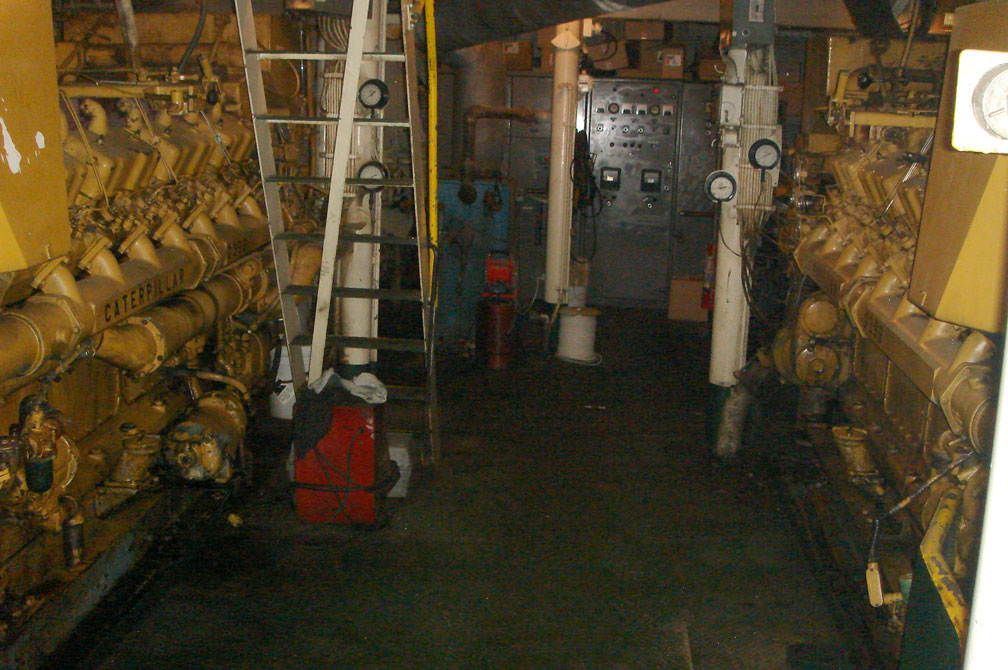
Here’s a look at the engine room, facing forward. The main engines are right and left, with the electrical distribution panel directly ahead. Electricity is provided by two separate diesel driven generators which make enough power for about four typical houses.

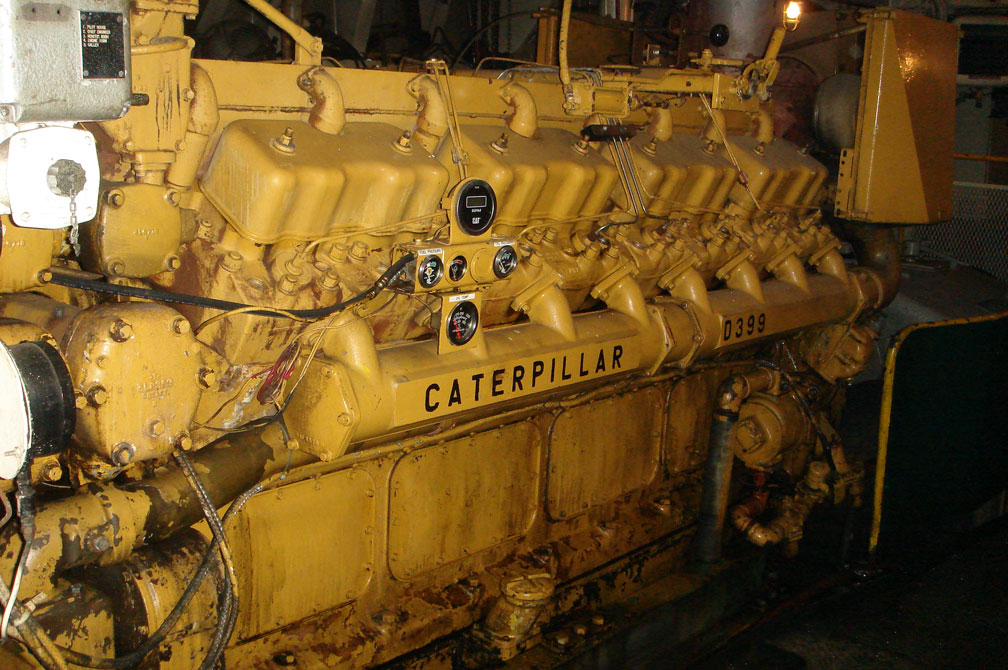
Another look at a main engine, in this case a Caterpiller D399 of 16 cylinders, developing 1,200 horsepower.

That engine uses tons of fuel. Literally. The High Roller carries more than 20,000 gallons of fuel. Do the math at today’s prices. (Hey, put it on your credit card and get the frequent flier miles.) Anyway, that engine is connected to a clutch and reduction gear that looks like this:

That’s a little bigger than the tranny in your old Camaro. When one of these gears lets go, it makes a hell of a racket and costs a fortune and ruins your whole week.

Again, notice there isn’t much space to live and work on a tugboat. Most things have the aroma of diesel or fresh paint. If two guys aren’t getting along, there’s no where to hide. I knew one captain who used to take two feuding men and toss them into the smallest room on the boat. They weren’t to come out until whatever they were arguing about was settled. If not, he’d go in there with them and settle it himself. Furthermore, things have to be maintained and repaired while underway. Spare parts are carried on the boat. Except in the case of a major breakdown, the work continues, the solutions implemented and improvised by those aboard.

In An Island Away, the reader gets some of the back story of Nathan Beck. He started working on launches and small tugs as a teenager then worked his way up to captain. This experience helped to shape his outlook on the world and turned him into the man the reader meets in the novel. I hope this post augments the narrative and puts a few pictures to the words.