Tugboat Anatomy, Part III

This will be the final installment for Tugboat Anatomy. At least for now. It’s time for a look at living aboard a tug. The High Roller works around the Philadelphia Harbor with a crew of five. On long, ocean tows, she would carry seven and sometimes as many as ten men.

Here’s where they sleep.

This is a typical bunkroom for the crew. Two bunks, two lockers, one porthole and a few shelves. The captain has his own suite just behind the wheelhouse. There are two bunks in there with a sink. The rest of the crew doesn’t get a sink, except for the one in the head. The head on the High Roller has two showers, two sinks, two toilets. There’s also a washing machine for laundry.

And here’s the galley.

The galley spans the boat from one side to the other. Out of the frame is a large refrigerator and freezer. The table on the left faces a bench that seats four. Notice the racks above the sink, designed to keep plates and cups from flying during rough weather. This boat has the galley at the stern, which encourages the crew to check the engine room every time they pass from the bunk area to get something to eat. You can never check the engine room too much.

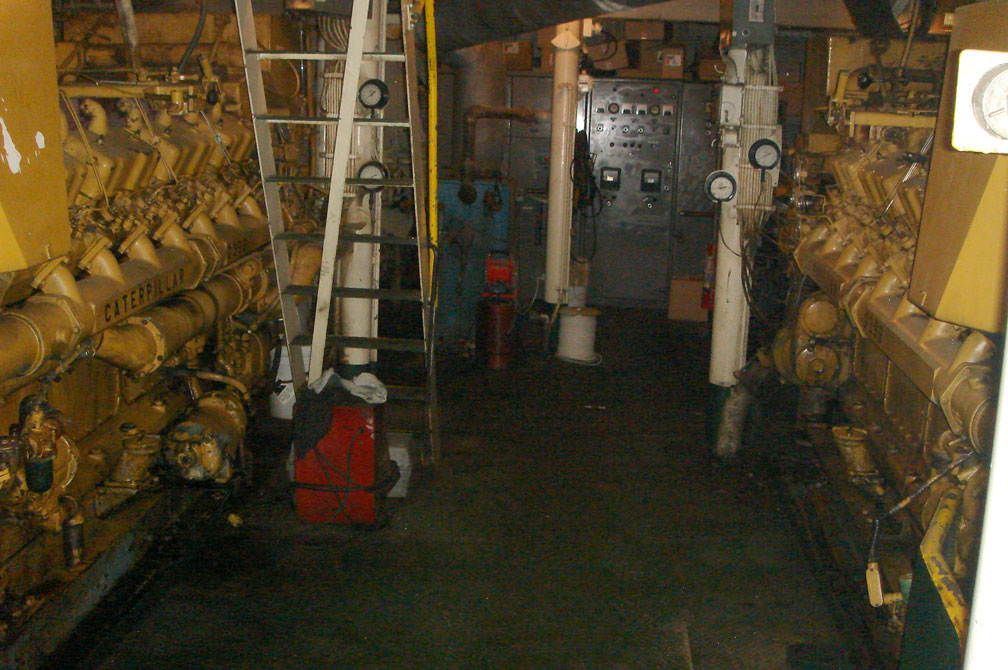
Here’s a look at the engine room, facing forward. The main engines are right and left, with the electrical distribution panel directly ahead. Electricity is provided by two separate diesel driven generators which make enough power for about four typical houses.
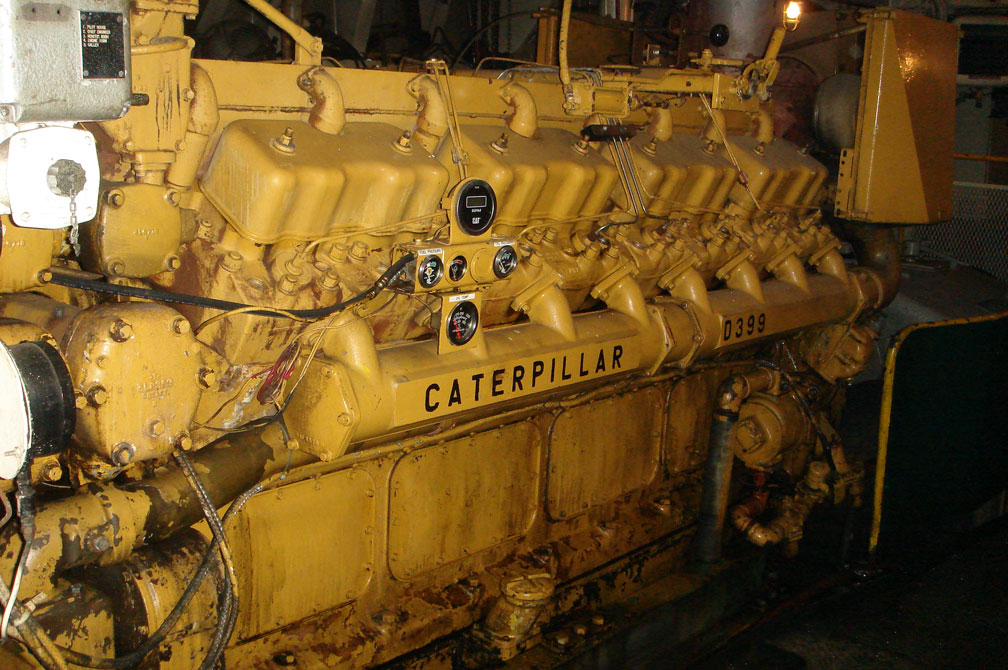
Another look at a main engine, in this case a Caterpiller D399 of 16 cylinders, developing 1,200 horsepower.
That engine uses tons of fuel. Literally. The High Roller carries more than 20,000 gallons of fuel. Do the math at today’s prices. (Hey, put it on your credit card and get the frequent flier miles.) Anyway, that engine is connected to a clutch and reduction gear that looks like this:

That’s a little bigger than the tranny in your old Camaro. When one of these gears lets go, it makes a hell of a racket and costs a fortune and ruins your whole week.

Again, notice there isn’t much space to live and work on a tugboat. Most things have the aroma of diesel or fresh paint. If two guys aren’t getting along, there’s no where to hide. I knew one captain who used to take two feuding men and toss them into the smallest room on the boat. They weren’t to come out until whatever they were arguing about was settled. If not, he’d go in there with them and settle it himself. Furthermore, things have to be maintained and repaired while underway. Spare parts are carried on the boat. Except in the case of a major breakdown, the work continues, the solutions implemented and improvised by those aboard.

In An Island Away, the reader gets some of the back story of Nathan Beck. He started working on launches and small tugs as a teenager then worked his way up to captain. This experience helped to shape his outlook on the world and turned him into the man the reader meets in the novel. I hope this post augments the narrative and puts a few pictures to the words.

Tugboat Anatomy, Part II

Having seen some of the basics, let’s stop on deck for a few minutes to talk about what goes on there. Here is a photo of the foredeck, directly below the front of the wheelhouse.

The H bit is used to make lines fast. They can be led through the bull ring at the very bow of the boat or off to either side through the single bits that stand against the gunwale. The ropes lying there will be tidied up. Harry’s crew was sorting through things, figuring out what’s good and what’s not, otherwise they would be hanging on pegs or stowed in lockers. The work of a deckhand is truly the case of hurry up and wait. He has to be ready to catch a line, toss one to someone else, or loose one at the command of the captain. The lines aren’t heavy until you’ve hauled them around for a couple of hours straight or pulled with all your might to get that last turn around a bit. (Well, actually they are quite heavy but you don’t notice that right away.) You also have to know when to let go. If you hold onto the line and it starts to run, it will pull you through the bit, twisting your arm and whatever other body part follows through the bit. This is not pretty and you’ll be lucky if you only go to the hospital.

Here’s a look at the stern deck.

Surprise! There stands another H bit. Beside it, painted red, white, and blue, is the capstan. This capstan is hydraulically powered. It is used to wind in the towing rope, which the deck hands must then “flake” or lay out in a neat pile atop a pallet that would normally be here, but was taken up to allow for painting of the deck. That rope which is used to tow barges is called a hawser and the High Roller carries one that’s more than a thousand feet long. It is slowly let out through the stern H bit until the captain thinks he has enough out to allow for safe towing. Then it is made fast as describe earlier. The hawser takes up the shock created by the difference in movement between the tug and the barge (or whatever else is being towed). One vessel may be riding up a wave while the other is on its way down. The hawser stretches between the two. It also moves from side to side and you don’t want to get caught between it and the gunwale or a bit or anything else. It will crush you. Again, a good deckhand has to anticipate what’s going to happen, be ready, and act accordingly.

Here’s a view over the stern.

That steel fixture in the middle is called a cleat. You can tie off to that or use it to lead a rope, again depending on the operation. When this photo was taken, the boat was sitting in the Delaware River, so there isn’t much to see. Often times you’ll be looking at a ship coming up from astern or a sunset or a lighthouse, all of which have their own drama.

My character, Nathan Beck, and his crew do the jobs I described here. An Island Away is not a sailing adventure, but there are a few scenes which take place aboard tugboats, including one dramatic event in the Delaware River when another tug catches on fire. Beck and his men have to jump into the fray in order to rescue the other guys on the river. One thing I’d like the reader to take away from these photos is the compactness of the space on deck. There isn’t much room to do anything. Thus, everyone has to work together. One person out of synch creates a big problem that may be dangerous or make for back breaking extra work. However, when a crew works together, it is a choreographed operation that’s a thrill to be a part of. Remember, these objects are big an heavy. The High Roller weighs hundreds of tons. The barges it tows and pushes weigh thousands of tons. Ships weigh tens of thousands of tons. It is this type of work, and more importantly this type of responsibility for other men’s lives and equipment, that forms the character who is Captain Nathan Beck.

In Part III, we’ll go inside to see the engine room and living quarters. Want a job?

Tugboat Anatomy, Part I

One of the main characters in my novel, An Island Away, is a tugboat captain named Nathan Beck. Captain Beck washes ashore on the island of Aruba after his boat sinks in a storm. During my seventeen years working on the Philadelphia waterfront and beyond, I had the pleasure of knowing several tugboat captains very well, not to mention the others that I sailed with every now and then. My friend Harry owns the High Roller, which is shown below.

The High Roller is your typical general purpose tugboat built about 40 or so years ago. Yes, when well cared for, these boats last a long time. I worked with this boat for about six years, towing barges down the Delaware River, into the Atlantic Ocean, and some other places (most times I found my way back). One thing you’ll notice is the bow fender on the front of the boat. Tugboats push as much as they pull. The fender protects both the tug and whatever it happens to be pushing against. It took me a long time to get used to the idea that you actually bump into things when you’re working on tugs as opposed to land vehicles where touching is usually a bad thing. In the center of the bow you’ll see the bull ring where a line can be passed through before leading to a pier, barge, or ship. It is made fast on the front bit by turning figure eights. That first level of deckhouse is bunkrooms and the next level is the wheelhouse. All the way at the top is another steering station used to see over the top of tall barges.

Let’s go inside.

Above you’ll see the two throttles, one for each engine. The view from the wheelhouse is actually pretty good when looking forward. There are windows all the way around but plenty of blind spots to the stern. There is a stern steering station outside, but from there, of course, it is hard to see forward. You have to learn to anticipate your moves, judge how far something will move, and how fast it will move there. Anyway, push the throttle forward one notch to engage the wheels (propellers). Further than the first notch increases the speed of the propeller (not necessarily the boat). Steering is accomplished with a small lever. Sorry, no big, wooden ship’s wheel here. Above the windows is a panel that is shown below.

The two dials show your engine rpm and the center needle is an indicator for the position of your rudder. That’s Harry in the reflection on the computer screen. (He just turned 79. He and his father performed some heroic deeds when a tanker burned at the dock back in the day). If the screen were on, you would see a chart plotter image that ties into the GPS system to show where you are. Comes in handy, especially in the fog. Here is the view down onto the foredeck.

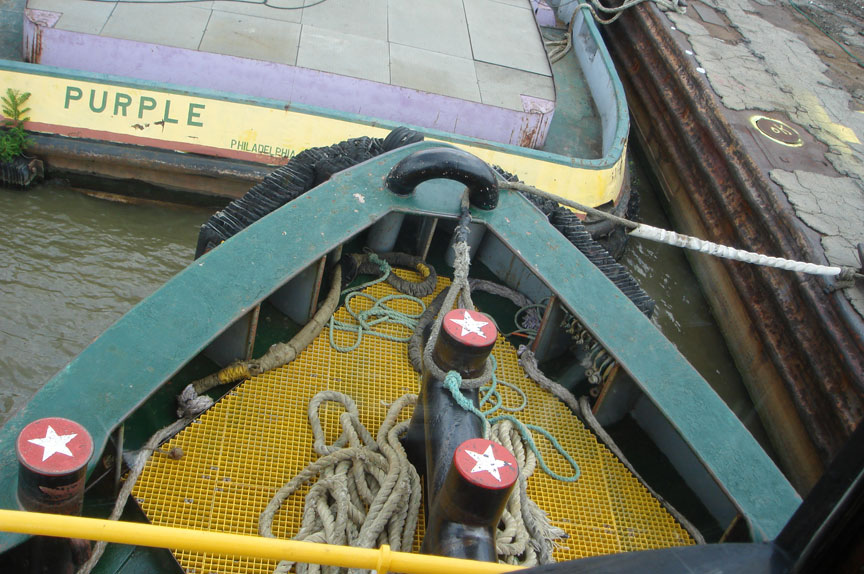
In the center, you see the bit, which is shaped like an H. The bit on the left (port side) is a single bit with a horn that you could also use for making a line fast. These bits are used to lead lines in different directions depending on your purpose. (By the way, Harry’s other boat in the frame there is called the Purple Hays. He has a sense of humor when it comes to naming boats.)

In An Island Away, Nathan Beck is the captain of a much larger tug, but the anatomy is the same. Beck’s grandfather was in the merchant marine during the Second World War, serving as a cook on ships that were torpedoed and sunk on Atlantic Convoy duty. Thus, the older Beck opened a restaurant with a view of the waterfront in Philadelphia. Well, Nathan Beck was raised by this grandfather because his own father abandoned him there at the restaurant. He grew up with a view of the river and the tugboats roaming about. Captivated by these stout vessels he made them his career, ultimately becoming the man who would wash ashore in Aruba, encounter Sam, Luz, and Charlie (yes, of Charlie’s Bar mentioned earlier in my blog).

Part II will take a look at the main deck and what goes on there.

Aruba, Way Up Here

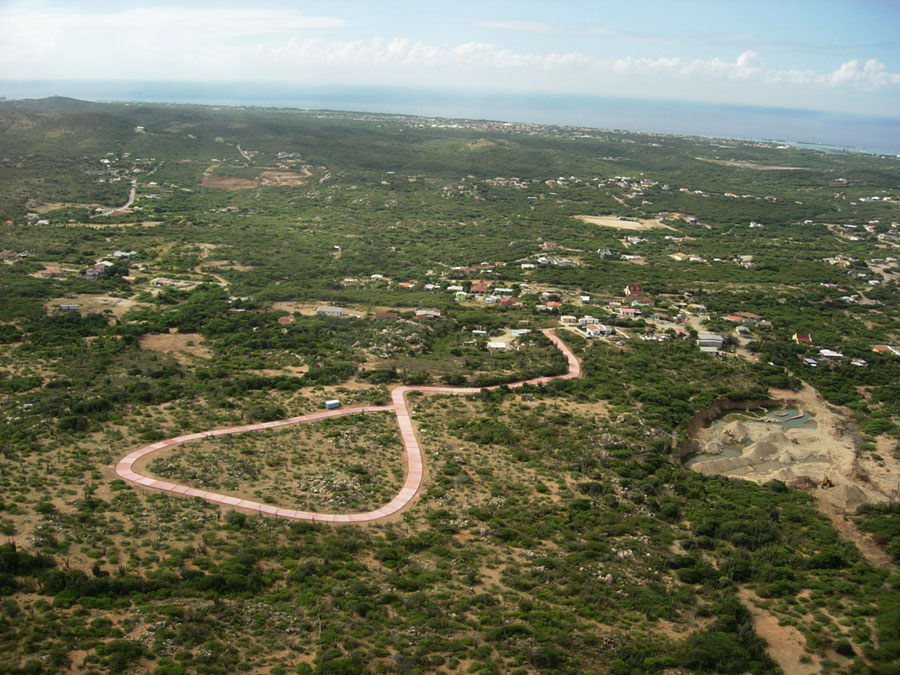
This is a shot of Aruba taken from a helicopter. The point of it was to show the new concrete road installed in the area known as San Fuego. I own two small lots there on which I will someday build a couple of houses. No big hurry, nor any great ambition. If you look back through my posts, you’ll find one called Day and Evening. The day shot was taken at ground level from this road.

This photo shows another thing I mentioned in that post, that from a second-floor balcony it is possible to have a view of the sea. Way up here, a place many people in Aruba think is far from everything, is only a few miles (as the crow flies) from the Caribbean. In this area, you’ll find the burrowing owls and plenty of birds. However, they’re skittish. You have to be still and never approach directly or they fly off. I leave them to their own as much as possible. Still, they’re cute as could be and fascinating to watch.

You’ll also note how much undeveloped space there is on the island. To the left of this frame is the Arikok National Park, which takes up more than 25% of the whole island. There are trails through the park on which you can drive to observe the wildlife or hike or ride your mountain bike. There won’t be any development in there, which is good news for the owls.

Now, if I could only talk the Arubans into building some big windmills on the east side of the island, they would be entering a low-emission zone and be able to add eco-tourism destination to their literature. Stay tuned, we’re working on that and more. I wouldn’t mind sitting on my second-floor balcony, looking out at the sea to the west and a row of tall windmills to the east. That’s just about perfect.

Published in: on June 23, 2008 at 8:06 pm  Comments (4)  
Tags: , , , ,