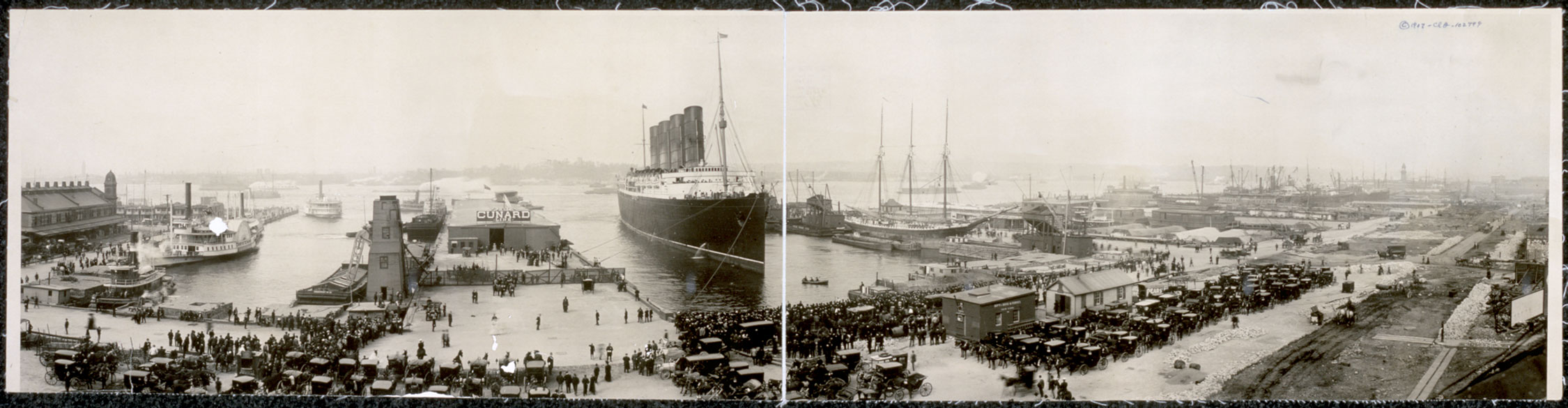
A View of the Lusitania

Since my novel, An Island Away, has a shipwreck scene in it, I was looking through various databases for information on such incidents. Here is one of those fantastic panoramic photos courtesy of the United States Library of Congress, perhaps one of the ultimate databases of all time. It is not of a shipwreck, but it is of a famous ship that sank in record time, 18 minutes according to some accounts. You cruise ship passengers might enjoy a view of the Lusitania, that famous liner that sank under mysterious circumstances. The incident helped move America into the First World War.

I’m not sure where this waterfront is. It may be New York or somewhere in England. I’m trying to find out, and when I do, I’ll update this post with the correct info. The only data I have is that the photo was taken at the “end of a record voyage.”

On the left side of the frame, in the corner of the slip, you’ll see a steam tug. This must have been quite a vessel, an actual wooden-hulled steam tug. Many of them went to the bottom with all hands after a boiler explosion. Hard work that was. Dangerous, too. I worked with a tugboat captain in Philadelphia. He told me both his uncle and his father were engineers back in the days of steam. He added that he became a captain because they died in explosions because as engineers they were below deck when disaster struck. Wise move on his part, eh? He was a skilled operator, knew all the old tricks and had some hand-made instruments for plotting speed against the tide for a given boat and barge combination. I adapted his methods and made one of my own, a sort of slide rule device. It was accurate enough to save me many hours and plenty of money. All this without a computer. Amazing.

Published in: on June 30, 2008 at 4:45 pm  Leave a Comment  
Tags: , , , , , , , , , , ,

An Island Away, Excerpt 2

The second excerpt from my novel, An Island Away, posted here for those who would like a peek. A synopsis and more info is available at my website. The book is available at Amazon.com.

Chapter 5: Captain Nathan Beck has been adrift for more than five days. At last he has come ashore in Aruba…

Finally, he was head and shoulders out of the ocean. Only a few inches of water skirted the sand. The place he wanted to go was amidst a grove of low trees. He took another rest. It felt wonderful to be on solid ground. Looking at his bare feet, he wondered what the other parts of his body looked like. He had to be a fright for whoever was going to see him first.

He sat up and stared in the direction of the music. Between the trees he saw shapes dancing. A man leaned over a bar. Beer bottles clanked as two guys toasted one another. Just a few more feet and he would be there among them. He would be safe, alive to tell the tale.

Forgetting his previous failure at walking, he tried to get up again. He heard voices, a man and a woman, very close. He looked up and there they were, a couple dancing on the beach. They stopped and the man turned the young lady to face him. He kissed her. They were so close Beck could hear their lips smack. Why couldn’t they see him?

He wanted to find out. He struggled against the all-powerful force of exhaustion that pressed down on his shoulders. His vision blurred as he wobbled upright. A screeching roar filled his ears. The distorted view before him tilted one way, then the other. He went light-headed, dizzy to the point of retching. He put his arms out to break the coming fall.

He collapsed on the beach with his feet in the water. He caught a glimpse of the moon before it went black and took all the stars with it.

“I didn’t drown,” he whispered into the darkness.

The Greatest Travel Writer

In my humble opinion, the greatest travel writer I’ve read is Mr. H.V. Morton. Morton’s original claim to fame was as the journalist who broke the story of King Tut’s tomb back when Howard Carter was poking around the Egyptian desert. He went on to write an entire shelf of books about various countries, cities, and regions, all in the context of a travelogue.

Before discussing Morton’s work further, I’d like to say that most other travel books I’ve read are either the romp-through-a-place-kind, or the guidebooks that have about twenty words for each stop. Both of these serve a purpose. The first type are vicarious fun. The second give practical information and pointers in the right direction when assembling an itinerary. Almost without exception I’ve found these books quite thin on the type of information I’m looking for.

Thus, H.V. Morton. Morton synthesizes history, culture, geography, all sorts of things into an integrated travel experience. In the course of his books, he relates these facts through a series of encounters with whatever subject matter is at hand. It might be a hidden gem of a church in a back street in Rome or a pawnshop in Venice. Each gives an opportunity to inform the reader of an incredible array of details, each more fascinating than the one before it. It is this type of presentation that offers the reader a sense of “knowing” a place. Morton sleeps in monasteries and run-down hotels. He eats meals that give him stomach troubles. He rides on mules when he has to. And he doesn’t hesitate to let the reader know that all does not go well when traveling, a reality that too many other writers ignore.

I read A Stranger In Spain between my second and third trips to that country. Upon my third and several trips thereafter, I found myself recalling much of what Morton had written. Astonishingly, many of the places he visited are still there, some in the same condition as he found them. The same could be said for In Search of London. I read this before a trip to that city and while in the Temple area remembered Morton’s stories about the Knight’s Templar and the lawyers that operated there in his time.

Anthony Bourdain said, “Be a traveler, not a tourist.” This certainly holds true for Morton. Who is your favorite travel writer? Do you have a favorite book about a place you’ve visited or would like to?

Published in: on June 28, 2008 at 12:23 pm  Leave a Comment  
Tags: , , , , , , , ,

Tugboat Anatomy, Part II

Having seen some of the basics, let’s stop on deck for a few minutes to talk about what goes on there. Here is a photo of the foredeck, directly below the front of the wheelhouse.

The H bit is used to make lines fast. They can be led through the bull ring at the very bow of the boat or off to either side through the single bits that stand against the gunwale. The ropes lying there will be tidied up. Harry’s crew was sorting through things, figuring out what’s good and what’s not, otherwise they would be hanging on pegs or stowed in lockers. The work of a deckhand is truly the case of hurry up and wait. He has to be ready to catch a line, toss one to someone else, or loose one at the command of the captain. The lines aren’t heavy until you’ve hauled them around for a couple of hours straight or pulled with all your might to get that last turn around a bit. (Well, actually they are quite heavy but you don’t notice that right away.) You also have to know when to let go. If you hold onto the line and it starts to run, it will pull you through the bit, twisting your arm and whatever other body part follows through the bit. This is not pretty and you’ll be lucky if you only go to the hospital.

Here’s a look at the stern deck.
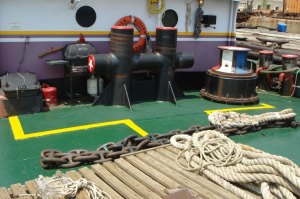
Surprise! There stands another H bit. Beside it, painted red, white, and blue, is the capstan. This capstan is hydraulically powered. It is used to wind in the towing rope, which the deck hands must then “flake” or lay out in a neat pile atop a pallet that would normally be here, but was taken up to allow for painting of the deck. That rope which is used to tow barges is called a hawser and the High Roller carries one that’s more than a thousand feet long. It is slowly let out through the stern H bit until the captain thinks he has enough out to allow for safe towing. Then it is made fast as describe earlier. The hawser takes up the shock created by the difference in movement between the tug and the barge (or whatever else is being towed). One vessel may be riding up a wave while the other is on its way down. The hawser stretches between the two. It also moves from side to side and you don’t want to get caught between it and the gunwale or a bit or anything else. It will crush you. Again, a good deckhand has to anticipate what’s going to happen, be ready, and act accordingly.

Here’s a view over the stern.
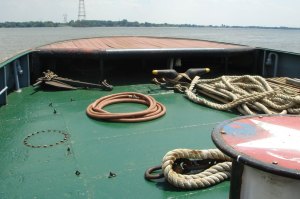
That steel fixture in the middle is called a cleat. You can tie off to that or use it to lead a rope, again depending on the operation. When this photo was taken, the boat was sitting in the Delaware River, so there isn’t much to see. Often times you’ll be looking at a ship coming up from astern or a sunset or a lighthouse, all of which have their own drama.

My character, Nathan Beck, and his crew do the jobs I described here. An Island Away is not a sailing adventure, but there are a few scenes which take place aboard tugboats, including one dramatic event in the Delaware River when another tug catches on fire. Beck and his men have to jump into the fray in order to rescue the other guys on the river. One thing I’d like the reader to take away from these photos is the compactness of the space on deck. There isn’t much room to do anything. Thus, everyone has to work together. One person out of synch creates a big problem that may be dangerous or make for back breaking extra work. However, when a crew works together, it is a choreographed operation that’s a thrill to be a part of. Remember, these objects are big an heavy. The High Roller weighs hundreds of tons. The barges it tows and pushes weigh thousands of tons. Ships weigh tens of thousands of tons. It is this type of work, and more importantly this type of responsibility for other men’s lives and equipment, that forms the character who is Captain Nathan Beck.

In Part III, we’ll go inside to see the engine room and living quarters. Want a job?