Privateers and Pirates

As mentioned earlier, I’ve been researching a novel tentatively titled MacMillan Judge, Privateer. The course of this research has taken me through many volumes, a few trips, and into places that I normally wouldn’t go. It has been quite an education into a subject I knew very little about. I’ve examined the circumstances surrounding privateer activity during the American Revolution and the War of 1812. Originally this story was going to be something akin to a swashbuckler. However, I came to believe that the people who performed heroically during these two wars deserved better. They are entitled to a representative character who upholds the ideals of the new nation as well as his own private convictions as to what it means to command a vessel of war. I say vessel of war as opposed to warship because the privateer typically used a converted merchant ship or one built for speed rather than brute force. Below is a photo courtesy of the United States Federal Government of the Pride of Baltimore, the type of Balitmore Clipper on which MacMillan, Judge will sail.

This is a tricky subject because privateers operate under a letter of marque granted by the government under which they sail. Their activities would normally be considered piracy, but the letter of marque gives them privileges normally reserved for standing navies. A privateer raids merchant ships, attacks other nations’ warships, and shells their land forces. However, in the course of these dangerous forays, any salable goods or vessels captured are subsequently sold and the proceeds go to the privateer. Therein lies the rub: the privateer is a money-making venture as much as it is a military affair.

Of course, when the United States declared independence (and later in the War of 1812), they didn’t have much in the way of a navy. They faced the most powerful naval forces the world had ever seen, those of the British Empire. The solution was to empower private individuals to take great risks in order to create some semblance of a marine force. According to some of the books I’ve read, this was a very effective method. Benjamin Franklin was an investor in a privateer ship during the revolution, as were many others of all walks of life. The privateers racked up a string of victories that would be amazing even by today’s standards. One particular ship captured six vessels in six days right under Britain’s nose in the English Channel. Another privateer sent a letter to Lloyd’s of London, bravely stating that the the British Isles were under his blockade. That’s a bold statement from a man aboard one ship. But the letter was posted at Lloyd’s and insurance rates skyrocketed.

But what about that sticky question of outright profit in the course of the war? Are these people really just pirates by another name? From what I’ve learned I would have to say, no, they are not pirates. Pirates, despite our Disney version of them today, were not the happy go lucky bunch looking for treasure and a cute place to drink rum. Pirates murdered their way around the world until allied forces hunted them down. The American privateers caused their share of casualties and made their profits, but they did not indiscriminately attack neutral ships. At the same time, when the war was over, they ceased their activities and resorted to non-combatant trading.

One way to look at the privateers is to think of their prizes as a method of payment. Instead of receiving a salary, they collected money from successfully attacking the enemies resources. It saved the United States Treasury a bundle and created a number of highly successful businessmen in the process. Many of these people invested their money in the growing economy of the United States, which only furthered progress in a place that was still a backwater when compared to Europe.

I’m looking forward to writing MacMillan Judge, Privateer. Our Mr. Judge is going to be the thinking man’s warrior, not a Disney-fied hero who dodges grapeshot and dances about the deck. First I have to finish Under A Blue Flag, which is the sequel to An Island Away, but that’s another story that I’ll be talking about soon.

Published in: on July 3, 2008 at 4:02 pm  Leave a Comment  
Tags: , , , , , , , , ,

Coca-Cola Corner

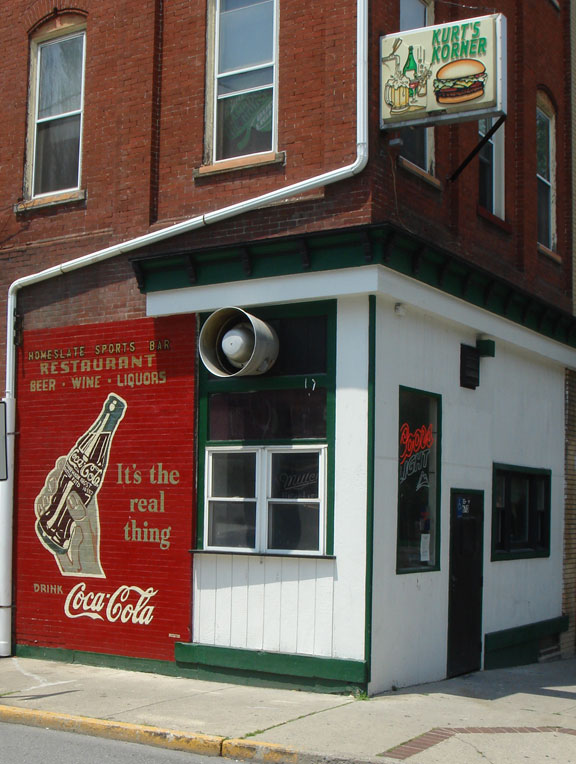
Here’s a photo from a corner in Slatington, Pennsylvania, USA. I’m not sure what the name of this place is, either Kurt’s Korner or Homeslate Sports Bar. Kurt’s has the sign above, but Homeslate shows up on the Coca-Cola painting on the wall.

Doesn’t matter. I’ve driven past this place about three hundred thousand times in my life. Okay, not that many but I grew up a couple of towns away and this place was frequently on my route to somewhere else, especially when fuel was cheap. Ah, those were the days, sometimes.

As might be gleaned from the name of the town, Slatington was once surrounded by slate quarries. It was a prosperous business for a while, especially before the advent of asphalt shingles. All those roofs of a  growing America needed something to keep the rain off of our ancestors. Of course, nothing lasts forever. The slate pits filled with water after they were abandoned.

I’ve been known to crisscross the northeast United States in search of such places. Sometimes I find people who were alive during the glory days of these old-time industries. They love to chat about the past. Often times they explain unique solutions to everyday living that were actually commonplace in an age before computers and modern appliances.

As mentioned before, I’m going to start photographing these people and writing down as much of what I learn from them as is practical. At the moment, I can’t remember where, but various historians are taking oral histories from people in order to build a record of the past that is from many more first-hand sources. It seems like I’m duplicating their efforts. Nonetheless, why not? In the first place, those who have gone before me deserve a record of their accomplishments. Second, who knows what comes of such writing? I remember my early days in Aruba. Plenty of people told me stories about the island and their lives. Then, some years later, I was writing An Island Away. If not for the people I met there, the story would never have come about.

Just like the Coca-Cola tagline, my thinking is that life… “It’s the real thing.”

Creating Atmosphere, Part 1

In the course of writing a book, one of the challenges is to create the atmosphere in which the story unfolds. The setting could be the frozen tundra or the tropics but simply stating where a character is doesn’t do the job. There are elements that have to be added to give a sense of the place, a mood, a feeling in the readers mind. The greatest writers do this without the reader realizing it.

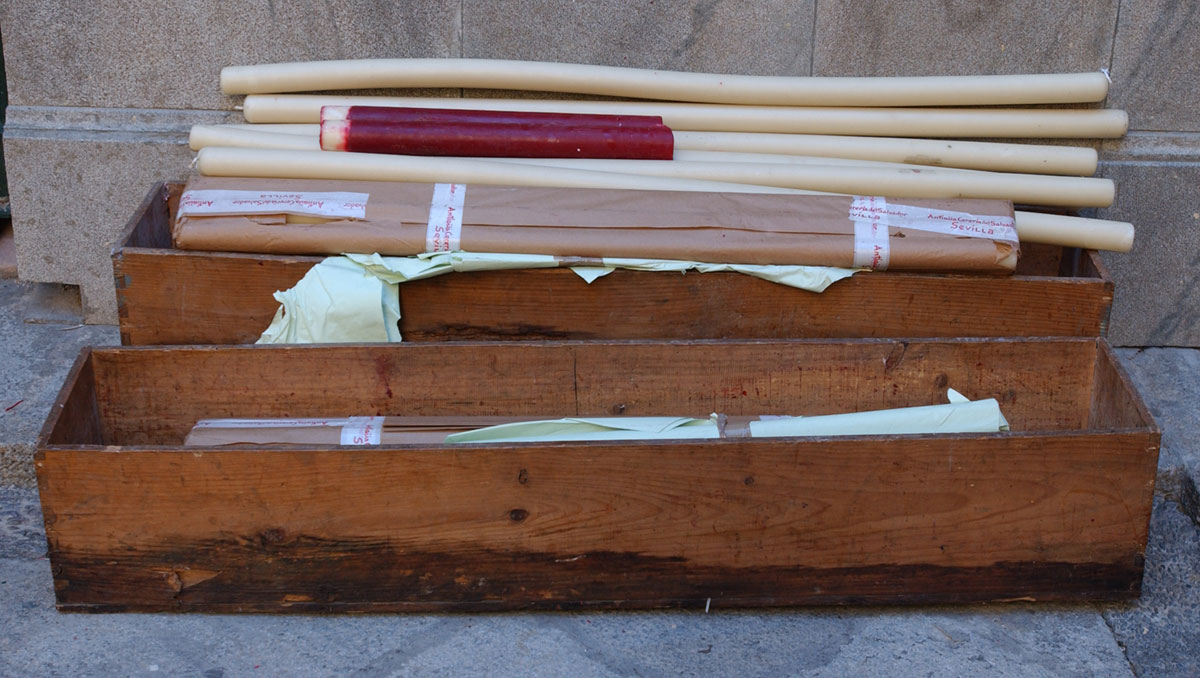
I’ve always enjoyed visiting old churches be they big or small. Of course a cathedral is the epitome of the form and I’ve visited them in England, France, Spain, and the United States. Talk about atmosphere, these places are loaded with it. For example, while in Seville, Spain, I spotted this delivery of candles.

They weren’t going to the massive cathedral there, but rather to a much smaller church in another neighborhood. However, the size of these candles is impressive. Their light is more than the average taper. They will certainly cast shadows among the old stones, worn wooden pews, and gazing icons inside. The faint scent of burning wax, mixed with incense and old dust, will lurk in the sanctuary. Interiors like that are enough to make the goose-bumps pop. See Creating Atmosphere, Part 2 for a look at this first hand.

And that’s part of the fun of writing a story. The writer has the pleasure of creating the world. Of course, he also has to take responsibility for it and that can be a daunting challenge.

Published in: on July 3, 2008 at 9:07 am  Leave a Comment  
Tags: , , , , , , , , ,

Belmonte Castle, Spain

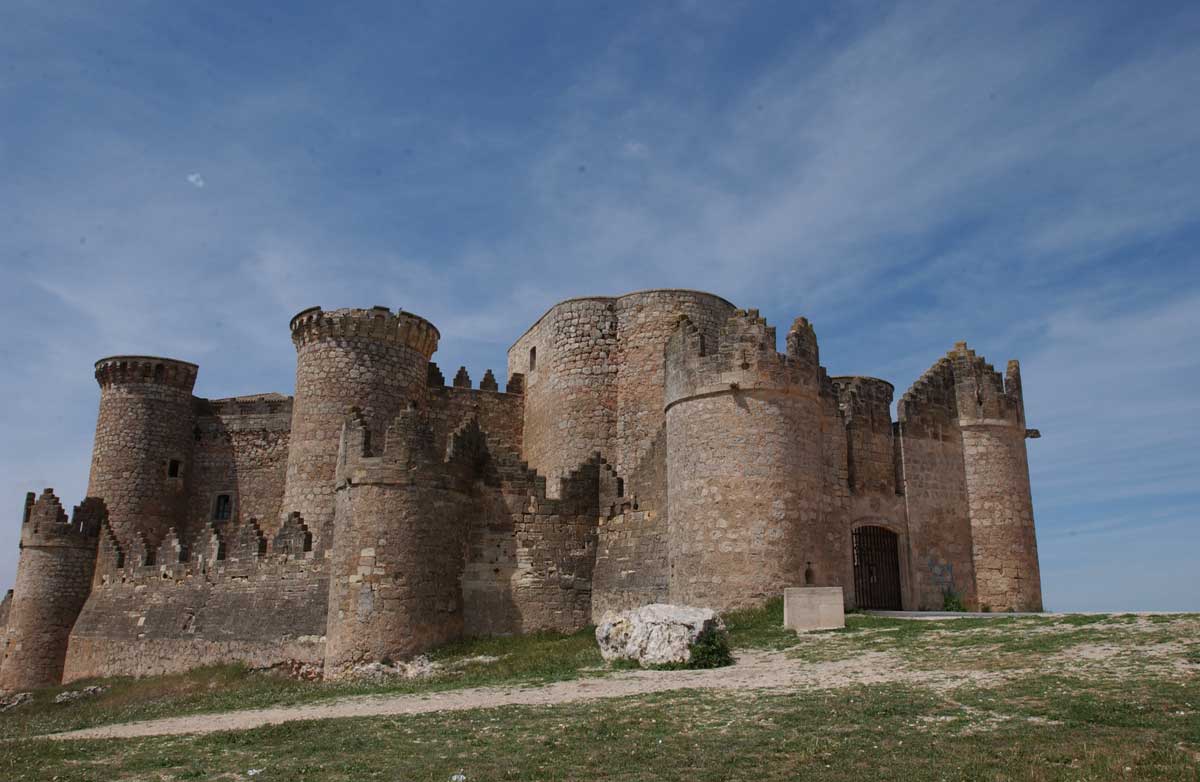
Belmonte Castle (Spain) might have been taken from a story book. Or, perhaps it is the other way around. Whatever the case, this place gives the impression that the middle ages are not yet over. Here’s a first look:

The crenelated ramparts, the towers, the long walls down to the village, all lend themselves to medieval impressions. The best part is, you can walk right to the base of those walls, stare up, and wonder what kind of nerve it took to attack such a place. Madness perhaps?

I’ve never been inclined to write about this era. There are plenty of novels set in these times in various locations. Most of them don’t interest me. I’d like to read a book about building castles the way Ken Follet wrote about building a cathedral in Pillars of the Earth. That would be an interesting story. Here’s another look that shows most of Belmonte:

As you can see, there are multiple layers of defense, a gatehouse, a keep, all the trappings of a well designed fortress. It is compact, making it easier to defend with a smaller force. This castle, like so many of them, sits at the top of a hill and overlooks the town and surrounding plain. It would be a challenge to sneak up on this place. Again, I’m not interested in someone pouring boiling oil down on me. I’ll hold off until the battles over and the celebration begins.

In another post I’ll show the castle at Ballesteros de Calatrava. Stay tuned.

Published in: on July 1, 2008 at 3:30 pm  Comments (2)  
Tags: , , , , , , , , , , , ,