Creating Atmosphere, Part 1

In the course of writing a book, one of the challenges is to create the atmosphere in which the story unfolds. The setting could be the frozen tundra or the tropics but simply stating where a character is doesn’t do the job. There are elements that have to be added to give a sense of the place, a mood, a feeling in the readers mind. The greatest writers do this without the reader realizing it.

I’ve always enjoyed visiting old churches be they big or small. Of course a cathedral is the epitome of the form and I’ve visited them in England, France, Spain, and the United States. Talk about atmosphere, these places are loaded with it. For example, while in Seville, Spain, I spotted this delivery of candles.
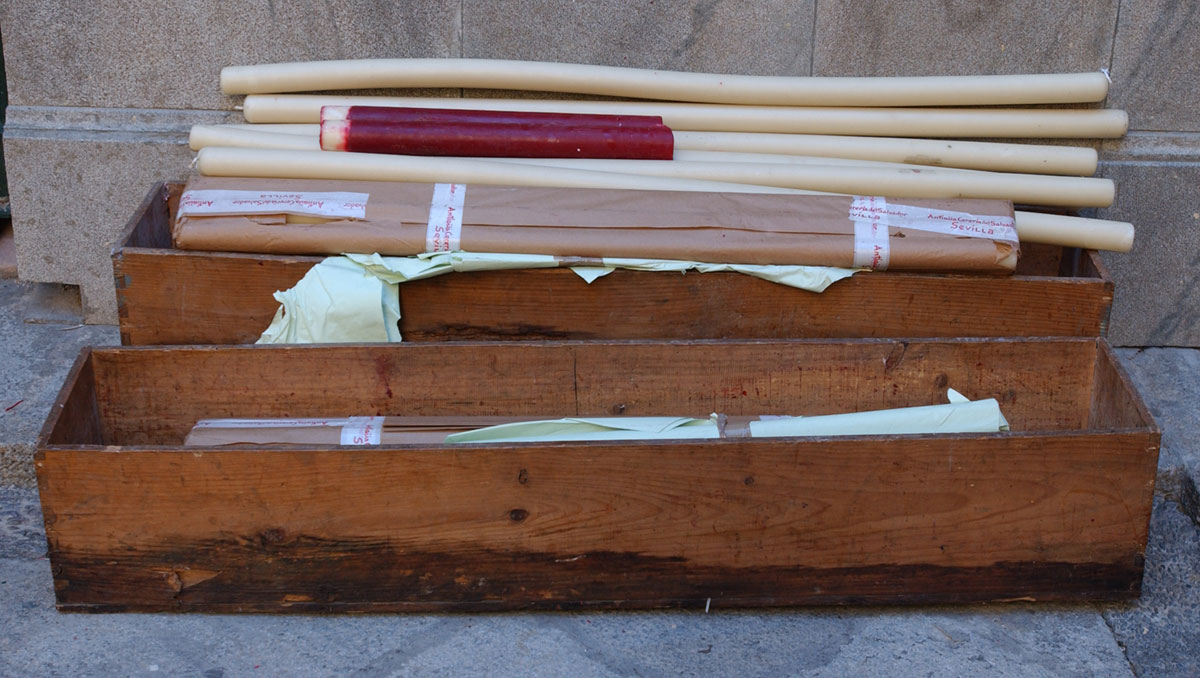
They weren’t going to the massive cathedral there, but rather to a much smaller church in another neighborhood. However, the size of these candles is impressive. Their light is more than the average taper. They will certainly cast shadows among the old stones, worn wooden pews, and gazing icons inside. The faint scent of burning wax, mixed with incense and old dust, will lurk in the sanctuary. Interiors like that are enough to make the goose-bumps pop. See Creating Atmosphere, Part 2 for a look at this first hand.

And that’s part of the fun of writing a story. The writer has the pleasure of creating the world. Of course, he also has to take responsibility for it and that can be a daunting challenge.

Published in: on July 3, 2008 at 9:07 am  Leave a Comment  
Tags: , , , , , , , , ,

Key West, Way Back When

This is a photo taken from the City Hall Tower in Key West, Florida, USA back in 1907. Also from the archive of the United States Library of Congress.  Cruise ship travelers take notice. Things were different then.

If you click on the photo and open it in a separate window, you’ll see there is an amazing amount of detail. This must have been a holiday of some kind, perhaps the 4th of July. There is a parade going on. There is bunting on some of the building. But you can also make out several ships, including a schooner sailing through the narrows on the right.

I’ve been to Key West several times. I stayed at a bed and breakfast called The Mermaid and The Alligator. Fantastic place to stay, great atmosphere, walking distance to the center of town, but away from all the noise. Key West is loaded with so many good restaurants and fun things to do. No wonder so many people are repeat visitors.

I need to work Key West into a story. At the moment the way to do that isn’t in my head. Sooner or later, I’ll figure out. I know that Pan American Airways started here with a flight to Cuba. That may be the hook. Now I only need the line and the sinker.

An Island Away, Excerpt 1

Chapter 1: Charlie and his cat, Screwball, are on his balcony, looking over the town of San Nicolaas, Aruba, the principal setting for my novel, An Island Away.

Charlie lived in a place where the illegal was legal, where the immoral was moral, and where some people’s fantasies were other people’s realities. So, he lived every day in anticipation of the fantastic. And why not? It was the night before his birthday, the start of another year in a place where anything could happen.

…a little further on….

A car rolled beneath his balcony, flashed its signal, and turned right. Charlie watched his lifelong friend Sam park at the end of the block. He couldn’t help but smile at the man’s reliability and persistence. No one but Sam took the time to make his birthday a grand affair. Unfortunately, and despite Charlie’s constant warnings, Sam fell prey to indomitable emotions with regard to the girls working in San Nicolaas and frequently found himself miserably heartbroken, a condition Charlie studiously avoided.

“Thanks to Sam, we’re in for a nice time,” Charlie said to Screwball. “Unless something else comes up. You never know. Eh? Let’s hope we have a party and something else.”

The cat shifted on the parapet, licked his forepaw, and once again put his head upon it.

Something else? Charlie asked himself. What could it be? Well, this town was named San Nicolaas and not for the Jolly Old Saint Nicolas the Americans called Santa Claus. Nonetheless, the town gave its gifts (such as they were) to one and all, Charlie included. Christmas was every night of the week, every day of the year, with the exception of the actual Christmas Day, New Year’s, Carnival Saturday, and Easter Sunday. And on those days, too, an enterprising man need only walk the lane known as Rembrandtstraat, peek into the caged halls leading to the rooms upstaris, and call out. Someone would unlock the door, lead the man  inside, and provide the service of the oldest profession. The experience could be another meaningless act, or it might change somebody’s life. As he knew, the outcome depended on the man, the woman, and the people in between.

Charlie stubbed out his cigarette and looked over the street one more time. “Welcome to San Nicolaas,” he said, “We’re open for business.”