Old Tugboats Never Die

But they do sink! Sadly these two boats sank in a slip along the Schuylkill River in Philadelphia, Pennsylvania, USA.

They sat on the bottom for a while. Then a salvage crew hoisted them onto the pier using a massive floating crane. The Carol Wales is what’s known as a “railroad tug.” She was built by one of the railroads, probably in the 1930’s or 1940’s. The railroads used to have large marine departments. Railcars were loaded onto barges known as “car floats.” These car floats typically had three sets of tracks onto which the railcars where rolled and secured. Then the barges were towed across rivers and to a special type of bridge onto which the railcars could be unloaded and sent on their way. The Big Boy was a “navy hull,” meaning that it was built during World War II under a Defense Plant Contract. These tugs are sometimes referred to as DPC hulls.

That gash in the wheelhouse above was probably caused by one the cables strung under the tug by the salvage crew. It’s a shame for these old boats. They’re big and clumsy compared to their modern counterparts. However, they have proud lines and a long history. Trouble is, they’re obsolete.

They’re both single screw, having only one main engine and one propeller. Many ship owners want twin screw boats helping their vessels to the dock simply for the sake of reliability. This is especially true in the case of oil tankers.

That propeller on the left is about seven feet in diameter, which means the Carol Wales probably had an engine in the 1700 horsepower class. I worked with plenty of single screw boats and never had a problem. A good engineer and crew keeps things in reliable condition. And if you have an anchor, you drop the hook, fix what broke, and get on with the job. If not, well, chances are you’ll be in for plenty of misery that happens slowly enough that you can see it coming.

I’m glad to have taken these photographs. Both of these boats will be cut up for scrap iron in the next couple of weeks. Two more for the boneyard and a piece of history gone from the planet.

Published in: on September 6, 2008 at 11:24 am  Comments (4)  
Tags: , , , , , , ,

Sinking of the Red Oak

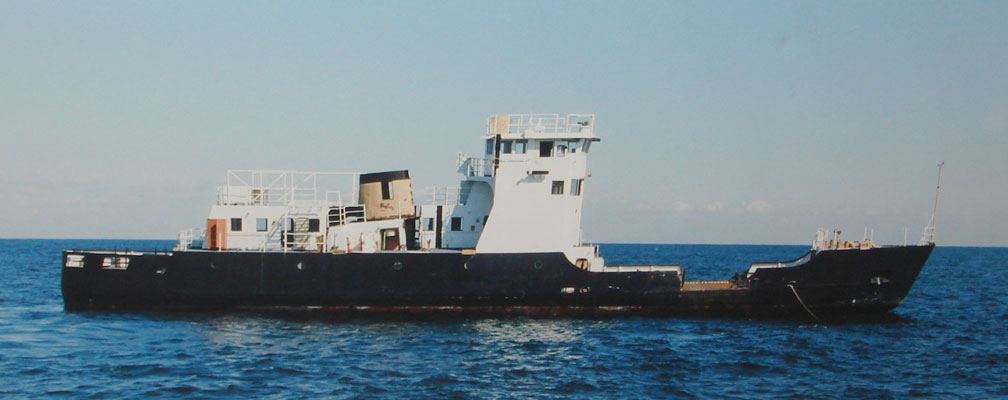
The Red Oak was a United States Coast Guard buoy tender. As mentioned in previous posts, I used to build artificial reefs by sinking ships and other materials off the coast of New Jersey and Delaware, USA. The Red Oak was stripped of all re-usable equipment, including her engines, generators, and other machinery. All fuel, oil, and floatables were also removed. In the end, she was a steel hulk that looked like this:

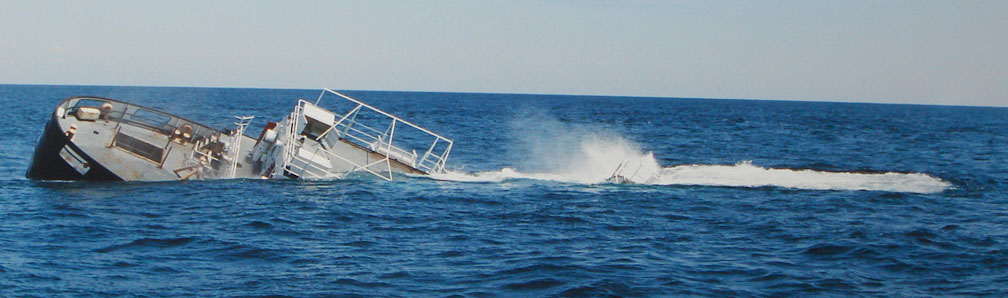
We towed her from Baltimore to a spot just off Cape May, New Jersey. Once anchored, I went below and cut several holes at the waterline using a standard cutting torch. Water lapped into these holes and to accelerate the process, I removed two covers from the stern tubes that were well below the waterline. It took about half an hour until the hull heeled and took solid water over the deck like this:

It was strange how this vessel sank. The holes were in the stern, but it went down bow first. There was less space forward and thus less water was required for the area to lose buoyancy. However, the stern was definitely heavier and should have pulled itself down first. No matter, soon the scene looked like this:

I’ve heard that the wreck is an excellent dive and fishing spot. Given that it is close to Cape May, I’m not surprised. There are any number of good charter operators who take people fishing from the various marinas most every day the weather is good enough. The artificial reef program in the United States has done wonders for the sport fishing community and the environment. It is an effort that deserves continued support. Please enjoy our marine resources responsibly.

Now, if I could only get my friends in Aruba to do this. Aruba has ideal conditions to sink wrecks for both diving and marine habitat enhancement. One more thing I have to work on there.

Published in: on July 9, 2008 at 3:52 am  Leave a Comment  
Tags: , , , , , , , ,

A View of the Battery and Beyond

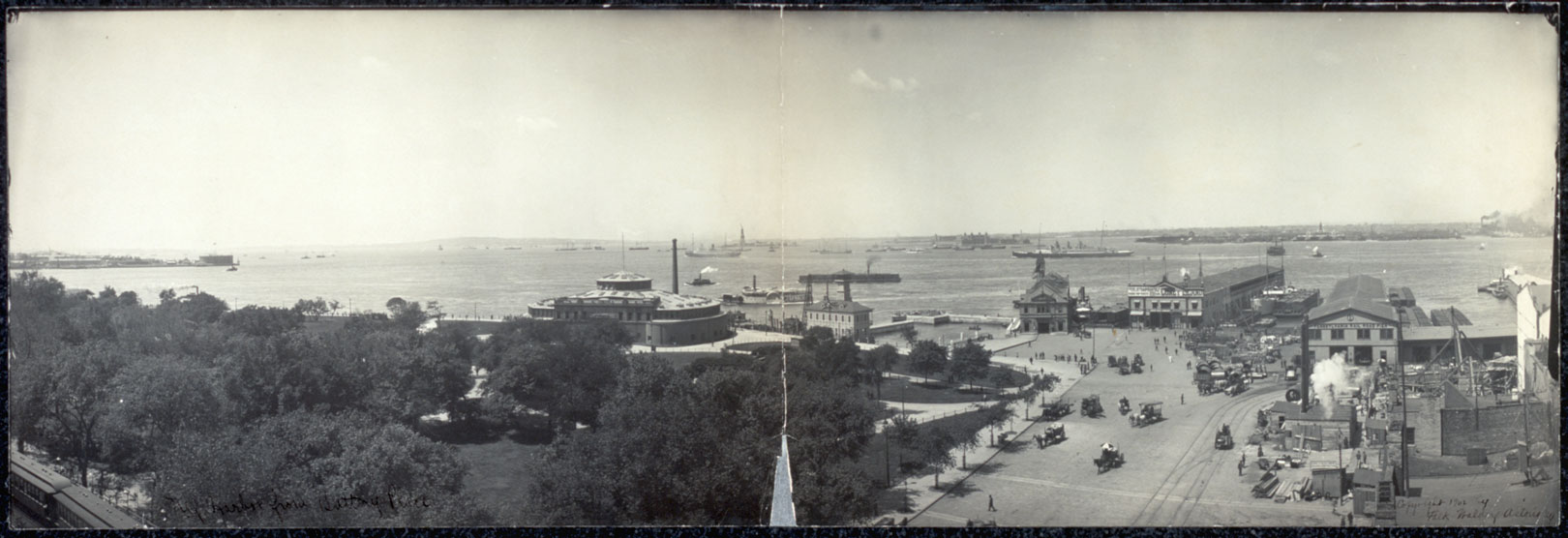
I posted those other photos of New York City, the ones of Grand Central and such. I couldn’t resist this one, taken in 1902 looking at New York Harbor from the end of Manhattan. There are so many details in this photo that it would take hours to catalog them all. First, take a look at the image.

Of course the Battery, is just left of center. Beyond the Battery is the Statue of Liberty. Turning to the right, you’ll see Ellis Island. Between the Battery and the Statue of Liberty, note the tugboat steaming along, towing a barge just behind it. In the foreground you see terminals for ferries going to Coney Island and Staten Island. Then there is the warehouse-like structure for the Pennsylvania Railroad. The park leading up to the Battery looks immaculate, as do those carriages on the wide boulevard that fronts it.

This must have been quite a time in New York. Things have changed but the Battery is still there. Ellis Island is now a tourist attraction. The Statue of Liberty is ringed with security.

I remember during my first few weeks of film school at New York University, I was given an assignment to take documentary photographs of a permanent structure. I trotted from Washington Square to the World Trade Center, camera and tripod in tow. I set up at the edge of the plaza and took a 360 degree panorama of the scene. I didn’t realize it at the time but I captured the completion of the World Financial Center, which is built on land that did not exist when the photo above was taken. The trailers from the construction companies were still there but this was the very end of the job. After the events of that fateful September, I found this series of photos on my shelves. The negatives (this was in the days of film) are in good condition. I’ll have to find a lab to make the prints and stitch that photo together again. It’ll feel the same as looking at the above photo, and yet it’s only twenty two years later.

A View of the Lusitania

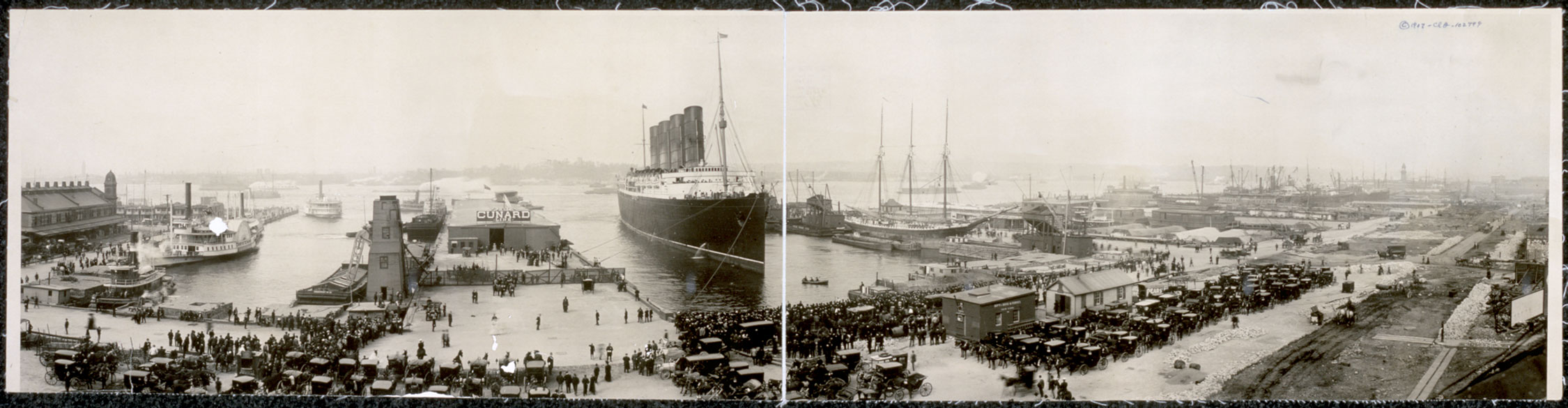
Since my novel, An Island Away, has a shipwreck scene in it, I was looking through various databases for information on such incidents. Here is one of those fantastic panoramic photos courtesy of the United States Library of Congress, perhaps one of the ultimate databases of all time. It is not of a shipwreck, but it is of a famous ship that sank in record time, 18 minutes according to some accounts. You cruise ship passengers might enjoy a view of the Lusitania, that famous liner that sank under mysterious circumstances. The incident helped move America into the First World War.

I’m not sure where this waterfront is. It may be New York or somewhere in England. I’m trying to find out, and when I do, I’ll update this post with the correct info. The only data I have is that the photo was taken at the “end of a record voyage.”

On the left side of the frame, in the corner of the slip, you’ll see a steam tug. This must have been quite a vessel, an actual wooden-hulled steam tug. Many of them went to the bottom with all hands after a boiler explosion. Hard work that was. Dangerous, too. I worked with a tugboat captain in Philadelphia. He told me both his uncle and his father were engineers back in the days of steam. He added that he became a captain because they died in explosions because as engineers they were below deck when disaster struck. Wise move on his part, eh? He was a skilled operator, knew all the old tricks and had some hand-made instruments for plotting speed against the tide for a given boat and barge combination. I adapted his methods and made one of my own, a sort of slide rule device. It was accurate enough to save me many hours and plenty of money. All this without a computer. Amazing.

Published in: on June 30, 2008 at 4:45 pm  Leave a Comment  
Tags: , , , , , , , , , , ,