This will be the final installment for Tugboat Anatomy. At least for now. It’s time for a look at living aboard a tug. The High Roller works around the Philadelphia Harbor with a crew of five. On long, ocean tows, she would carry seven and sometimes as many as ten men.
Here’s where they sleep.

This is a typical bunkroom for the crew. Two bunks, two lockers, one porthole and a few shelves. The captain has his own suite just behind the wheelhouse. There are two bunks in there with a sink. The rest of the crew doesn’t get a sink, except for the one in the head. The head on the High Roller has two showers, two sinks, two toilets. There’s also a washing machine for laundry.
And here’s the galley.

The galley spans the boat from one side to the other. Out of the frame is a large refrigerator and freezer. The table on the left faces a bench that seats four. Notice the racks above the sink, designed to keep plates and cups from flying during rough weather. This boat has the galley at the stern, which encourages the crew to check the engine room every time they pass from the bunk area to get something to eat. You can never check the engine room too much.
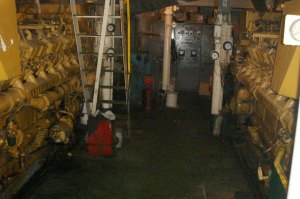
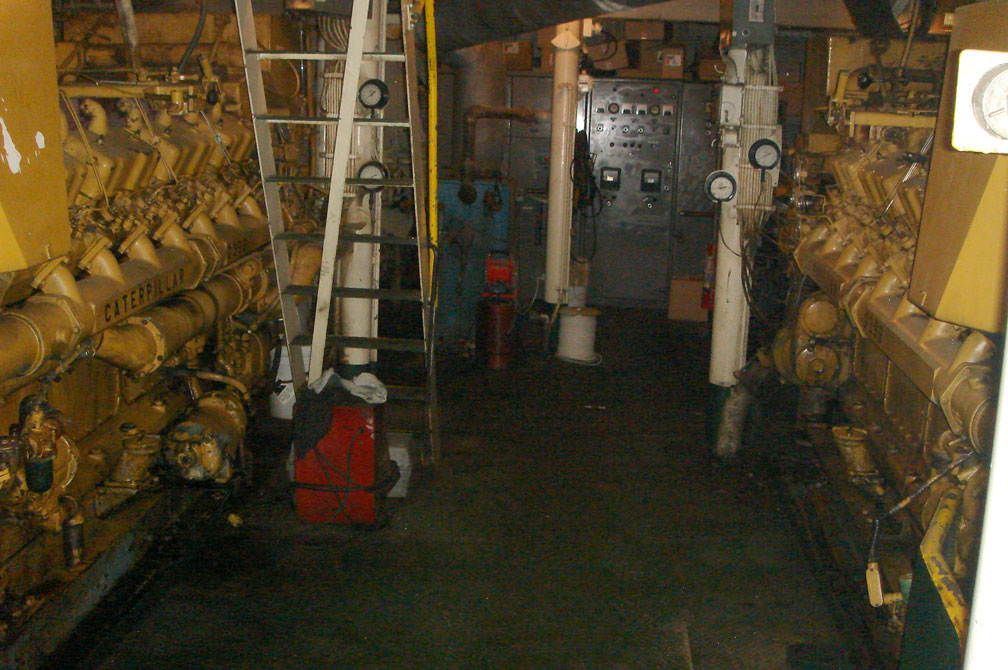
Here’s a look at the engine room, facing forward. The main engines are right and left, with the electrical distribution panel directly ahead. Electricity is provided by two separate diesel driven generators which make enough power for about four typical houses.
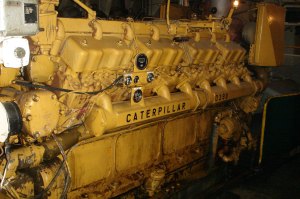
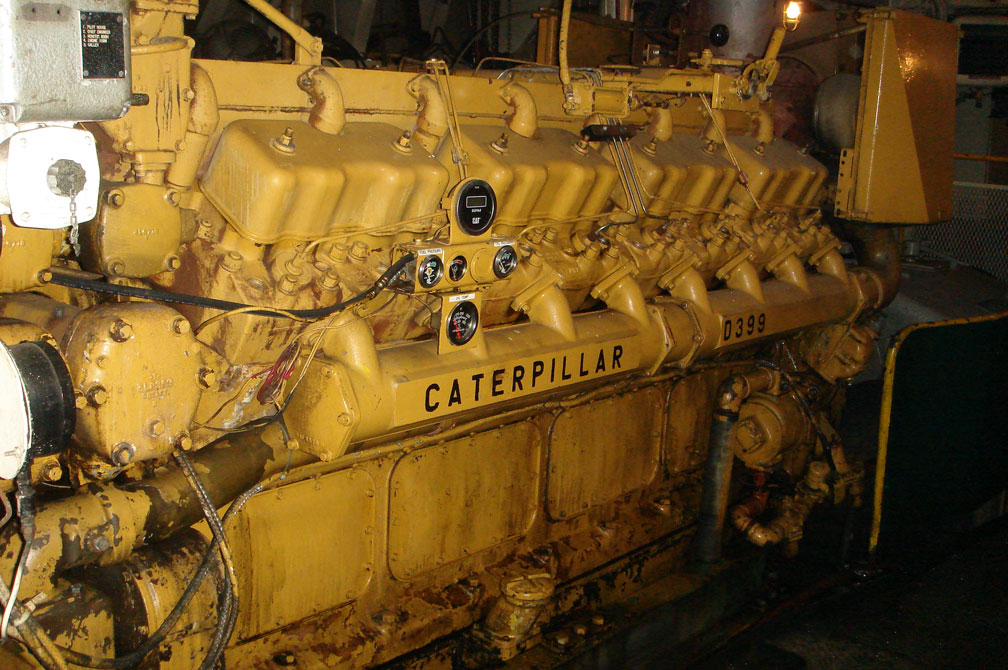
Another look at a main engine, in this case a Caterpiller D399 of 16 cylinders, developing 1,200 horsepower.
That engine uses tons of fuel. Literally. The High Roller carries more than 20,000 gallons of fuel. Do the math at today’s prices. (Hey, put it on your credit card and get the frequent flier miles.) Anyway, that engine is connected to a clutch and reduction gear that looks like this:

That’s a little bigger than the tranny in your old Camaro. When one of these gears lets go, it makes a hell of a racket and costs a fortune and ruins your whole week.
Again, notice there isn’t much space to live and work on a tugboat. Most things have the aroma of diesel or fresh paint. If two guys aren’t getting along, there’s no where to hide. I knew one captain who used to take two feuding men and toss them into the smallest room on the boat. They weren’t to come out until whatever they were arguing about was settled. If not, he’d go in there with them and settle it himself. Furthermore, things have to be maintained and repaired while underway. Spare parts are carried on the boat. Except in the case of a major breakdown, the work continues, the solutions implemented and improvised by those aboard.
In An Island Away, the reader gets some of the back story of Nathan Beck. He started working on launches and small tugs as a teenager then worked his way up to captain. This experience helped to shape his outlook on the world and turned him into the man the reader meets in the novel. I hope this post augments the narrative and puts a few pictures to the words.



 The Bent Page
You must be logged in to post a comment.