So in the last post, I said I needed to DELIVER 7,000 watts of power to keep my airco system working here in Aruba. The next logical question is how am I going to produce electricity in the first place. Well, here in Aruba we have copious supplies of both wind and sun. The trade winds blow across this island day and night, month after month, we few exceptions. My own observations show that the average wind speed on my property is in excess of 24 mph. As for the sun, it blazes at least 8 hours a day. Cloudy and rainy days do occur but not very often and rarely several in a row.
So, how do we get the wind to make electricity? With one of these:
 To the left is a Southwest Wind Power, Whisper 200, wind turbine. More commonly referred to as a “windmill.” The unit produces a maximum of 1,000 watts of power when a steady breeze of 27 mph is passing through its blades. But wait a minute, I said my average speed is only 24 mph. That’s right and at 24 mph this unit produces 800 watts. To keep it simple, this wind turbine could (theoretically) power an electrical device requiring 800 watts of power given the conditions I described.
In the real world, things are a bit different. Here’s where we all have to concentrate. Let’s say that at my house the wind blows at 24mph for 10 hours each day. That means the windmill would produce 800 watts times 10 hours for a total of 8,000 watts. What can 8,000 watts do? It could run that big airco of mine for a little more than 2 hours. Now, my on-site observations show that the wind blows MORE than 24 mph for approximately 20 hours per day (yes, it is that windy in Aruba). So, I can reasonably expect this unit to deliver 16,000 watts per day to the system.
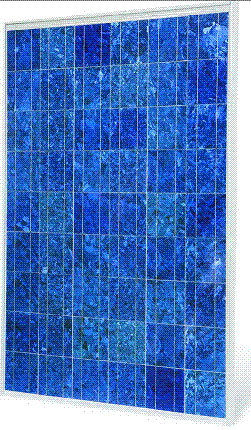
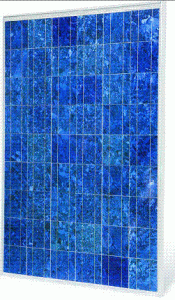 I did mention something about the sun. The example is much the same with different equipment. A solar panel like the one on the left does the job. Yeah, it’s one of those sort of shiny blue things that typically goes on the roof. My system will use 200 watt panels. Each one will produce 200 watts if operating at its maximum. I’m going to string 5 of them together to have the potential for 1,000 watts. Again, I’m going to de-rate the output to 800 watts and I’m going to say that it will produce that much 7 hours per day for a total of 5,600 watts per day.
Now it is time to combine these two sources. Together, I’m expecting them to produce a total of 21,500 watts per day. Let’s round DOWN again, to 21,000. Finally we get to the fun part. What can I do with the 21,000 watts and those airco units? Just divide the production by the demand. I could run them both for 3 hours since they require 7,000 watts together. I could run the larger one for about 6.5 hours, or the smaller one 7 hours, or some combination of both. Since I rounded demand UP and production DOWN, I should have some room to maneuver here.
Either way, I’m satisfied that this method of production will give me what I want, which is to run those air conditioners long enough to keep my cat, my wife, and myself comfortable here in Aruba. Next time I’ll talk about combining this power into a manageable form. In between, we’ll have some more fun on the island, writing books, and taking photos.
 Then a cage of rebar is set up like this:
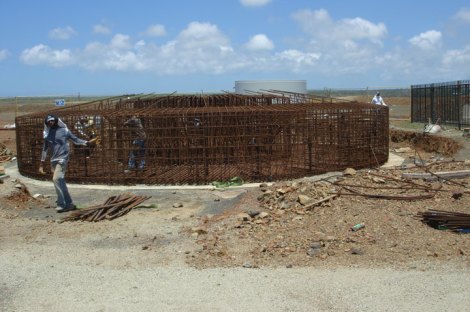 With the man standing on the left in the photo above, you get a sense of the scale of this structure. Finally, the concrete is poured around the rebar to complete the base, which looks like this:
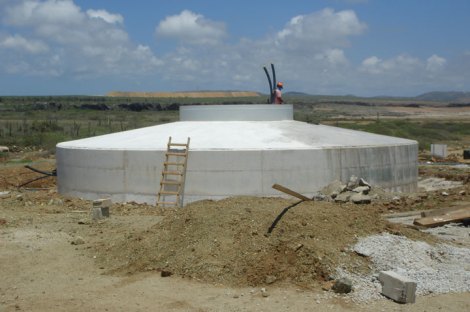 Soon there will be towers standing atop these bases. Then will come the turbines themselves with their massive blades turning in the wind.

 The Bent Page
You must be logged in to post a comment.