Another kind of High-Ball

In earlier posts, I mentioned a novel I work on from time to time about a couple of pals whose lives intertwine between the end of the First World War and D-Day of the Second. One of them is employed by the Pennsylvania Railroad and much of the story centers around life along the lines in Eastern Pennsylvania. It’s hard to imagine what the scenery was like back then. By this I mean the large number of steam equipment traversing the countryside as well as working in massive railyards located in major cities and small towns alike. Everything moved on the rails, especially if it had to move over a long distance.

Thus, I found this video of a Union Pacific steam locomotive running out west. The term high-ball originated from a signal which consisted of a ball run up to the top of a pole, indicating to the locomotive engineer that the track ahead was clear. Thus, he laid on the coal and proceeded with all due haste. Take a look at more than 200 tons of locomotive moving at full speed.

In case you missed it, watch the video all the way through. The whistle isn’t all that clear, but it does spark the imagination. I’m grateful to all the people who post videos like this. They go a long way to making my job as a writer a bit easier. Just think, sixty or so years ago, before jet liners arced through the sky, there were hundreds of steam trains like this striking out across the nation.

Published in: on June 19, 2009 at 12:40 pm  Leave a Comment  
Tags: , , , , , , , ,

What CAN be done.

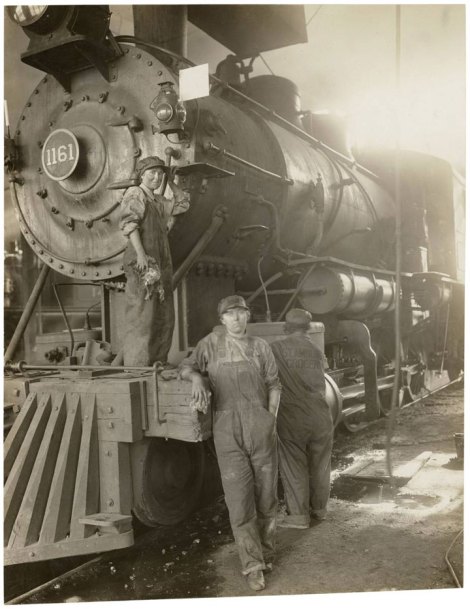
Lately, there has been so much talk about economic doom that people have whipped themselves into a frenzy of negativity. Politics aside, instead of so much chatter about what can not be done, may I humbly suggest we start talking about what CAN be done. Of course, let’s start with ourselves. (This is because I’m a firm believer that when you point your finger, three more are pointing back. If you don’t believe me, point your finger at something and then take a look at your hand. Get it?) I think we have forgotten how far and how quickly we have traveled along the economic timeline. For instance, I was doing some research in the United States National Archives, and came across this photo:

womenrailwkAccording to the National Archives, these women are working on this steam locomotive somewhere in Montana, circa 1919. Now, certainly Montana and the year 1919 were not the easiest of places and times. Forget socio-economic conditions, just imagine working against the natural environment and those beasts affectionately known as steam locomotives. Some of the tools used to repair and maintain this equipment were larger than the arms and legs on these women and they were made of steel. Thus, it must have taken two or three women to perform these jobs. And yet, they got the job done, and made the Nation a better place for their children in doing so. Today’s locomotive shops sport hydraulic lifts, computer diagnostic tools, and climate control, not to mention an array of safety measures designed specifically to protect life and limb. The women above had to persevere without such niceties.
Therefore, before we all start bellyaching about how bad we have it, we might better take a look at the people who did jobs exponentially more difficult physically (and perhaps mentally) then we do today. Perhaps CAN and NOT were never placed close together in their sentences the way they are in today’s vernacular. Perhaps these people had the strength and determination to do better for themselves rather than the weakness to cry for government help. Perhaps they preferred the honor and satisfaction of being self-sufficient over the pathetic dependency of being a ward of the state.

So, if all day we speak of nothing but what can NOT be done, well, NOTHING will be done. But if we pause, take a deep breath, and THINK about what CAN be done, well, we might discover just how vast the possibilities are. Initially the future may be uncomfortable, which is simply an expression of the details to which we forgot to attend. Then, as progress is achieved, this minor annoyances will fall away as the pride of achievement rewards those who are willing to do what it takes.

Published in: on March 29, 2009 at 12:58 pm  Comments (1)  
Tags: , , , , , , , , , , ,

New Hope & Ivyland Railroad

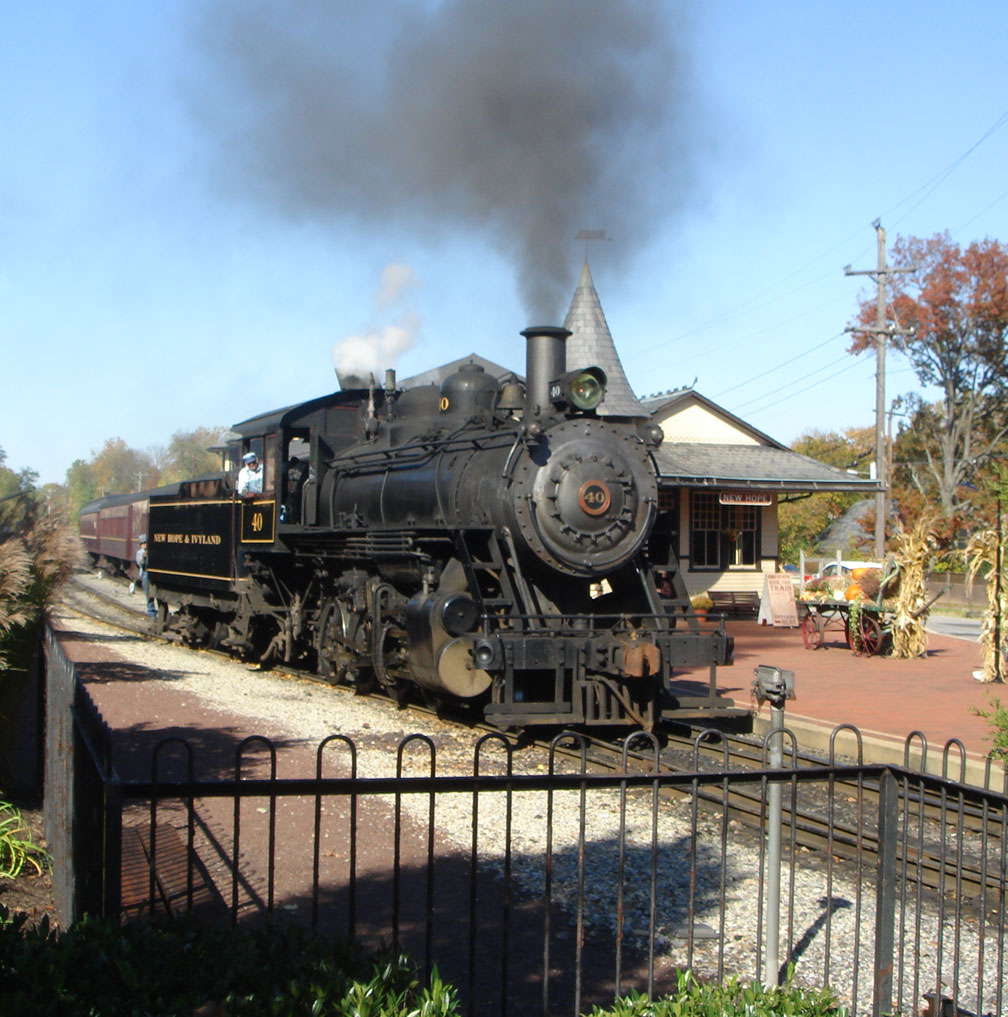
The New Hope & Ivyland Railroad is another piece of living history. It is a tourist train that carries passengers from New Hope, Pennsylvania to Lhaska, several miles away. I’m not positive, but I think the line was originally part of the old Reading Railroad.

This isn’t my greatest photo of No. 4, which was built by the Baldwin Locomotive Works many years ago. I actually have some very nice black and white photos of this engine and her tender in both black and white and color. I took them back when I used Hasselbalds and large format cameras. The prints hang on the walls of my house. Take a look at the engineer; he certainly looks the part. I have to get a hat like that.

The last few weeks the train has been running steadily, giving people great views of the fall foliage and pumpkin patches set up for children. New Hope itself is a fun town with plenty of good restaurants, odd shops, and dinner theaters. It gets crowded on the weekends.

Published in: on October 30, 2008 at 12:56 am  Leave a Comment  
Tags: , , , , , , ,

Strasburg, Pennsylvania, USA

Strasburg, Pennsylvania is not far from all the outlet shopping near Lancaster. The town is well known for its railroad which thrills children and adults alike. On the day I took these shots, Thomas the Train was on site, much to my disappointment. However, kids love that character. I prefer the regular steam engines which make for great photography. The tower at the left was moved to this location. The view from up there is fantastic. Although only two stories tall, the surrounding countryside opens up because it is the gentle, rolling farmland of the Amish. It also gives you the perspective of the yard master in days gone by.

Across the street is the Pennsylvania Railroad Museum, which hosts literally dozens of steam engines and cars of all description. At the height of its operations, the Pennsylvania Railroad was known as “the standard railroad of the world.” It controlled much of the passenger traffic between, Philadelphia, New York, DC, and Chicago, not to mention the freight business. Using the type of engines shown below, the “Pennsy” connected the eastern half of the country with the west.

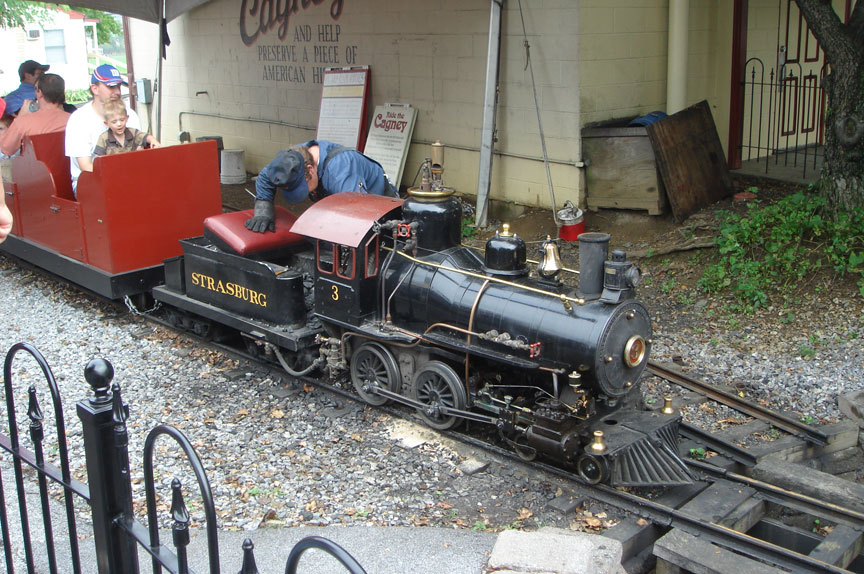
It’s hard to imagine the smoke and soot of steam locomotives. I’ve had the pleasure of seeing some of them in action here at Strasburg as well as in New Hope, PA. They may be majestic, but they’re also dirty. Nonetheless, it’s important to see such machines in action. They are a form of living history that helps us keep things in perspective. Of course, there’s fun to be had in Strasburg, such as this little steam locomotive.

This post begins a new category here at The Bent Page. Years ago I used to take many photographs of trains and industrial sights. Some of them were published in the magazines that focus on those subjects. So TRAINS becomes a category here starting today.

Published in: on September 14, 2008 at 2:51 pm  Leave a Comment  
Tags: , , , , , , , , , , ,