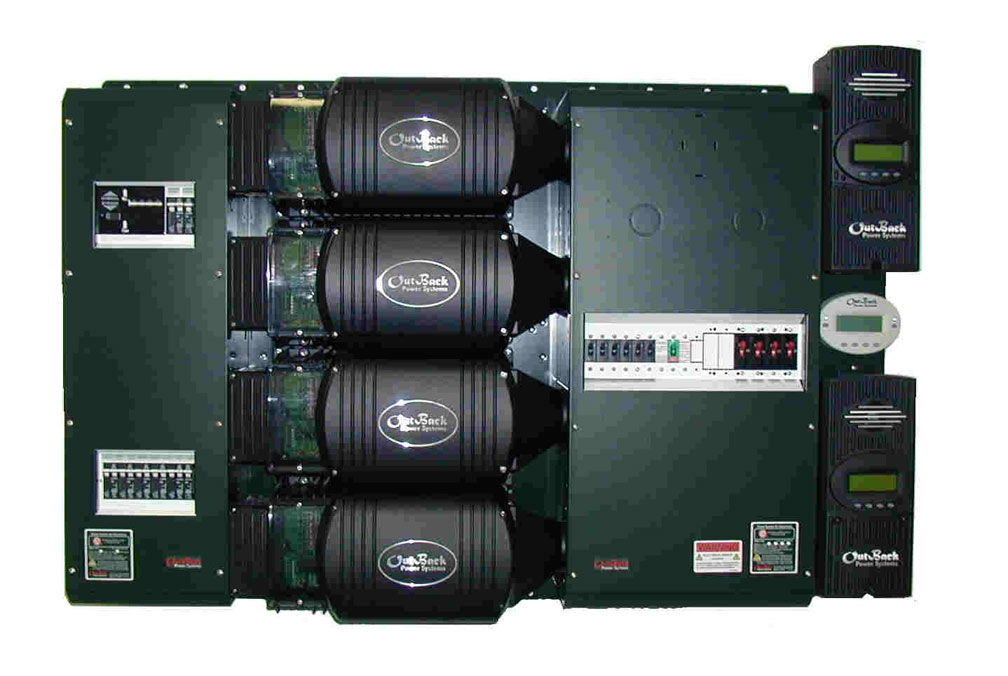
The DC/AC inverter is the heart of any off-grid power system with electricity produced by solar and wind. Most small wind turbines and solar panels produce direct current (DC) electricity. However, the electricity you use in your home is alternating current (AC). We won’t bog down here with the details of that. Suffice it to say that you need to convert the DC to AC. The device that does this is called an inverter. The inverter draws power from the wind turbine and solar panels as well as from the batteries in the system. It then delivers it to the system in clean, regulated, AC form. Here’s a look a stack of four inverters as part of a system built by Outback Power.

Those four magic block boxes, one on top of each other, are the inverters. Each one of those takes 48 volt DC current and converts it to 120 volt AC current. The output of each one is combined in the adjacent boxes so that you can have both 120 and 240 volts. This system, with its four inverters produces a maximum of 10,000 watts of steady power. It can handle a surge load for a brief period of up to 14,000 watts.
10,000 watts is enough to power my entire house in Aruba, including those two power-hungry air conditioners. I rarely run them at the same time. Nonetheless, I’ve over-sized the system to handle the demand. Over-sizing is the key to happiness with off-grid systems (and pick-up trucks). It is always cheaper to build a larger system at the beginning than to upgrade later.
Lately, these systems have been growing in popularity. Companies like Outback have made them easier to set up, more efficient, and less maintenance intensive. Similarly, contractors have used them in “plug and play” systems that are easy for homeowners to understand. I can’t wait to have mine working and putting the money back into my own pocket instead of paying a utility company.
 Not much room to sit in this thing. Anyway, it was interesting to see the vehicle out on the street. As you can see from the photo, they allowed people to get rather close. The kids thought it was great. Here’s a plug for all the sponsors of the effort.
 It’s good to know there are smart people out there working hard to solve various energy issues. While this vehicle may not seem practical, the knowledge gained from such ventures can be applied to any number of other projects. No doubt the future will bring things that we might never have expected.
 The Bent Page
You must be logged in to post a comment.