Refinery At Dawn

This is a photo of the refinery located in San Nicolaas, Aruba. Back in the day when I used film in my photographic efforts, I always wanted to take a great night shot of the place. I never got around to it, and now my film cameras rest in my museum of things I used to love. I took a chance using my little consumer digital camera and this is what I got:

It’s not the greatest picture. However, it does give the impression of the photo I always wanted to take. Among the cameras that I used to use regularly was a Horseman 4X5 field camera. If you’re not familiar with photography, just think of those old cameras with the bellows and the guy sticking his head under a cloth. The film was 4 inches by 5 inches in size. When you have an original that large, you can make enlargements that are crystal clear up to about 3 feet by 4 feet. I have a few of those around the house. The problem was that getting the film developed became more and more expensive as well as more difficult to find a lab to do it. Thus, into the museum went the camera, lenses, and film holders.

I regularly consult photographs of locations that appear in my stories. These pictures help keep my writing organized. With digital cameras and small printers it is easier than ever to build a story board that chronicles the narrative from beginning to end. This becomes more important as the amount of pages increases. You would be surprised how easy it is to get lost in the middle of writing a novel. A quick look at the story boards and you’re back on track. Not only that, it’s fun to look at your original ideas after the book is completed. It’s amazing what you thought you were going to do as compared to how things turned out. That’s the beauty of fiction, you can rearrange it when you have to.

Published in: on September 2, 2008 at 12:24 pm  Leave a Comment  
Tags: , , , , , , , ,

Island Power, Inverters

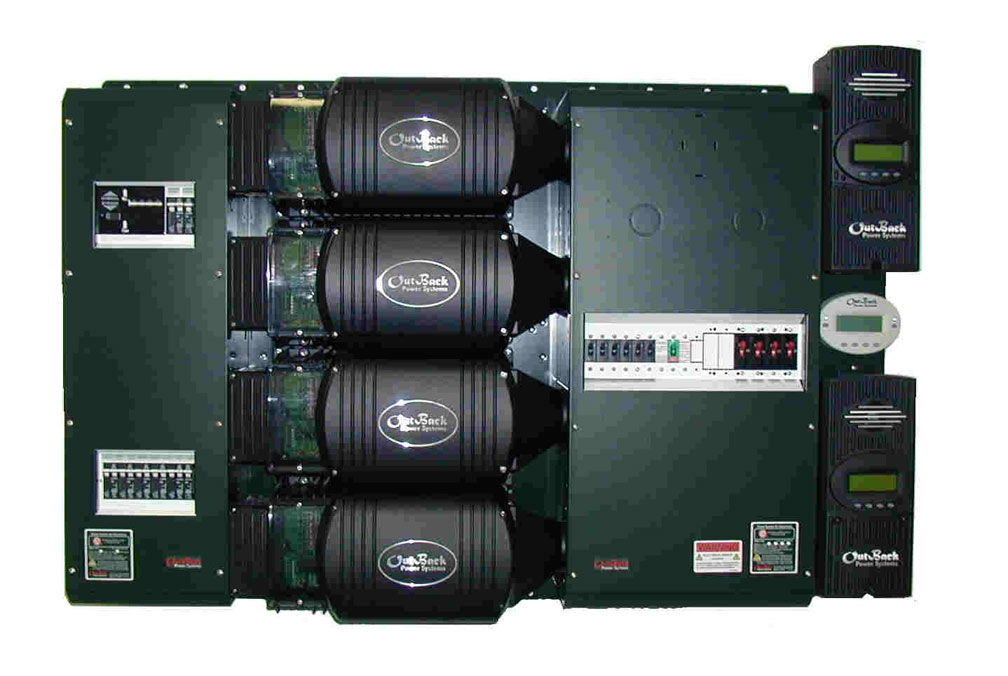
The DC/AC inverter is the heart of any off-grid power system with electricity produced by solar and wind. Most small wind turbines and solar panels produce direct current (DC) electricity. However, the electricity you use in your home is alternating current (AC). We won’t bog down here with the details of that. Suffice it to say that you need to convert the DC to AC. The device that does this is called an inverter. The inverter draws power from the wind turbine and solar panels as well as from the batteries in the system. It then delivers it to the system in clean, regulated, AC form. Here’s a look a stack of four inverters as part of a system built by Outback Power.

Those four magic block boxes, one on top of each other, are the inverters. Each one of those takes 48 volt DC current and converts it to 120 volt AC current. The output of each one is combined in the adjacent boxes so that you can have both 120 and 240 volts. This system, with its four inverters produces a maximum of 10,000 watts of steady power. It can handle a surge load for a brief period of up to 14,000 watts.

10,000 watts is enough to power my entire house in Aruba, including those two power-hungry air conditioners. I rarely run them at the same time. Nonetheless, I’ve over-sized the system to handle the demand. Over-sizing is the key to happiness with off-grid systems (and pick-up trucks). It is always cheaper to build a larger system at the beginning than to upgrade later.

Lately, these systems have been growing in popularity. Companies like Outback have made them easier to set up, more efficient, and less maintenance intensive. Similarly, contractors have used them in “plug and play” systems that are easy for homeowners to understand. I can’t wait to have mine working and putting the money back into my own pocket instead of paying a utility company.

Published in: on August 31, 2008 at 10:45 am  Leave a Comment  
Tags: , , , , , , ,

Owls in Aruba

Given that Aruba is a desert island, the wildlife is limited as compared to more tropical locations. However, there are quite a few interesting birds to  be seen, including these burrowing owls. You have to look at this photo very carefully to spot the owl on the rock in the center of the photo.

The owls are very skittish. I took this photo from about 100′ away, which is why the resolution is poor. If you get much closer, they fly away. Notice the burrow beneath the rock in the lower left of the picture. That’s where they nest. I’m always extremely careful not to disturb the next or the owls themselves. There aren’t many of these guys left on the island. The good news is that conservation efforts are helping.

Published in: on August 30, 2008 at 11:33 am  Leave a Comment  
Tags: , , , , , , , ,

Stop and Go, Oranjestaad

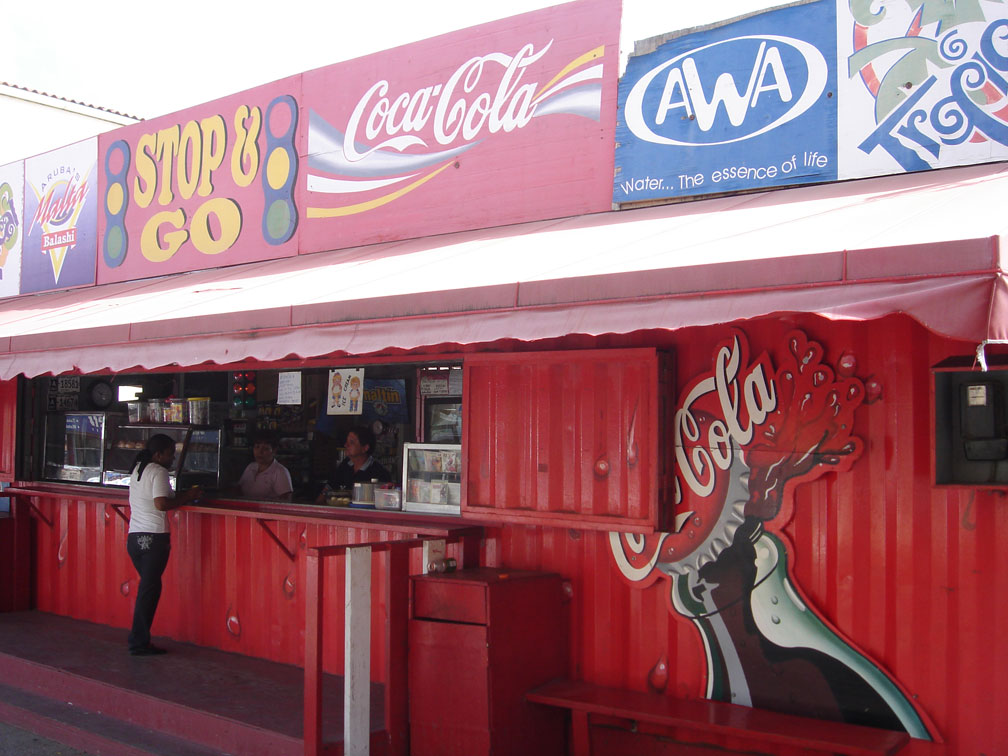
It’s been a while since I wrote a post about Coca-Cola. Therefore, take a look at the Stop & Go snack stand located in Oranjestaad, Aruba.

This place was built using a steel shipping container that normally would be carrying cargo back and forth between someplace else and Aruba. Now it is a great place to stop in for an ice-cold Coca-Cola. They sell other soft drinks, pastechi, as well as other little snacks. It is located behind the Renaissance Mall in downtown Oranjestaad, across the street from Chez Matilde. You can’t miss it.

From time to time, I borrow a table at the various places inside the mall and do some writing there. People passing through serve as inspiration for characters. Then, after I’ve cranked out about two thousand words, I’ll head out to the Stop & Go for a refresco as my Spanish-speaking friends would say. In the heat of the Aruba afternoon, an ice-cold Coca-Cola is just the thing to refresh and renew.

Published in: on August 29, 2008 at 12:13 pm  Leave a Comment  
Tags: , , , , , ,