Island Power, Inverters

The DC/AC inverter is the heart of any off-grid power system with electricity produced by solar and wind. Most small wind turbines and solar panels produce direct current (DC) electricity. However, the electricity you use in your home is alternating current (AC). We won’t bog down here with the details of that. Suffice it to say that you need to convert the DC to AC. The device that does this is called an inverter. The inverter draws power from the wind turbine and solar panels as well as from the batteries in the system. It then delivers it to the system in clean, regulated, AC form. Here’s a look a stack of four inverters as part of a system built by Outback Power.
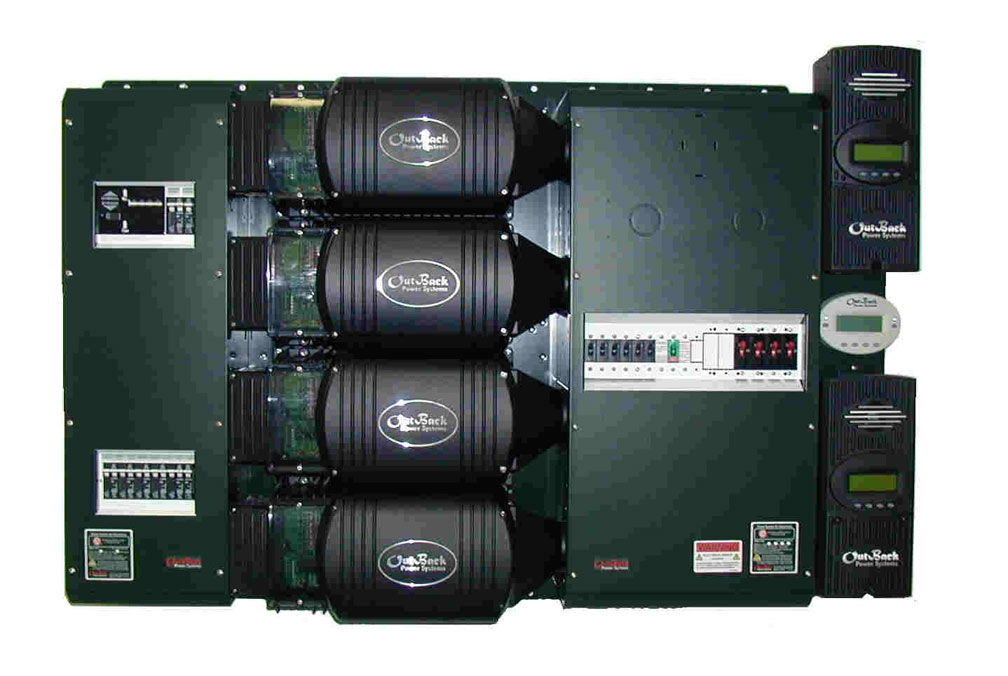
Those four magic block boxes, one on top of each other, are the inverters. Each one of those takes 48 volt DC current and converts it to 120 volt AC current. The output of each one is combined in the adjacent boxes so that you can have both 120 and 240 volts. This system, with its four inverters produces a maximum of 10,000 watts of steady power. It can handle a surge load for a brief period of up to 14,000 watts.

10,000 watts is enough to power my entire house in Aruba, including those two power-hungry air conditioners. I rarely run them at the same time. Nonetheless, I’ve over-sized the system to handle the demand. Over-sizing is the key to happiness with off-grid systems (and pick-up trucks). It is always cheaper to build a larger system at the beginning than to upgrade later.

Lately, these systems have been growing in popularity. Companies like Outback have made them easier to set up, more efficient, and less maintenance intensive. Similarly, contractors have used them in “plug and play” systems that are easy for homeowners to understand. I can’t wait to have mine working and putting the money back into my own pocket instead of paying a utility company.

Published in: on August 31, 2008 at 10:45 am  Leave a Comment  
Tags: , , , , , , ,

Island Energy (Demand) Calculations

We’ve been having fun, traipsing around Aruba, looking at beaches, checking out the sights, dining at all kinds of restaurants. However, having a house here is like having a house most anywhere else in the sense that utilities are a serious issue. The cost of electricity in Aruba is quite high because they burn oil to make it. (I’m not going to get into the politics of this just now. Suffice it to say that I believe in private solutions.)

My original goal for the house was to power the air conditioning system off the grid. Thus, the question, “How much power do I need to produce to get those airco’s off the grid?” The answer follows:

Last year, I installed two brand new split-type air-conditioners. The larger one uses 14.4 amps of power at 220 volts which means approximately 3168 watts. The smaller one uses 12.6 amps at 220 volts, consuming 2772 watts. Add those two together and you end up with at least 5,940 watts. When it comes to power use, I like to round UP. Therefore, at a minimum, I need to produce 6,000 watts of electricity to run both air conditioners at the same time. But wait a minute! When you first turn the airco on, it draws a bit more power to get started. So, let’s set the minimum at 7,000 watts. To correct myself slightly, I need to DELIVER that many watts to keep these unit cranking.

Okay, how am I going to do this? Production will come from a wind turbine and solar panels (photovoltaic). This power will have to be converted from direct current (DC) to alternating current (AC). How is that going to be done? With an INVERTER. What if the wind isn’t blowing and the sun isn’t shining? Electricity will be stored in a BATTERY BANK. How is the battery bank going to be charged? Through the inverter and a CHARGE CONTROLLER.

Are you still with me? I hope so. None of this is as complicated as it sounds and there are some details that aren’t discussed here. (Please, if i made any mistakes, let me know so I can correct them.) You can purchase entire systems that are basically “plug and play.” A qualified electrician can have you up and running in no time.

Now, the next post is going to look at ENERGY PRODUCTION for this system. There will be pictures, too. Remember one thing: Once the system is operating, you get a return on your investment and protection against future price increases. Every time the price of energy goes up, it’s as if you’re saving more. And you are because you have a fixed cost for your system and a little extra for the maintenance.

Enough for now. Stay tuned. And don’t forget that you can control your energy consumption AND production. Don’t let anyone tell you differently. You have to be willing to change a little or a lot depending on your goals. However, you do not have to live in a cave, eating berries.

Island Wind Power, Part 1

I am optimistically titling this post Island Wind Power, Part 1, because I hope to post numerous more times on this subject. Here in Aruba, the trade winds blow just short of constantly. They range from a breeze of about 5 knots to a steady cracking of 30 at times. Nonetheless, the island currently relies on an oil fired electricity plant. Part of this plant has boilers and turbines, the other part is giant reciprocating units (think big diesel engines). To me, this is outrageously foolish. (There is a plan to investigate a wind farm here but it’s moving slower than backwards.)

Anyway, some people have put up small wind mills to generate electricity for their domestic needs. The unit shown below doesn’t look like much, but it is probably in the 500 watt class.

 I’ve seen a bunch of these go up in the last six months. With the price of fuel, it’s no wonder there aren’t more. So, just how much power can this unit provide? Given that the wind in Aruba is steady and strong, the unit probably runs at 90% of it’s output about 80% of the time. Thus, we’re talking about 72% of 500 watts or 360 watts at any given time. Doesn’t sound like much, does it? Well, consider that this is 24 hours a day. (I know it’s an assumption so don’t remind me how this may be inaccurate. We’re making an example to illustrate the point for discussion. Okay?) Then, 360 watts times 24 hours equals 8,640 watts per day. What will that do for your electric bill? Here in Aruba, it will do a lot. That is enough power to run one of my air conditioners about four hours a day which is all I run it in the first place. Given that air conditioning is the single biggest user of power in my house here, it would reduce my electric bill by a significant amount thereby giving me a handsome return on the investment for the wind turbine, and protection against future price increases.

If your eyes haven’t glazed over yet, let me say I’m cutting the cable now so as not to bore you to tears. These posts will take a look at how a system can be put together, one piece at a time, and supply virtually all of a home’s electricity needs off the grid. In Aruba, there is foolish talk that if you put up a windmill the electric company will cut you off the grid. Not true. The electric company does not want your system CONNECTED to the grid and at present this is a good thing. In the first place it is a safety issue to protect the linesmen who must work on the transmission cables. Secondly, every Tom, Dick, and Harry, dumping power into the grid without a standard is bad for the grid. Therefore, as long as your system is COMPLETELY INDEPENDENT of the grid, you’re okay. They will send you a nasty letter, and after your lawyer sends a nasty one back with verification that you’re not connected the story ends there.

But our energy alternatives will continue here, hopefully, because I love the idea of making a reasonable investment, getting a great return, and protecting the environment in the mean time. Power on!