Here it began all those years ago…
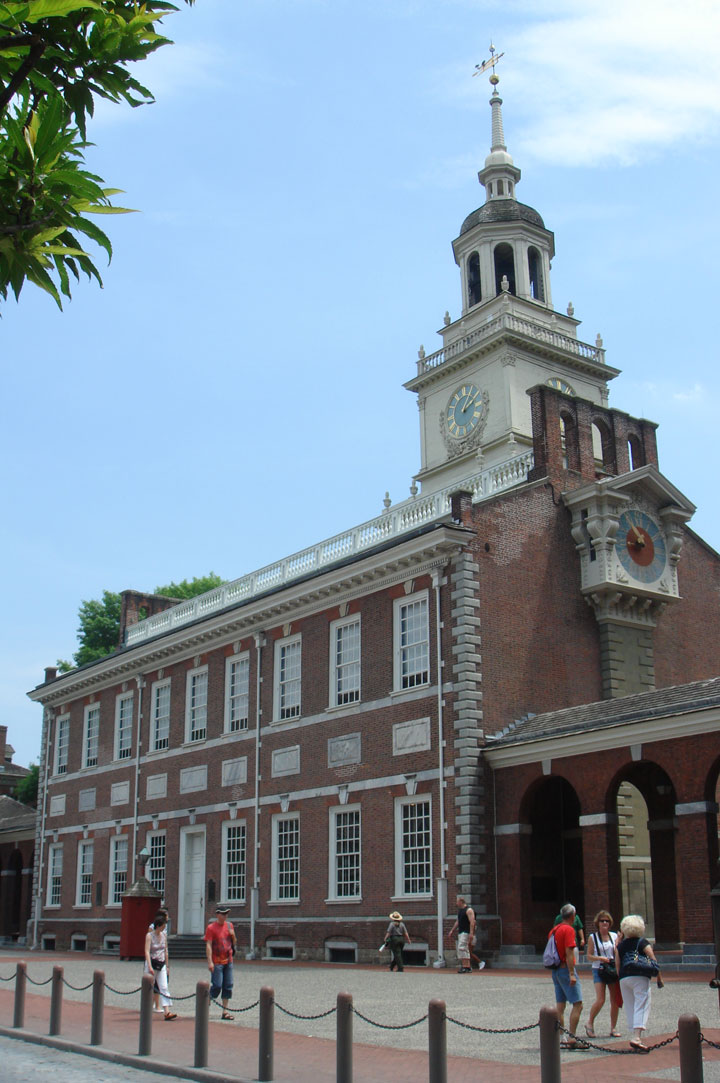
“Talk not to me of your rights until you have first demonstrated your worthiness through great acts of virtuous responsibility,” Preston Sinclair, American.
Here it began all those years ago…
“Talk not to me of your rights until you have first demonstrated your worthiness through great acts of virtuous responsibility,” Preston Sinclair, American.

Here are two more of those panoramic photos, this time from Nome, Alaska, when it was only two months old. They built fast back in those days. I suspect it had something to do with gold. The photos were taken in September of 1899, so the town only started construction in July.

Notice that the saloon is one of the first wooden structures while the living quarters remain tents. Goes to show what was really important and what wasn’t. To think what these people went through is incredible. So many hoped to get rich; so many returned poor. Probably the saloon owners made the most money. It must have been a rambunctious time.
Here’s a look at the waterfront.
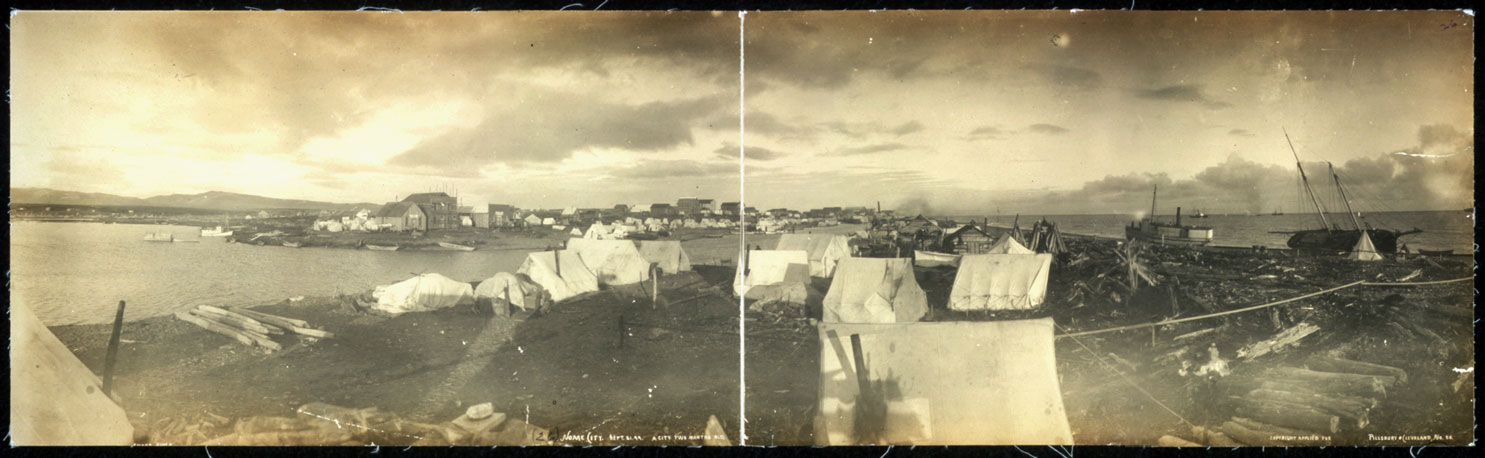
There is a twin masted schooner there on the beach. Maybe she’s up for repairs or just lying there until her owners want to make the next voyage. Sailing her down through the Pacific must have been quite an adventure. Behind her lies a small steam boat. Again, I note the tents. Must have been a muddy mess.
Photos like these bring ideas for stories. Whenever I travel, I look for flea markets, yard sales, things like that, in hopes of finding old photographs. Each one has a story of its own and sometimes the best one is the one not told, that of the person who took the picture. What did they have in mind when they released the shutter? What was their purpose? Why did they find it necessary to take a picture at that moment? Of course, you can never really know. However, you can create answers of your own to those questions. It’s good exercise for the imagination.
These are the kinds of things history shows us. I only hope we learn something from it.
As mentioned earlier, I’ve been researching a novel tentatively titled MacMillan Judge, Privateer. The course of this research has taken me through many volumes, a few trips, and into places that I normally wouldn’t go. It has been quite an education into a subject I knew very little about. I’ve examined the circumstances surrounding privateer activity during the American Revolution and the War of 1812. Originally this story was going to be something akin to a swashbuckler. However, I came to believe that the people who performed heroically during these two wars deserved better. They are entitled to a representative character who upholds the ideals of the new nation as well as his own private convictions as to what it means to command a vessel of war. I say vessel of war as opposed to warship because the privateer typically used a converted merchant ship or one built for speed rather than brute force. Below is a photo courtesy of the United States Federal Government of the Pride of Baltimore, the type of Balitmore Clipper on which MacMillan, Judge will sail.

This is a tricky subject because privateers operate under a letter of marque granted by the government under which they sail. Their activities would normally be considered piracy, but the letter of marque gives them privileges normally reserved for standing navies. A privateer raids merchant ships, attacks other nations’ warships, and shells their land forces. However, in the course of these dangerous forays, any salable goods or vessels captured are subsequently sold and the proceeds go to the privateer. Therein lies the rub: the privateer is a money-making venture as much as it is a military affair.
Of course, when the United States declared independence (and later in the War of 1812), they didn’t have much in the way of a navy. They faced the most powerful naval forces the world had ever seen, those of the British Empire. The solution was to empower private individuals to take great risks in order to create some semblance of a marine force. According to some of the books I’ve read, this was a very effective method. Benjamin Franklin was an investor in a privateer ship during the revolution, as were many others of all walks of life. The privateers racked up a string of victories that would be amazing even by today’s standards. One particular ship captured six vessels in six days right under Britain’s nose in the English Channel. Another privateer sent a letter to Lloyd’s of London, bravely stating that the the British Isles were under his blockade. That’s a bold statement from a man aboard one ship. But the letter was posted at Lloyd’s and insurance rates skyrocketed.
But what about that sticky question of outright profit in the course of the war? Are these people really just pirates by another name? From what I’ve learned I would have to say, no, they are not pirates. Pirates, despite our Disney version of them today, were not the happy go lucky bunch looking for treasure and a cute place to drink rum. Pirates murdered their way around the world until allied forces hunted them down. The American privateers caused their share of casualties and made their profits, but they did not indiscriminately attack neutral ships. At the same time, when the war was over, they ceased their activities and resorted to non-combatant trading.
One way to look at the privateers is to think of their prizes as a method of payment. Instead of receiving a salary, they collected money from successfully attacking the enemies resources. It saved the United States Treasury a bundle and created a number of highly successful businessmen in the process. Many of these people invested their money in the growing economy of the United States, which only furthered progress in a place that was still a backwater when compared to Europe.
I’m looking forward to writing MacMillan Judge, Privateer. Our Mr. Judge is going to be the thinking man’s warrior, not a Disney-fied hero who dodges grapeshot and dances about the deck. First I have to finish Under A Blue Flag, which is the sequel to An Island Away, but that’s another story that I’ll be talking about soon.
As a film student at New York Unviersity’s Tisch School of the Arts, I had the opportunity to live in New York City. Of course, New York offers more chances at success and failure than perhaps any other place in the world (maybe Hong Kong has more of both). This is one of the unique aspects of the place that makes it attractive to people the world over.
Well, a friend of mine graduated from another program at NYU (not film school like me) and went to work for the Waldorf-Astoria Hotel. I went to visit one day and was given a private tour of the kitchens, the ballroom, all the behind the scenes stuff that goes on at a hotel. There’s plenty the guest never sees and that may be a good thing. By this time, I was writing steadily and one of the places I used to write was at a table in the Park Avenue Lobby. This area was called the Cocktail Terrace. Here’s what it currently looks like:
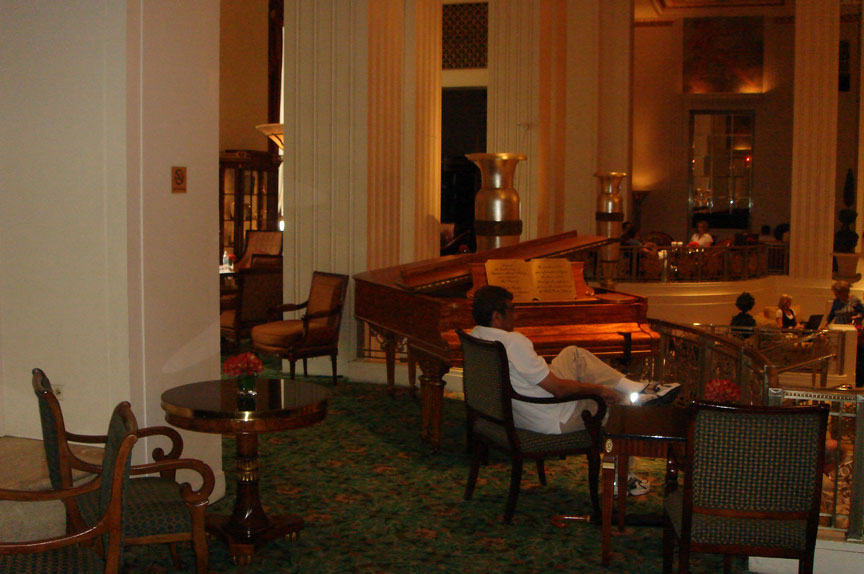
Not the greatest photo but the little round table there to the left of where that man is sitting used to be my regular spot. I was not yet twenty years old, but had a few decent suits and would put one on and go up town with my notebook and pen to scribble as long as the words kept coming. That piano in the frame was given to Cole Porter who used to have it in his suite. There was drink service and I consumed my share of Maker’s Bourbon and club soda at that table. A waitress named Gretchen used to enjoy the bits of stories I told her.
Here’s a longer view of the terrace:

The bar used to be in the back there. One of the fun things about sitting here was all the people watching. Well known people and strangers alike would come up those stairs from the Park Avenue entrance. It was possible to watch them without them watching you. Some of the things that happened after midnight were highly entertaining, if not a bit unnerving.
On the floor in the middle of this space is the Wheel of Life Mosaic, which was actually covered up for many years, until the entire hotel was remodeled in the middle 1980’s. Here’s a look at it:
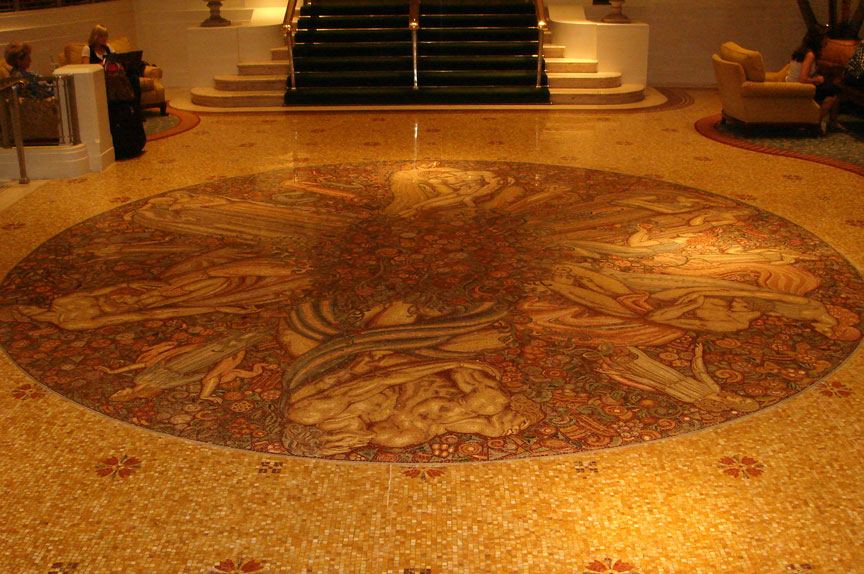
It is worth a visit if you’re passing through town, especially given that many of the old style hotels like the Waldorf are going modern and losing this kind of older elegance. Some of them have become condominiums so they’re basically private residences.
For many years my mother was a florist and she loved to look at the flower arrangements in the big hotels. Here’s a look at what the Waldorf put on the day I took this photos:

Yes, they’re real and fresh and updated constantly. One more reason to pass through this lobby on your way through New York.
I’m grateful to my friend for allowing me to pass many nights at the Cocktail Terrace, and also to the management who never seemed to mind that I was there with my pen and paper. The stories I wrote here have yet to make it into print. They’re stashed away in a stack of scrawled notes. There’s some gems in there, I just have to make the time to mine them out.
Do you have a favorite lobby? Perhaps another space where you think or write or create? Let me know.
 The Bent Page
You must be logged in to post a comment.