I am optimistically titling this post Island Wind Power, Part 1, because I hope to post numerous more times on this subject. Here in Aruba, the trade winds blow just short of constantly. They range from a breeze of about 5 knots to a steady cracking of 30 at times. Nonetheless, the island currently relies on an oil fired electricity plant. Part of this plant has boilers and turbines, the other part is giant reciprocating units (think big diesel engines). To me, this is outrageously foolish. (There is a plan to investigate a wind farm here but it’s moving slower than backwards.)
Anyway, some people have put up small wind mills to generate electricity for their domestic needs. The unit shown below doesn’t look like much, but it is probably in the 500 watt class.
 I’ve seen a bunch of these go up in the last six months. With the price of fuel, it’s no wonder there aren’t more. So, just how much power can this unit provide? Given that the wind in Aruba is steady and strong, the unit probably runs at 90% of it’s output about 80% of the time. Thus, we’re talking about 72% of 500 watts or 360 watts at any given time. Doesn’t sound like much, does it? Well, consider that this is 24 hours a day. (I know it’s an assumption so don’t remind me how this may be inaccurate. We’re making an example to illustrate the point for discussion. Okay?) Then, 360 watts times 24 hours equals 8,640 watts per day. What will that do for your electric bill? Here in Aruba, it will do a lot. That is enough power to run one of my air conditioners about four hours a day which is all I run it in the first place. Given that air conditioning is the single biggest user of power in my house here, it would reduce my electric bill by a significant amount thereby giving me a handsome return on the investment for the wind turbine, and protection against future price increases.
If your eyes haven’t glazed over yet, let me say I’m cutting the cable now so as not to bore you to tears. These posts will take a look at how a system can be put together, one piece at a time, and supply virtually all of a home’s electricity needs off the grid. In Aruba, there is foolish talk that if you put up a windmill the electric company will cut you off the grid. Not true. The electric company does not want your system CONNECTED to the grid and at present this is a good thing. In the first place it is a safety issue to protect the linesmen who must work on the transmission cables. Secondly, every Tom, Dick, and Harry, dumping power into the grid without a standard is bad for the grid. Therefore, as long as your system is COMPLETELY INDEPENDENT of the grid, you’re okay. They will send you a nasty letter, and after your lawyer sends a nasty one back with verification that you’re not connected the story ends there.
But our energy alternatives will continue here, hopefully, because I love the idea of making a reasonable investment, getting a great return, and protecting the environment in the mean time. Power on!
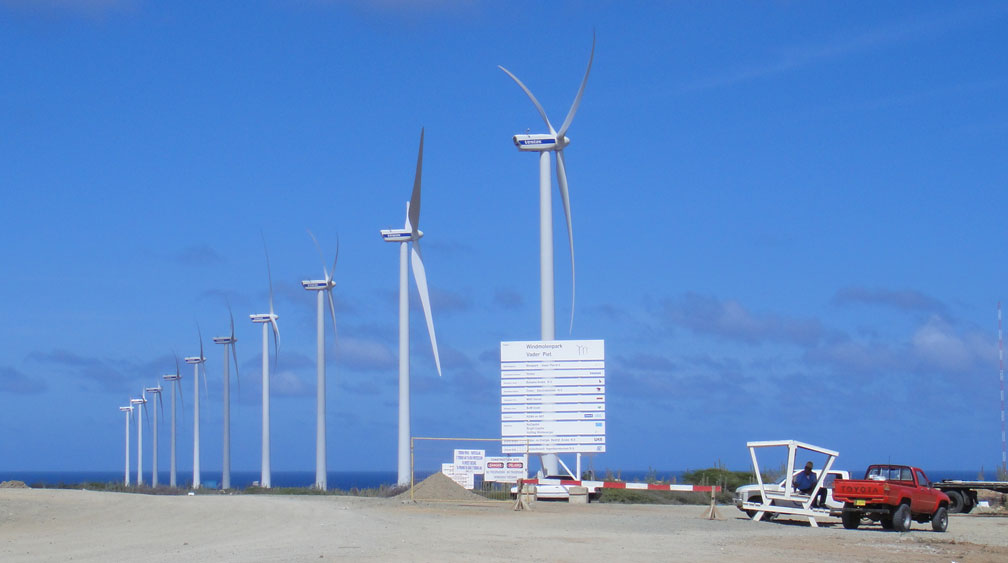 Tour buses now take visitors past this area, as do the private guides. It’s worth a look. These units hardly make a sound and yet they produce a handsome amount of electricity.
 To grasp the scale of these units, consider them beside that Toyota Yaris parked along side the truck. The next photo shows the base into which fits the tower and the nacelle which houses the generating unit.
 Finally, you can now see one wind turbine completely assembled and the next one in progress.
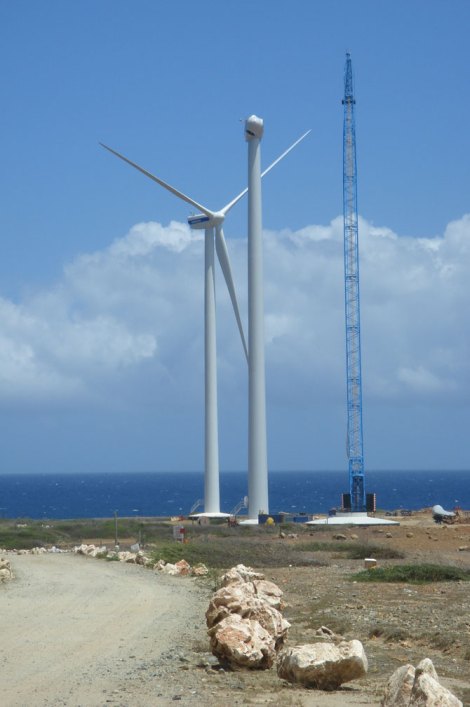 Let’s have one more look at that, shall we?
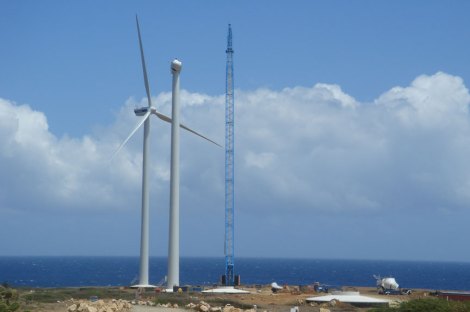 Reports indicate this facility will be producing energy in January 2010. I hope so. The wind blows strong in Aruba. No reason not to make some electricity. Why not built another ten or twenty or thirty?
 Then a cage of rebar is set up like this:
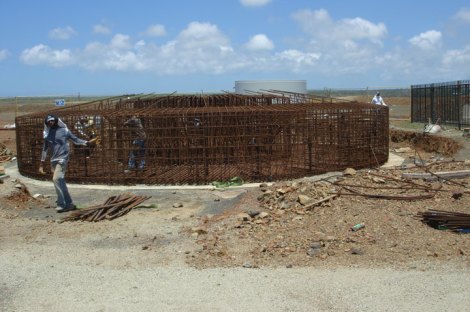 With the man standing on the left in the photo above, you get a sense of the scale of this structure. Finally, the concrete is poured around the rebar to complete the base, which looks like this:
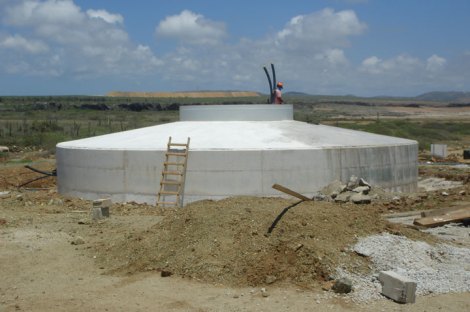 Soon there will be towers standing atop these bases. Then will come the turbines themselves with their massive blades turning in the wind.
 The Bent Page
You must be logged in to post a comment.