A View of the Battery and Beyond

I posted those other photos of New York City, the ones of Grand Central and such. I couldn’t resist this one, taken in 1902 looking at New York Harbor from the end of Manhattan. There are so many details in this photo that it would take hours to catalog them all. First, take a look at the image.
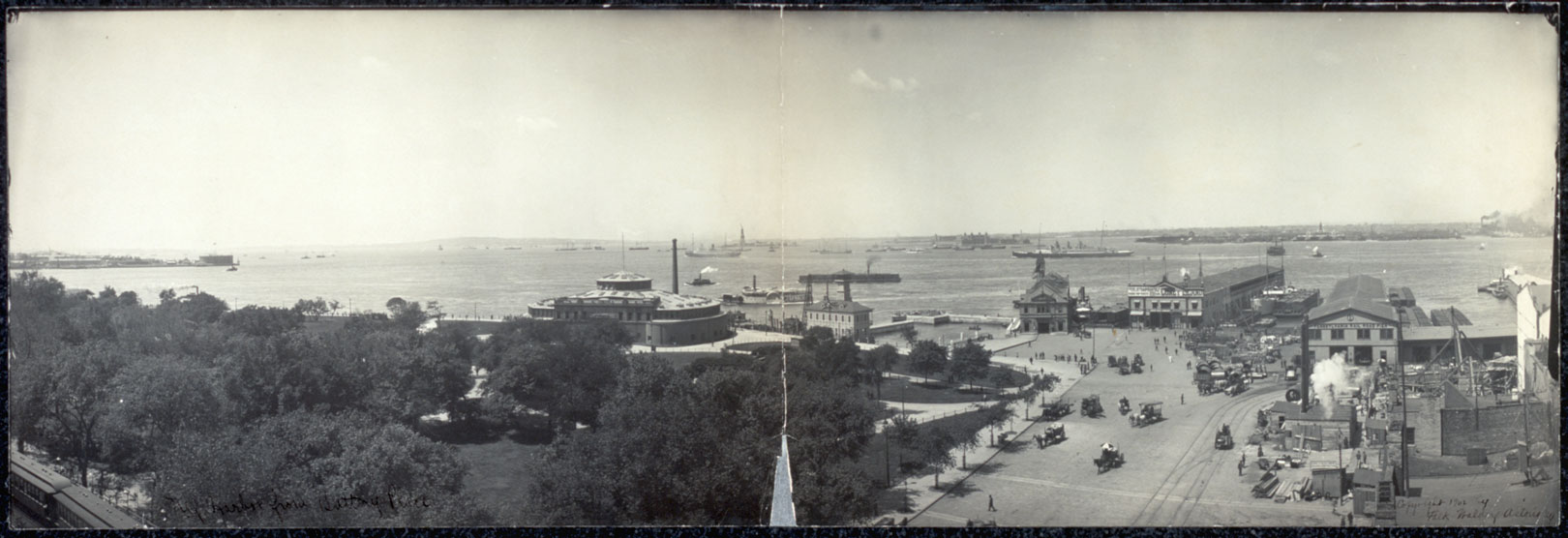
Of course the Battery, is just left of center. Beyond the Battery is the Statue of Liberty. Turning to the right, you’ll see Ellis Island. Between the Battery and the Statue of Liberty, note the tugboat steaming along, towing a barge just behind it. In the foreground you see terminals for ferries going to Coney Island and Staten Island. Then there is the warehouse-like structure for the Pennsylvania Railroad. The park leading up to the Battery looks immaculate, as do those carriages on the wide boulevard that fronts it.

This must have been quite a time in New York. Things have changed but the Battery is still there. Ellis Island is now a tourist attraction. The Statue of Liberty is ringed with security.

I remember during my first few weeks of film school at New York University, I was given an assignment to take documentary photographs of a permanent structure. I trotted from Washington Square to the World Trade Center, camera and tripod in tow. I set up at the edge of the plaza and took a 360 degree panorama of the scene. I didn’t realize it at the time but I captured the completion of the World Financial Center, which is built on land that did not exist when the photo above was taken. The trailers from the construction companies were still there but this was the very end of the job. After the events of that fateful September, I found this series of photos on my shelves. The negatives (this was in the days of film) are in good condition. I’ll have to find a lab to make the prints and stitch that photo together again. It’ll feel the same as looking at the above photo, and yet it’s only twenty two years later.

Panama Canal, Work in Progress

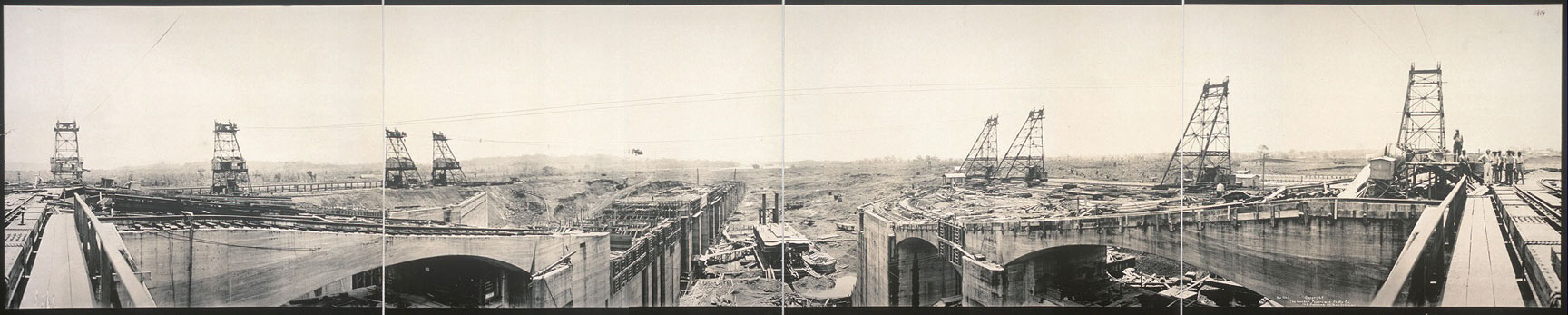
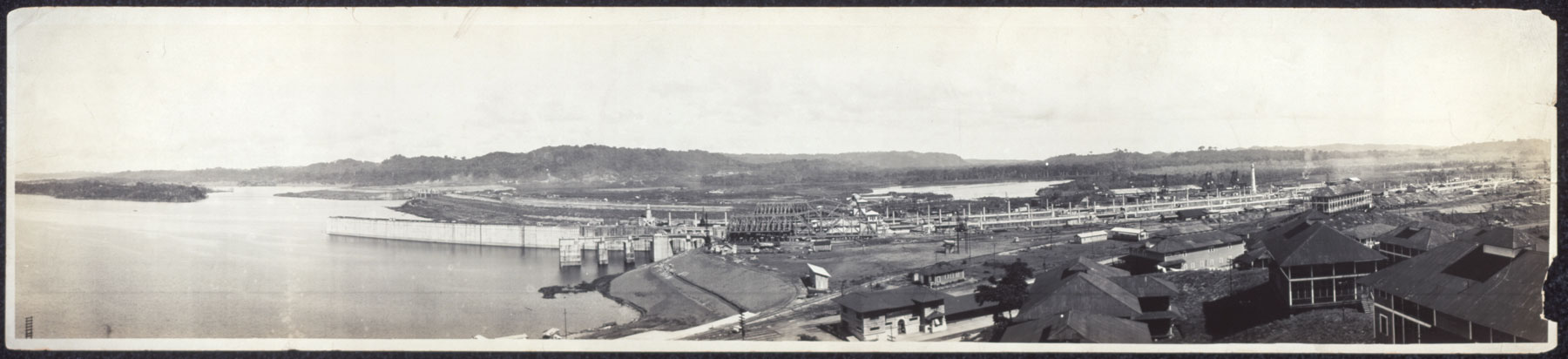
Cruise ship travelers may enjoy these photos of the Panama Canal in various stages of construction. I tried to select the most interesting ones from the United States Library of Congress archive. Building the canal was no easy project, which is probably the second greatest understatement of this blog. Oh, well, a trench was dug, locks built, equipment installed, and today millions of tons of cargo pass through along with pleasure vessels. The photos in the post were taken in 1913 and 1914.

Below is the Culebra Cut. Check out those steam shoves digging away:

If you look along the top edge of the photo, you can almost see how unstable the soil is. There were numerous landslides that ruined equipment and killed workers as the project progressed. The next photo is a look down at the Gatun Locks, north approach.

That’s a massive set of concrete walls in there. If you look carefully on the far right side of the photo, you’ll see a knot of men, probably curious as to how the photographer was creating this picture. To get a sense of scale for these locks, take a look at the Miraflores Locks at the lower level below:

The locks seem to go on forever. Note the railcars on the left, with tracks built right to the job site. Another point to remember is that the size of battleships was limited to the width of the locks in the Panama Canal. This way, they would be able to go from the Atlantic to the Pacific in the event they were needed in one hemisphere or the other.

Finally, here is a look at the approach to the first lock.

I have yet to traverse the Panama Canal. I missed a chance some years ago. A friend was relocating a tugboat from the West Coast of the United States to Philadelphia. I wish I would have made that journey.  Given the international traffic through Panama, it is the type of place (as Casablanca used to be) that is the perfect setting for intriguing stories. Plus, there is the possibility of escape or capture aboard a departing vessel, exciting chases through jungles, along rail lines, and through crowded towns. Then there is the climate, raining, tropical, vibrant. You never know. I’ve added Panama to my list of locations for the future.

I’d like to hear from cruise ship passengers who have been through recently. It would be something to notice the differences in things. Don’t hesitate to post comments. Thanks!

Published in: on July 6, 2008 at 3:08 pm  Comments (3)  
Tags: , , , , , , ,

Stories in Glass

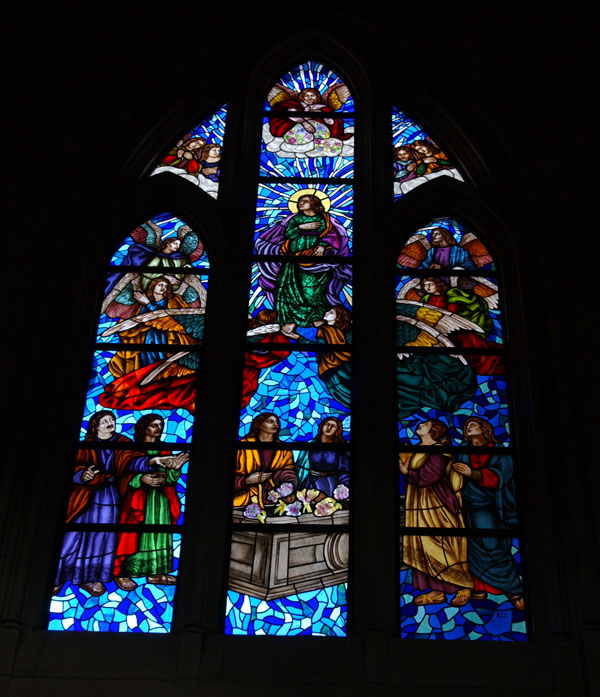
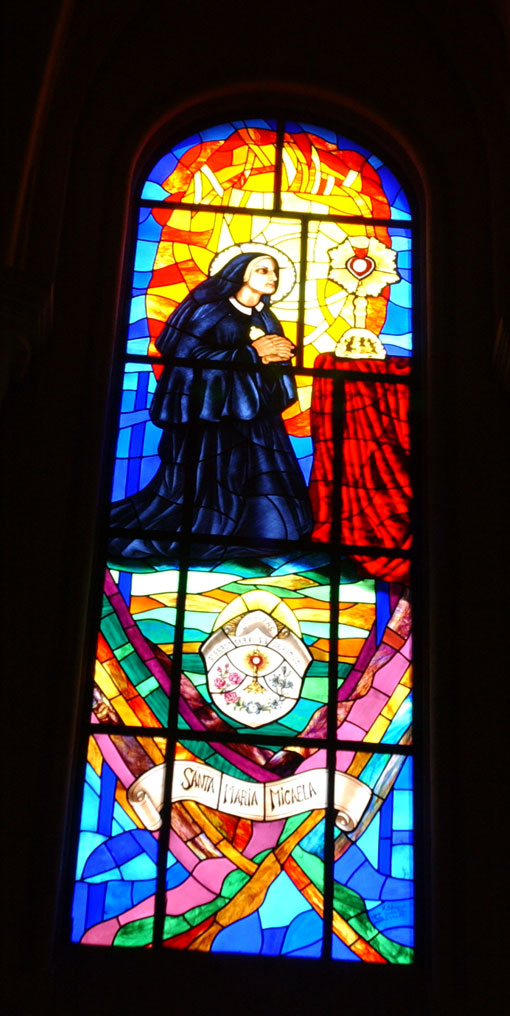
There are many ways to tell a story. There are books, movies, and songs to name a few. There’s also the sculptures and reliefs found in plazas and on the facades of various buildings. And then there is the stained glass of churches. I’m particularly fond of this last one. As mentioned in an earlier post, the right atmosphere greatly enhances a story. Stained glass windows create all sorts of atmosphere from both the inside and the outside. The windows pictured below are from the Cathedral of Almudena, Madrid, Spain.

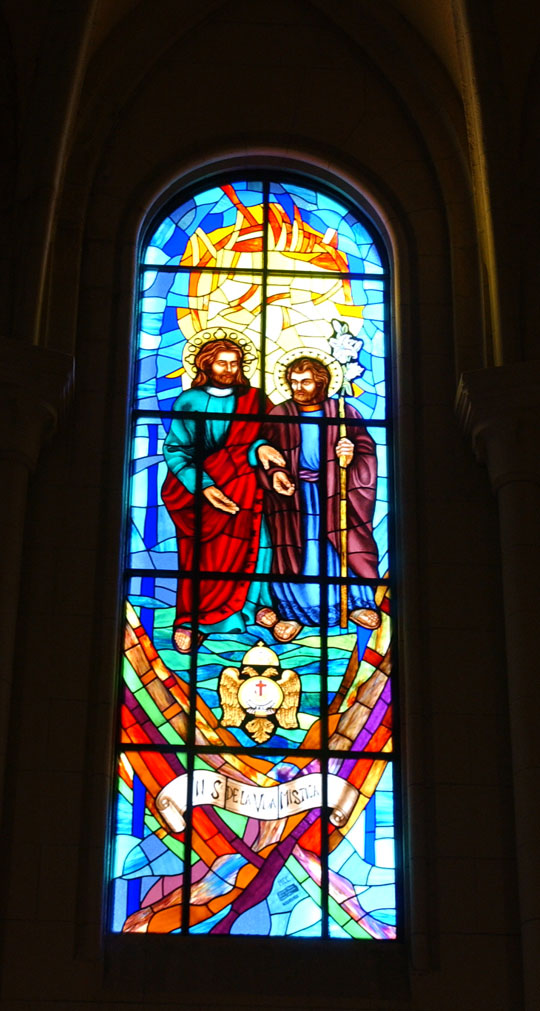
These windows are more modern than those found in say the Cathedral of Seville. The colors are more vivid, the individual pieces larger. Naturally, more light comes through. This colored light pools on the floor, spreads over the walls, and is unable to be avoided when inside the building. Then, at night, the windows shine outward so that a passerby sees the same scene from the other side thanks to internal illumination. Here’s another window:

 Of course, each window illustrates a scene from a Biblical story, informing the congregation about their faith. It may be hard to imagine a largely illiterate population relying on scenes such as this to access ecclesiastical knowledge. Nonetheless, this method was largely employed and can still be effective.

I’ve also seen stained glass windows with elaborate script at the base mentioning the particular person or organization who sponsored it. Thus, an opportunity to support the church and attain a sort of immortality.

One more window to gaze upon in this post:

While in Cordoba, Spain, I came across a school of the practical arts. Sorry, but I can’t remember the exact name. One of the trades taught at this school was the making of stained glass windows. Fortunately there are people who study and practice this art, going on to become master craftsmen who not only provide a barrier between the elements and us, but also a beautiful cultural expression that lasts for generations if not centuries.

So, when you find yourself on a travel adventure, don’t forget to slow down and let the different elements come to you one at a time. Your experience will be that much more interesting and fulfilling.

Published in: on July 6, 2008 at 12:18 pm  Leave a Comment  
Tags: , , , , , , , , , , ,