Ready for the Roof

Now that the foundation and walls have gone up, we’re ready to frame out the roof. Since you don’t have to worry about the snow load in Aruba, the framing is a bit lighter. My own house is framed lighter than I prefer, but it’s been on the house for over 20 years without a problem (wood knocking sounds) so I’m going to leave well enough alone. Just the same, these photos will go on to show clay tile roofs that are built to newer, and better, standards. Here’s a house with the cross members in place.

That V shape looks like the man is ready to put a dormer in there or something which would add some character to the house. Either way, this is a good start. Some roofs are built with internal trusses that allow for a cathedral ceiling inside, such as this one.
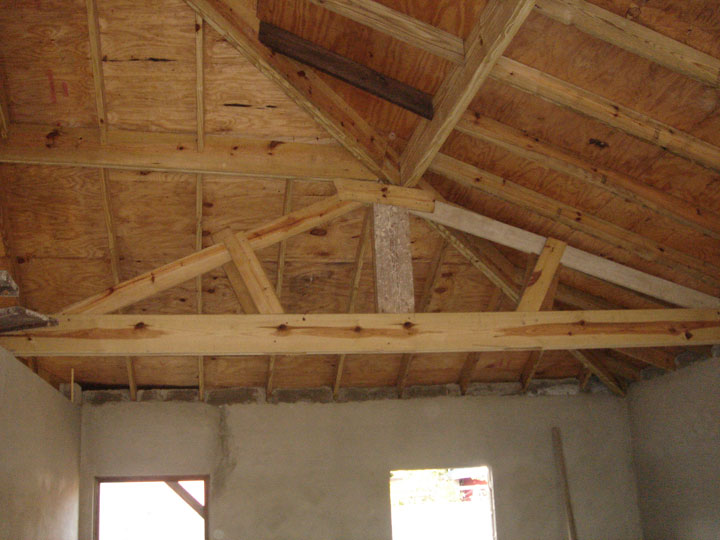
Do some finish work on that and stain it nice and you’d have a great feature on the inside. On the outside, the cross members are covered with plywood, then tar paper, and then the slats that accept the tiles, as shown in the next photo.
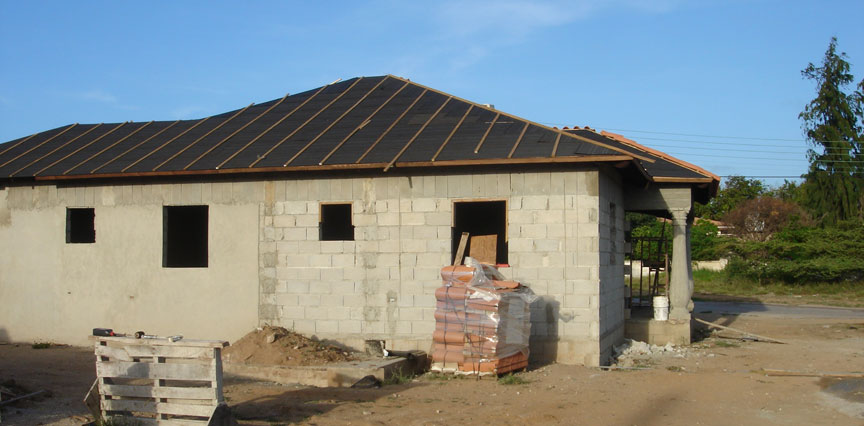
The roof is all ready to go. Here’s a closer look at those tiles.
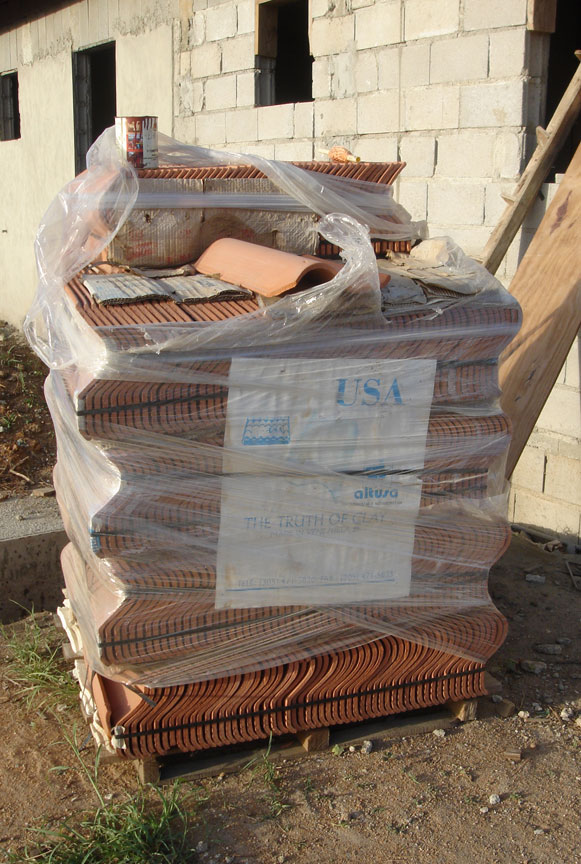
 I’m a big proponent of clay tiles as a roofing material. They’re durable, reflect the heat, low maintenance, and look great. Some houses in Aruba have switched to asphalt shingles. I don’t think this is a wise move. The sun here is brutal and those shingles may be cheaper but there’s no way they’re going to stand up to sun. You’ll be replacing them or dealing with leaks.

In the next post, I’ll show a couple of roofs with different styles of tiles just for fun.

Published in: on July 19, 2008 at 11:26 pm  Comments (1)  
Tags: , , , , , , ,

The Ring Beam

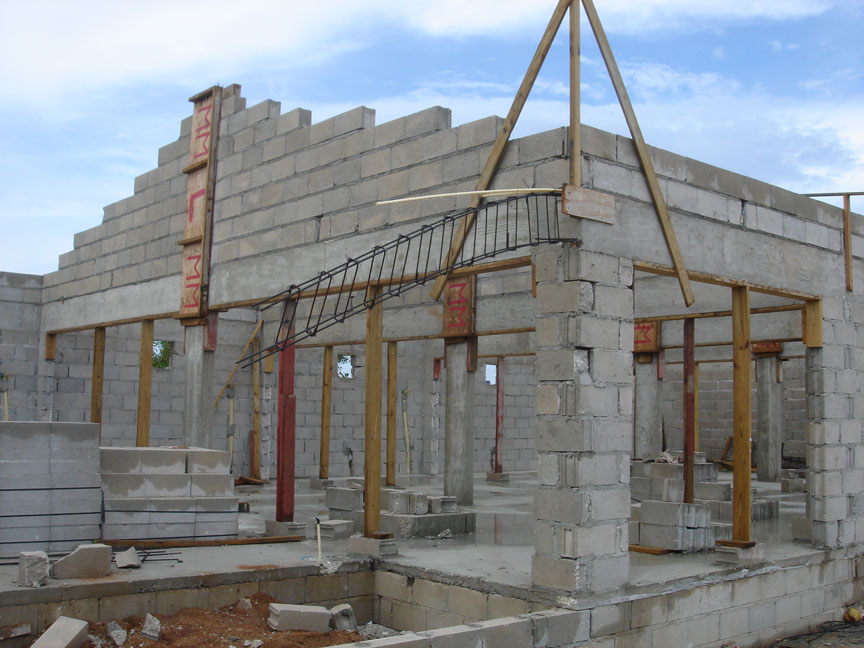
Continuing with my Island Practical series about home construction in Aruba, we’re now to the point where the “ring beam” is poured. The Aruban Department of Works has a standard for the dimensions of the beam and the reinforcing steel to be used in it. Again, make sure your plans comply with these regulations. Here’s a photo that shows the ring beam poured as well as some steel hanging out from one side.

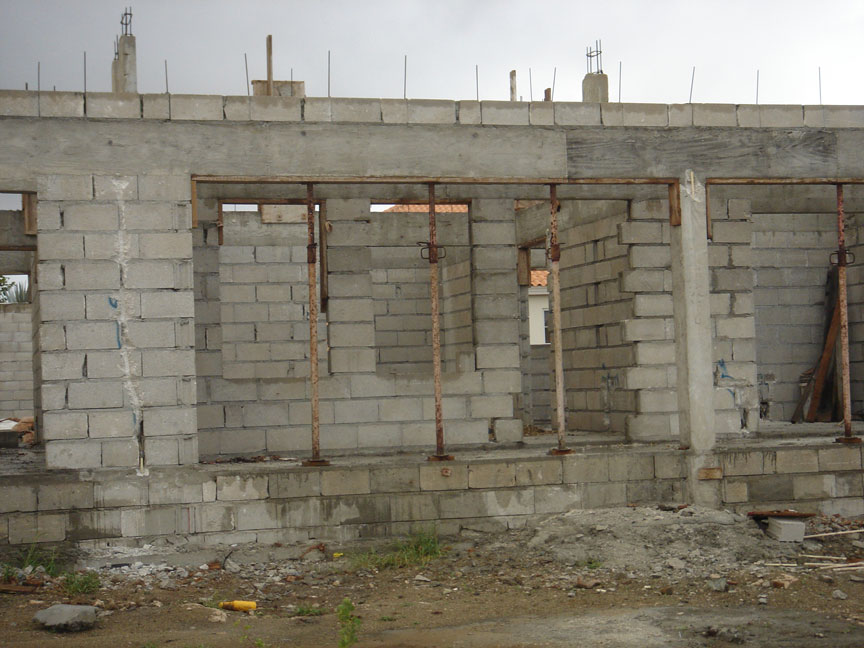
It’s not a good idea to leave the steel hanging like that. Better to brace it and keep it in shape. You can see the various vertical braces holding up the poured sections throughout this structure. The ring beam serves to tie the walls and columns together into a single unit that is stronger than if they were separate. There is very little seismic activity (earthquakes) in Aruba, but every once in a while things get a little shake. The ring beam, hopefully, will keep things from tumbling. Here’s another look.

This time, metal jack stands have been used. I like those things, they’re strong, easily adjusted, and can be reused almost for forever. In this photo, you’ll also note the rebar sticking up from the beam. The roof joists can be tied down to the ring beam which reduces the lifting action of the wind as it swirls around the eaves. In a storm, this is a critical function. If not, your roof lifts off and you’re on your way to the Yellow Brick Road. Not good.

Next we’ll take a look at the roof itself.

Published in: on July 19, 2008 at 6:52 pm  Leave a Comment  
Tags: , , , , , , ,

Island Practical, Home Construction

This is post Number 100, and we’re clipping right along. Since I’m still in Aruba, I’ll stay with the theme of the island. Today and tomorrow’s posts will be mostly those about building a house and a few other practical issues here. Many people ask me about building and owning a house on the island. I’m hoping these next few posts will provide many answers as well as inspire a few questions.

Here in Aruba, the building material of choice for most new homes is the concrete masonry unit, commonly referred to as the cement block. The ones shown below are solid, but the hollow core blocks are also manufactured on the island.

 For building foundations and walls in the United States, I would normally use hollow core blocks, employing the “dry stack” method. This method does not require as much skill as mortaring the joints. When the wall is stacked, lengths of reinforcing steel are inserted into the cores of the blocks and then concrete is poured in. When the concrete hardens the wall is a monolithic structure that is much stronger than one with mortared joints. Nonetheless, the blocks produced in Aruba and the people who work with them are not as familiar with this method. And so, we use solid blocks for the most part. They’re easier to cut and more forgiving as the mortar joint enables more space for leveling each course.

Thus, the foundation of a house in Aruba is typically laid out according to the wall plan. The footer traces the wall plan, usually about 20″ below grade. Then the first layers of blocks are built up over the footer to a foot or so above grade. It looks like this when finished.

Dirt or stone fills in the spaces between the walls. In the end these spaces will be covered with a poured concrete floor. Aruba has a standard for the footers and be sure to consult your local engineer before putting any concrete into the ground.

Once the foundations have hardened, you’re ready to get some walls up. At this point, you’re using all the common techniques found the world over when it comes to laying block and framing window and door spaces. It looks something like this.

Take a gander at those rebar cages on the left side of the frame. There’s going to be a poured column there, which is formed up conventionally, like this:

Note that the floor has been poured but a ramp stands where steps will be placed.  Take the forms off, and it should looks something like this.

 The rebar sticking out of the top will be tied in to the ring beam which will be part of the discussion in the next post.

Well, this has been a first look at home construction here in Aruba. If you’re thinking about building a new home, this is the most common method by which it will be built. The concrete blocks and form work give you plenty of options, allow for open spans (if engineered properly), and can last for many years with a minimum of maintenance. Maintenance is another subject for about 50 posts, but we’ll leave that to some other time. Not very exciting.

So far, so good.

Published in: on July 19, 2008 at 1:57 pm  Leave a Comment  
Tags: , , , , , , ,