Coca-Cola Corner

Here’s a photo from a corner in Slatington, Pennsylvania, USA. I’m not sure what the name of this place is, either Kurt’s Korner or Homeslate Sports Bar. Kurt’s has the sign above, but Homeslate shows up on the Coca-Cola painting on the wall.
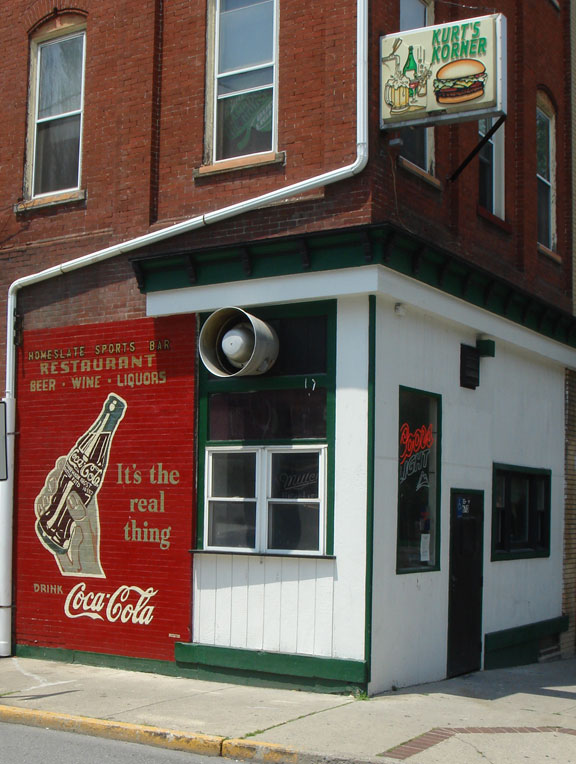
Doesn’t matter. I’ve driven past this place about three hundred thousand times in my life. Okay, not that many but I grew up a couple of towns away and this place was frequently on my route to somewhere else, especially when fuel was cheap. Ah, those were the days, sometimes.

As might be gleaned from the name of the town, Slatington was once surrounded by slate quarries. It was a prosperous business for a while, especially before the advent of asphalt shingles. All those roofs of a  growing America needed something to keep the rain off of our ancestors. Of course, nothing lasts forever. The slate pits filled with water after they were abandoned.

I’ve been known to crisscross the northeast United States in search of such places. Sometimes I find people who were alive during the glory days of these old-time industries. They love to chat about the past. Often times they explain unique solutions to everyday living that were actually commonplace in an age before computers and modern appliances.

As mentioned before, I’m going to start photographing these people and writing down as much of what I learn from them as is practical. At the moment, I can’t remember where, but various historians are taking oral histories from people in order to build a record of the past that is from many more first-hand sources. It seems like I’m duplicating their efforts. Nonetheless, why not? In the first place, those who have gone before me deserve a record of their accomplishments. Second, who knows what comes of such writing? I remember my early days in Aruba. Plenty of people told me stories about the island and their lives. Then, some years later, I was writing An Island Away. If not for the people I met there, the story would never have come about.

Just like the Coca-Cola tagline, my thinking is that life… “It’s the real thing.”

Working on the Railroad

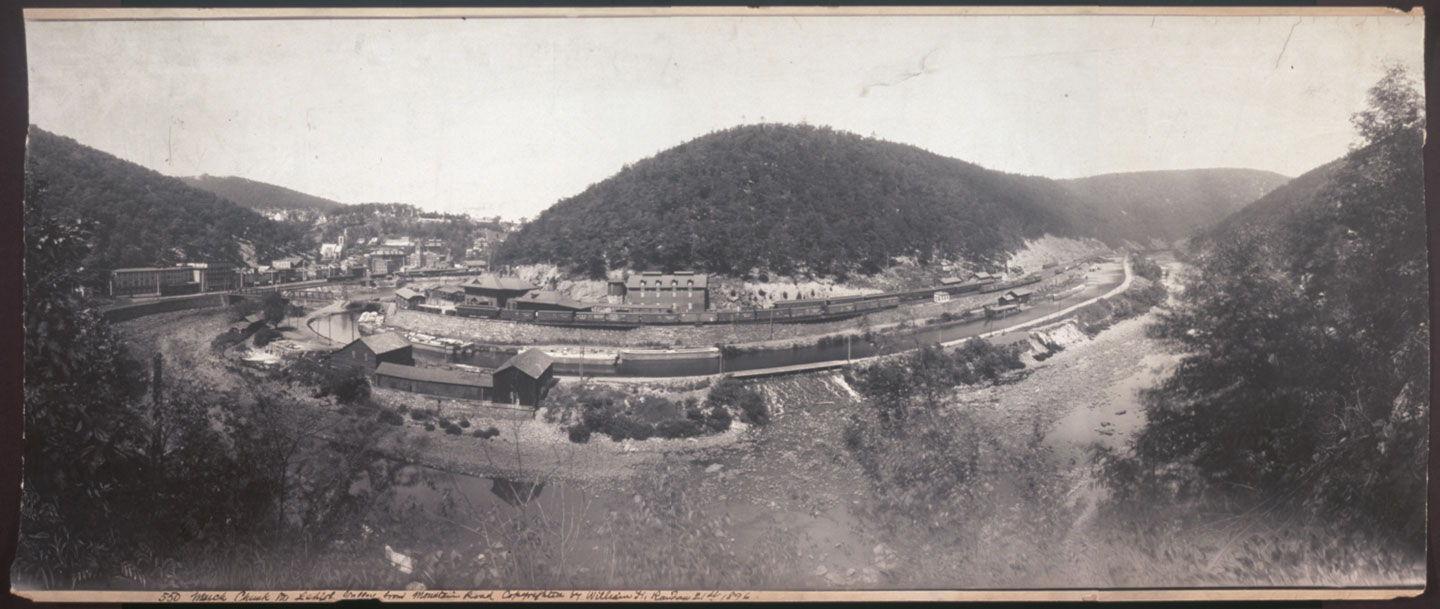
In the previous post, I mentioned my short story Big Iron Holiday. It takes place in December of 1918, just after the end of World War I. Thanks to another blog, I found a link to the Library of Congress site, which has now digitized a number of panoramic photographs. I found these two that were relevant to the story. The first one shows Mauch Chunk, PA, USA, which is just up the tracks from the Central Lunch shown in the previous post. The town is now called Jim Thorpe, named after the famous athlete. This view shows the railroad tracks, canal, and a little piece of the town. If you look closely, you can see the clock tower on the courthouse, the same courthouse where the Molly Maguires were convicted. (Sean Connery was in the movie of the same name for those who remember.)

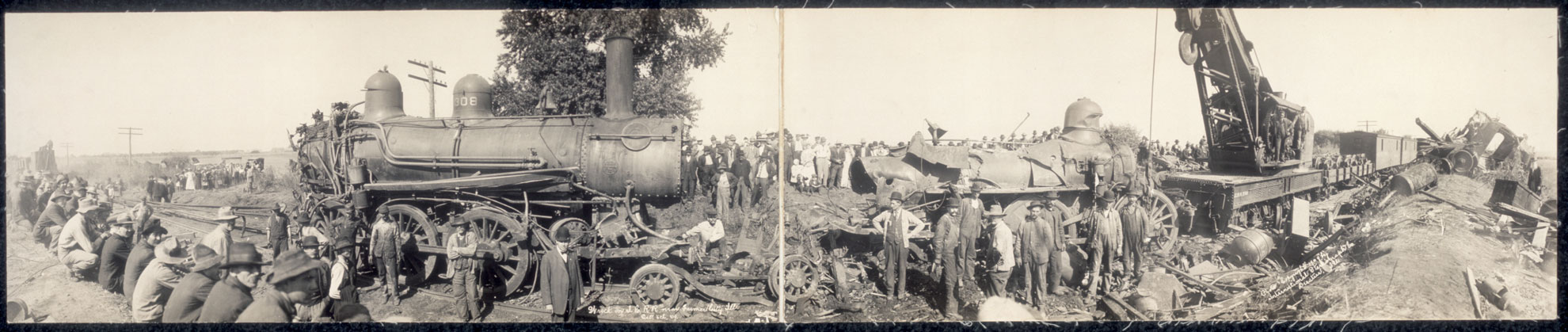
The next photo is not from Pennsylvania, but it does show a train wreck and the salvage crew at work. This is the type of job supervised by the character Ellsworth Botcher.

This was quite a violent wreck. The locomotive on the right side of the frame has its cab crushed. No doubt the engineer did not survive. Luckily, it appears that nothing exploded. Steam explosions are among the worst.

People forget how many train wrecks there used to be as well as how many people died in them. These days it’s more likely that a plane crash makes the news. However, in general, traveling is a thousand times more safe than it was in the days of Ellsworth Botcher and his pal, Ned Fry. Nonetheless, be careful out there. Or there will be a crowd around like this one shown below:

Another big THANK YOU to the Library of Congress for keeping track of all the books, photos, and paperwork that they do. If I worked there, I would never leave.

The Central Lunch

One of the places I remember visiting with my grandfather (the one who worked for Coca-Cola) was the Central Lunch. This little restaurant is located in Weissport, Pennsylvania, USA. In the photo below, you can see the place has recently been painted.

It sits beside the railroad tracks, serving quick meals to whoever happens to pass by. Originally there was a set of double tracks here. The line belonged to the New Jersey Central. On the other side of the building, out of view, is what remains of the Lehigh Canal. Both the canal and the railroad were instrumental in transporting anthracite coal which originated just north of this spot to Philadelphia, New York, and beyond. In those days there was also a fast steam train known as the Black Diamond that ran from Mauch Chunk (now called Jim Thrope, PA) to New York City. It provided regular service for the mine owners to meet the financiers of Wall Street.

In my short story titled Big Iron Holiday, two friends used to race each other along the tow path of the canal. The winner had to buy the other a slice of pie at the Central Lunch. Well, in the story, they are now adults, and the year is 1918. Ellsworth (“E.L.”) Botcher works for the railroad as the superintendent of a wreck crew. His pal Edward (Ned) Fry joined up with some other Americans to become a pilot during the First World War. As the story opens, it is Christmas Eve, the war is over, and Ellsworth is returning from a job with his crew. As they approach the Lehigh Water Gap he spots an airplane. Sure enough, it is Ned Fry, always a crafty character. And so, it is the iron horse versus the flying machine as they race yet again to the Central Lunch, just ten miles up the tracks, on the evening before Christmas.

I’ll have to figure out how to post longer entries like Big Iron Holiday. Then I’ll put it up for all to read. Ultimately, I’d like to turn this story into a book about these two men. Something like… Ellsworth climbs through the ranks of the railroad. Ned ends up flying airplanes for Hollywood and performing other crazy stunts. Ellsworth deals with the tragedy of train wrecks and boiler explosions, witnessing the death of a young protege that leaves him bitter but determined to press on as America becomes an industrial giant. Ned suffers his own losses as the movie business uses his talent but denies him stardom. The novel would culminate in World War II, D-Day, when both of them are much older men. Ellsworth, now a powerful railroader, helps organize logistics for Eisenhower. Ned begs him to use his influence to get him a spot in a fighter squadron. But they’re both too old, and too valuable, to be placed in such danger. They have to face the reality that their days of glory are behind them and that younger men are not only capable, but willing, to do the hard and bloody work of defending a nation.

All this from a stop at the Central Lunch. You never know where a good story will pop up.

Numbered Days

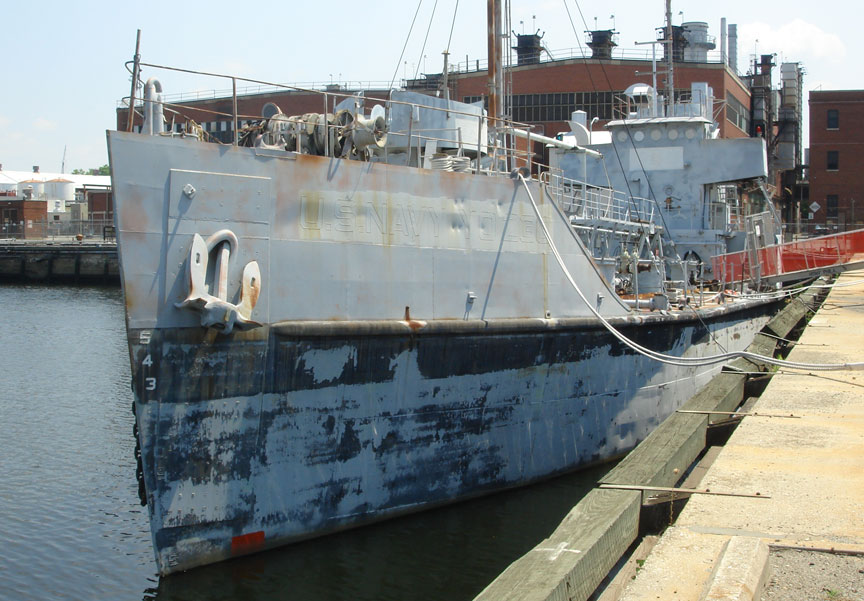
For the ships in the back basin at what remains of the Philadelphia Navy Yard, the days are numbered. These vessels are on the inactive list and subject to sale, scrapping, or another fate, that of an artificial reef. Before I became a novelist full time, I used to sink ships to build artificial reefs. Yes, it’s a long story from there to here. Anyway, I sank several small tankers like the one pictured below.

This little tanker is what the navy used to call a “yard oiler.” It carried fuel of various types to top off ships or other floating equipment. They were mostly built in 1944 and saw limited service until the end of World War II. In the end, they landed in places like this, moving no further than up and down with the tide. I sank three of these off the coast of New Jersey. They became great dive and fishing sites. However, it was a sad sight, watching them sink. Anyone who has lived and worked aboard a sea-going vessel knows that you become attached to your boat. You learn its foibles, the noises it makes, the noises it doesn’t make, and just where you fit in among its bulkheads. Thus, when you know all hope is lost and it’s destined for the bottom, you can’t help but feel a sadness others might not appreciate. Imagine your house, your job, your car, and all the times you’ve spent there, everything… disappearing in a matter of minutes, never to be seen again, except by the fish and the occasional scuba diver. There’s no rebuilding, as in the case of a hurricane or a tornado that knocked your house down. This was your boat, the specific one you knew. Gone.

Nonetheless, the fish need houses, too, and if the vessel is destined for nothing better than the scrappers, better it finds a home among the creatures of the sea.

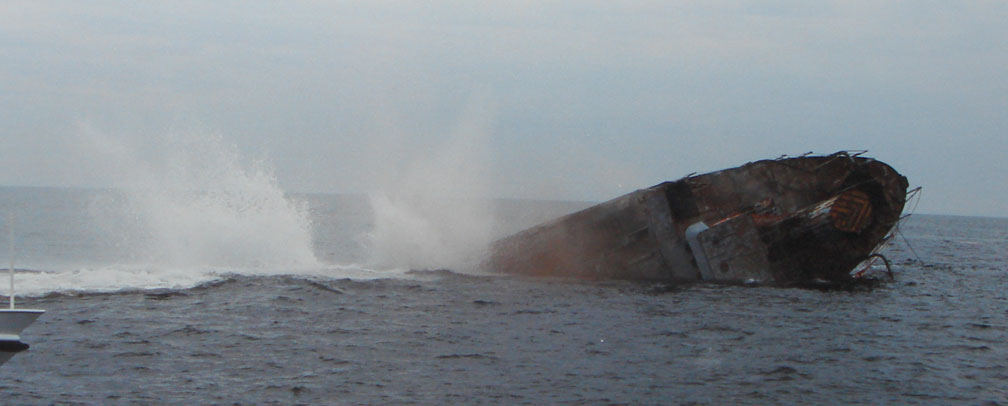
And here is the demise of an old yard oiler, off the coast of Manasquan Inlet, New Jersey, USA. The first photo below shows the ship at anchor. I’ve just opened a series of valves and removed plates in the hull to let water in.

A local beer distributer helped pay for the cost of sinking this ship. Thus, the Budweiser sign. In the next photo the ship is well on its way to the bottom.

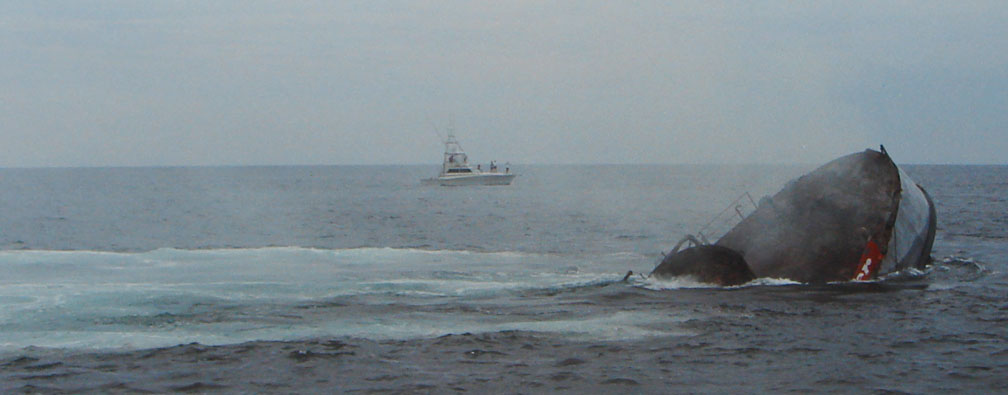
It rolled to the port side and took a nose dive toward Davy Jones’ locker. Finally, it’s all but under the surface, belching air as water finds its way into every space.

In the back of the last photo, you can see a fishing boat. Once the ship settled onto the bottom, he cruised over, logging the exact position on his GPS so that he can come back and reap the benefit. The States of New Jersey and Delaware promote reef construction as much as possible. It helps the environment and provides a renewable fishing resource for sport fisherman. These wrecks last about fifty to eighty years.

Still, it’s sad to put a good ship down. I’ll post one more separately, a former US Coast Guard buoy tender named the Red Oak.

Published in: on June 27, 2008 at 4:36 pm  Leave a Comment  
Tags: , , , , ,