Signpost in the Sand

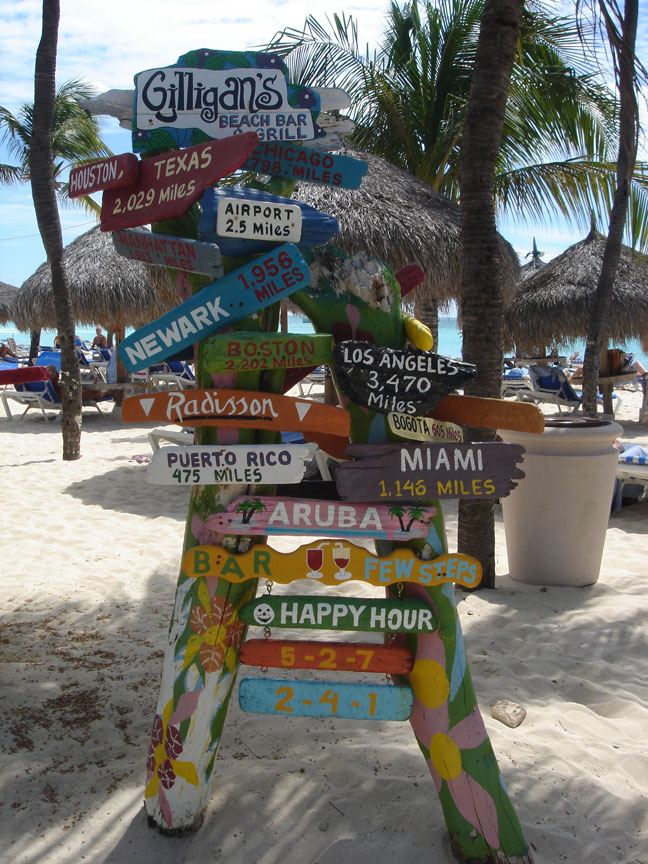
This signpost stands on the edge of Palm Beach, Aruba, on the promenade by the Radisson Hotel. Check out all those places and distances. Maybe your home city is on there.

This post actually reminded me of the one that was frequently seen in episodes of MASH. I used to watch that show years ago. I remember the last episode and the one where the colonel died. They were poignant to say the least. These days I don’t watch much television so I don’t know if there is a comparable show on. For one thing, I despise these make-believe reality shows. Once in a while I’ll view pieces of the ones on Discovery like Deadliest Catch or Ice Road Truckers. Still, too much is over-dramatized. Please, there’s enough drama in the real world. You want to impress me, make me laugh. That’s a tough assignment.

Back to the signpost. It’d be nice if there were such things in life to point you in the right direction. Maybe there are. I can remember people giving me very good advice along the way (not that I always listened or heeded it). There are things like graduation ceremonies, promotions, demotions, epiphanies, and revelations. These are signposts of a certain kind. They mark a beginning or an end, deny or permit passage on to the next stage of life.

Perhaps the key is not so much to be looking for the sign, but rather to interpret it correctly when you find it. Believe it or not, there’s plenty of wisdom out there to be had. It comes in all forms from the Bible to your grandfather’s remarks. The question is, what do you do with it? What is important and what isn’t? That’s a more difficult assignment than the first one. And the trouble is, life keeps moving while you’re standing there contemplating your next move. There’s no “pause” button, no “rewind,” and certainly no “undo” function. Or maybe there is. After all, people reinvent themselves all the time. It takes courage and willpower to go down the right or wrong road and then make another turn without knowing exactly what the destination will be. The only thing that’s for certain is that it will be different. Whatever the case, it’s better than standing at the curb while the world passes by.

Published in: on September 4, 2008 at 10:52 am  Leave a Comment  
Tags: , , , , , , , ,

Pisa, Italy, Way Back When

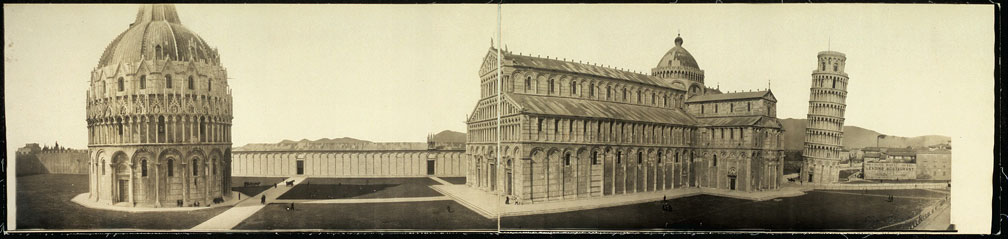
Looking through those old photos at the United States Library of Congress, I came across this one from Pisa, Italy. At first, I thought it was of a scale model. On closer inspection, I realized it was the real thing. Look closely at the buildings and people in the frame.

This is one of those large format, panoramic photos that are a joy to look at. It would most likely be impossible to make this image today. The crowds and the new buildings would all be in the way.

I haven’t been to Italy in many years, and the last time I was there, did not get south of Bologna. I’d like to see Pisa as well as the rest of the country. Of course, Italy is one of those places like Spain; you could spend a lifetime and still not absorb it all. Fortunately we have archives like the Library of Congress where you can see such sights without even leaving your desk. This is not a substitute for the real thing. However, it does satisfy a certain need to see what’s there.

I have a bad habit of writing two or three stories at one time. I bounce between them when the mood strikes. After looking at photos like this, I’m inspired to write episodes for my historical novels (such as MacMillan Judge, Privateer). It’s fun to play in the past where you know how things turned out. The future is a bit more difficult. It leaves you worried that when the future becomes the present, your interpretations will be judged. Maybe that’s the fun of it: putting yourself out there, asking other people to give their opinion on your work. You can’t please all of the people all of the time. I’d venture to say you can only please a few people once in a while. So long as you’re happy with what you’ve done, well, you’re on the right track.

Published in: on September 3, 2008 at 2:32 pm  Leave a Comment  
Tags: , , , , , ,

Ruins, Part 2

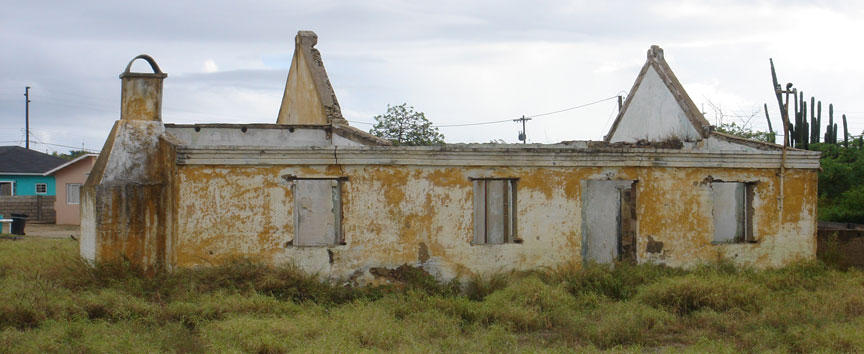
I’m working on a scene for my next novel, Under A Blue Flag, that takes place in this ruined house.

Ruins are great places for dramatic scenes. They’re abandoned, forgotten places where a character can meet his destiny or decide what it will be. If you remember some of those other posts I put up about atmosphere, you’ll know that ruins are also great for that purpose. They’re moody, full of history, reminiscent of the past, and sometimes pessimistic about the future.

The abandoned cunucu house shown in the photo above is actually in an area on the island of Aruba known as Paradera. My characters end up here after a series of wrong turns. I don’t want to say too much more out of fear of revealing too much. Under A Blue Flag ties in directly to its predecessor, An Island Away. Nonetheless, I’m writing the sequel to be a stand alone volume so that it is not necessary (but it would be a good idea) to read the first book.

Published in: on September 3, 2008 at 6:58 am  Comments (1)  
Tags: , , , , , , , ,

Refinery At Dawn

This is a photo of the refinery located in San Nicolaas, Aruba. Back in the day when I used film in my photographic efforts, I always wanted to take a great night shot of the place. I never got around to it, and now my film cameras rest in my museum of things I used to love. I took a chance using my little consumer digital camera and this is what I got:

It’s not the greatest picture. However, it does give the impression of the photo I always wanted to take. Among the cameras that I used to use regularly was a Horseman 4X5 field camera. If you’re not familiar with photography, just think of those old cameras with the bellows and the guy sticking his head under a cloth. The film was 4 inches by 5 inches in size. When you have an original that large, you can make enlargements that are crystal clear up to about 3 feet by 4 feet. I have a few of those around the house. The problem was that getting the film developed became more and more expensive as well as more difficult to find a lab to do it. Thus, into the museum went the camera, lenses, and film holders.

I regularly consult photographs of locations that appear in my stories. These pictures help keep my writing organized. With digital cameras and small printers it is easier than ever to build a story board that chronicles the narrative from beginning to end. This becomes more important as the amount of pages increases. You would be surprised how easy it is to get lost in the middle of writing a novel. A quick look at the story boards and you’re back on track. Not only that, it’s fun to look at your original ideas after the book is completed. It’s amazing what you thought you were going to do as compared to how things turned out. That’s the beauty of fiction, you can rearrange it when you have to.

Published in: on September 2, 2008 at 12:24 pm  Leave a Comment  
Tags: , , , , , , , ,