Some James Ellroy Novels

James Ellroy began his career writing detective fiction. His “LA Quartet” series is perhaps the best well known and includes The Black Dahlia, The Big Nowhere, LA Confidential, and White Jazz. The first book by Ellroy that I read was The Big Nowhere. This book hooked me on Ellroy’s writing. His work is not pretty, nor is it neat the way some crime fiction is. In fact, the mess of Los Angeles corruption is Ellroy’s fodder. He chews it up and spits it out like no other writer I know. His characters stand head and shoulders above the lame, hand-wringing ninnies of some series. He’s not afraid to have bad cops do good things, evil politicians stoop lower than a snake in the sand, and civilians get whacked in the cross fire. The plots are more convoluted than the frieze on a Hindu temple, and yet as believable as the reality they reflect.

But (and there’s always a ‘but’ in these posts of mine) Ellroy’s work grew beyond detective fiction to include a book that stands out among my top five books of all time, and that would be AMERICAN TABLOID. I put it in all capitals because this book will not only make the hair on the back of your neck stand up, it’ll cause you to break into a cold sweat and the occasional shaking fit. This one takes place in the run up to and aftermath of the Cuban Revolution. It features real-life characters salted in among two CIA agents gone off the reservation. One is Kemper Boyd. The other is Ward Little. These guys are on a collision course with history and each other, not to mention J. Edgar Hoover, Joe Kennedy, Sam Giancana, and a few movie stars in between. Ellroy winds his plot through the minefield of historical drama, giving the reader almost no rest between crooked and kinky deals that ultimately bring Boyd and Little face to face with what they’ve done.

Over the years, Ellroy’s style has evolved into a clipped, almost machine gun fire blitz of language. At times this can wear on me. Nonetheless, I think he is one of America’s great writers in this field. He holds nothing back and that’s what impresses me the most in an age of politically correct sterilization.

Published in: on August 17, 2008 at 8:21 pm  Leave a Comment  
Tags: , , , , , , ,

Some Mario Puzo Novels

Mario Puzo is famously known for his novel, The Godfather. I’ve read the book three times. It is definitely among his best. However, another book of his that I found to be very good and more insightful was The Fortunate Pilgrim. This is another immigrant tale, albeit one that is much shorter. It takes place in New York City and features all the characters you might expect including a woman named Lucia Santa. Every one of them is well drawn, each with their motivations, flaws, and virtues.

And then there is Fools Die. Fools Die is a story not only about Las Vegas, but about human nature. (I’ve also read this book three times.) One of the most fascinating characters in the book is named Gronevelt and he owns the Xanadu Casino. He’s as much an archetype as Don Corleone, but with a more mathematical sensibility that he applies not only to the returns on his gaming tables, but also to the people around him. Gronevelt knows that people will try to steal from his casino, that they will attempt scams, that they think they can somehow beat the house. All the while, the percentage is against them, not to mention a keen observer of human behavior like Gronevelt who can be on the merciless side. Thus, fools die, literally and figuratively.

Still, there is more to this book than simple casino derring-do and big-shot hustling. The book takes some wild tangents to follow a budding novelist, a wacky prize-winning author, and some other minor characters. If you’ve read The Godfather, you’ll remember that the book followed Johnny Fontain to Hollywood along with his hard drinking neighborhood upstart friend. Some people complain about this type of diversion in a book. I actually enjoy them, especially when a writer like Puzo keeps the characters and plot interesting to the point where you don’t realize how far off the main highway you’ve gone until you’re on your way back.

Too many novels I’ve read of late are too short, too bland, and too simple so as to leave me wondering what, exactly, was the story. Mario Puzo never takes the short or the easy road in the novels I mention above. He drags the story up a hill and the climb is not only worth it but also leaves you with a view you never forget. The finely tuned power of Don Corleone, the ruthless calculating mind of Gronevelt, or the perseverance of Lucia Santa, all deliver the reader to a place they will never forget.

So, if you haven’t checked out these Mario Puzo novels lately, I highly recommend a visit. You won’t be disappointed. As for his other books, well, they’re not on my list of favorites.

Published in: on August 16, 2008 at 10:04 pm  Leave a Comment  
Tags: , , , , , ,

An Island Away, Excerpt 5

Captain Upton’s voice filled his head. “Keep a firm hand on the wheel, or some mother’s son will turn it for you.”

An Island Away is the story of three people who have to figure out what they want, what they want from each other, and how they’re going to get it. Set in the refinery town of San Nicolaas, Aruba, this tale of flexible morality takes a hard look at the other side of paradise. It is available at Amazon.com, BN.com, as well as many bookstores and gift shops in Aruba.

Details from the Cemetery

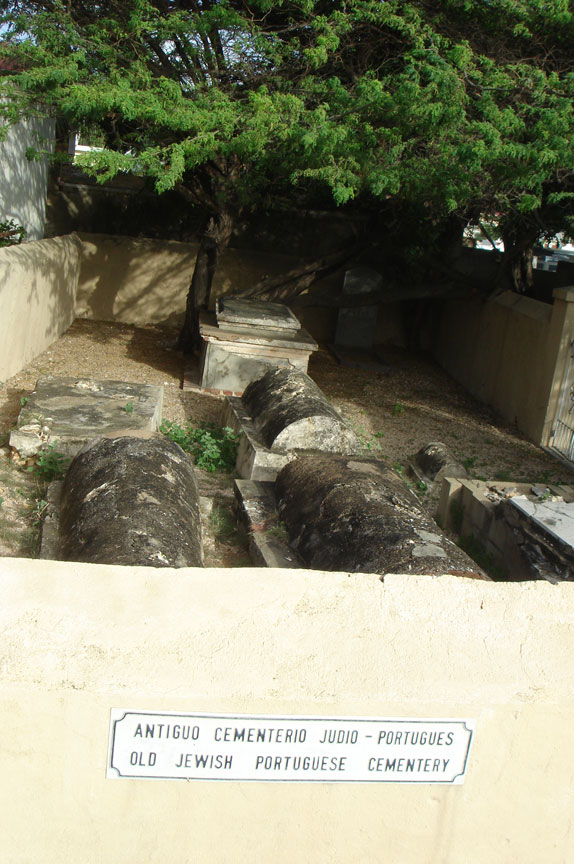
My writing is heavy on details. I put my words together with a fine brush, filling in all the nooks and crannies. (My editor constantly reminds me not to tell EVERYTHING.) This is a strange phenomenon for me because when I was heavy into photography, my images were large, sweeping vistas taken with wide angle lenses. This may go back to film school, where they taught me always to have an establishing shot to place the viewer in the location. Then, go in close for the minutia that is relevant to the story. Well, here in Aruba, I came across this old cemetery, which as the sign says, was for Jewish Portuguese people. Have a look.

The place is quite old by any standard, especially for the Caribbean whose history is often swept away by hurricanes and changes in government. By my count, there were only seven graves inside the walls. The largest one in the rear features a Divi tree growing up through it.

However, the detail that struck me most was among the arch-covered graves in the center row. It’s the small one on the right. Someone’s child didn’t survive and ended up here next to his elders. Wow, that’s all the detail I need to make this place interesting and the stuff of a story. Of course, graveyards are a no-brainer, and not just for mysteries. You’ll find all kinds of things that represent both the living and the dead, the beliefs or lack there-of held by those interred as well as the visitors still alive.

It strikes me when I see people leaving things behind for those who’ve passed away. I suppose it’s a soothing notion, a comfort to remember and contemplate. It must be part of the human condition because the activity goes back into pre-history. Certainly the Egyptians reached an all-time high with their temples to the dead that were staffed by priests and kept flourishing for years after a Pharaoh or other significant person died. Then again, details can be striking and a single person with a single flower is more powerful than a priestly retinue in a smoky temple. At least, in my way of telling stories it is.

Published in: on August 10, 2008 at 10:56 am  Leave a Comment  
Tags: , , , , , , ,