Aruba’s Local Newspapers

Aruba has several local newspapers, all written in Papiamento, the local language. Each paper has its own flavor. The Diario is my favorite. Jossy Mansur is the editor and he pulls no punches. He’s also written a few books, including a Papiamento-English dictionary, which I find very useful as I attempt to read (or should I say interpret) the newspaper. Here’s a look at the front page of a typical issue of the Diario:
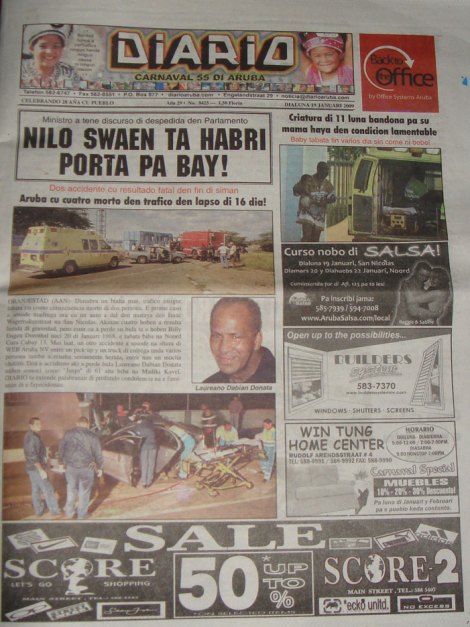
auapaper21And below you’ll see a photo of Mansur’s Papiamento/English dictionary:

auapaper3Wherever you go, reading the local papers will put you in touch with the sensibility of the citizenry, what’s going on in their world, what they think is important. I find this makes my traveling experience more enriching. Instead of taking in the sights, sampling the food, and heading for home, I’ll take the time to peruse their papers and magazines, try to decipher the letters to the editor, and get a deeper understanding of the culture. It’s a challenge, but one well worth the effort.

Published in: on January 22, 2009 at 11:36 am  Leave a Comment  
Tags: , , , , , , , ,

Short History of Aruba

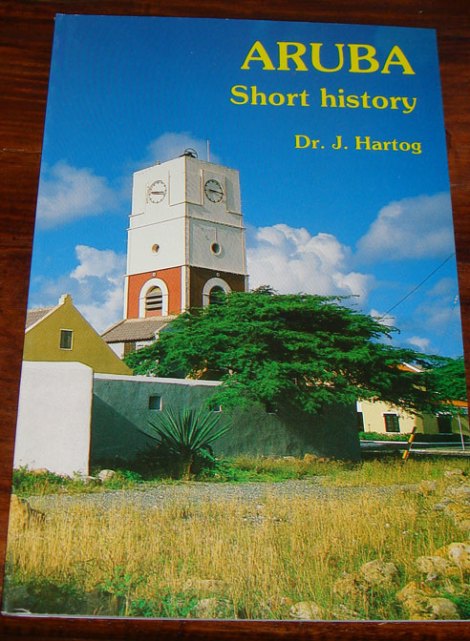
Aruba Short History by Dr. J Hartog is a handy reference guide for those curious about Aruba’s past. It provides information on the native indians who first inhabited the island all the way through the time when the Esso refinery was the largest in the world.

auahist1

You can find the book at the Samsom Bookstore on L.G. Smith Boulevard as well as at the DeWit-VanDorp main store in Dakota, not far from the airport. Among the many amazing fact in the book is that the population of Aruba in the mid-1920’s was 6,500 and in the mid-1970’s was more than 60,000. That’s quite an increase.

There’s much more in the book including a brief overview of the Esso Refinery days, some details about the Second World War, and bits of insight into local culture. This little book is worth the 14.50 florins you’ll pay.

Published in: on January 20, 2009 at 9:42 am  Leave a Comment  
Tags: , , , , , , ,

Aruba Maps

Until recently there were very few good maps of Aruba. Yes, it is a small island. Nonetheless, you can get lost here, which can be fun or annoying depending upon your purpose. Well, I was in the Samsom Bookstore the other day and found this Guia di Caya, or street guide as it is known in English.

auamap1This is quite a good resource. For example: If you’re looking for your friend’s house, especially that friend who has invited you to visit his home in Aruba but told you it was EASY to find. He might have said, turn left at the Divi tree, right at the big rock, go about half a mile then turn right again by the third cactus on the left. If this is the case, you definitely want this book.
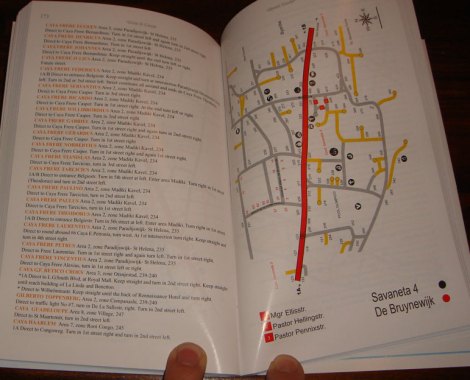
Seriously… let’s say you would like to buy a home on the island and you’ve been looking through the listings. You’ll be able to see individual neighborhoods, whether or not the roads are paved or packed dirt, and how they fit into the larger scheme of the island.

auamap22

The page above shows the De Bruynewijk area of Savaneta. The red line in the center of the right page is the main highway. The gray lines are paved secondary roads and the yellow lines are dirt roads. As you can see, some house numbers are listed, but not all of them. You’ll also note that house numbers are not sequential. It is my quest to convince the powers that be in Aruba to name all the streets and assign sequential numbers. The lack of them plays havoc with deliveries. It’s quaint until you spend half a day waiting for something that could have arrived in mere minutes.

Once again, I found this book at the Samsom Book Store on L.G. Smith Boulevard, across from the container port. The book was situated on a series of shelves under the heading “Aruba History.” Cost was rather expensive, $25.00 US. Given the price of gasoline, it is probably well worth it.

Bon dia from Aruba.

Published in: on January 14, 2009 at 11:10 am  Leave a Comment  
Tags: , , , , , , ,

Mangel Alto Snorkeling, Aruba

The Mangel Alto area of Aruba offers some very good snorkeling. There are several points of entry. Two are shown on the video clip here. There is a third if you drive down toward the beach, past the Nam Yong restaurant, which is located on Spanish Lagoonweg. The underwater still shots that are incorporated into the video were provided my Kent Gerber. Take a look at the video.

When snorkeling here, keep a close eye on the sea conditions. You want to move out toward the reef, but as you do, you’ll find the ocean a bit choppy. It’s not all that difficult to swim in this, just remain mindful of where you are in relation to the shore. I’ve also found some “holes” in the sandy floor in the calm area sheltered by the cliff. Here you’ll find some zany fish and other creatures. However, out near the reef is where you’ll find the best viewing. Again, special thanks to Kent for providing the still shots. Judging by the photos I’ve seen of the fish he has caught, he’s lucky they don’t take their revenge on him when he’s snorkeling. And as always, please respect the marine environment.

Bon dia from Aruba.