Lately, there has been so much talk about economic doom that people have whipped themselves into a frenzy of negativity. Politics aside, instead of so much chatter about what can not be done, may I humbly suggest we start talking about what CAN be done. Of course, let’s start with ourselves. (This is because I’m a firm believer that when you point your finger, three more are pointing back. If you don’t believe me, point your finger at something and then take a look at your hand. Get it?) I think we have forgotten how far and how quickly we have traveled along the economic timeline. For instance, I was doing some research in the United States National Archives, and came across this photo:
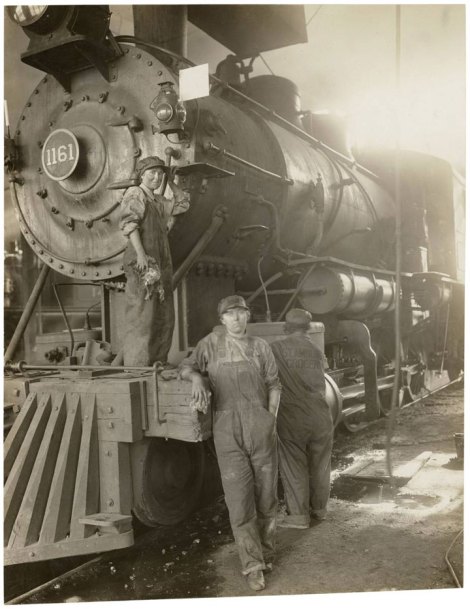 According to the National Archives, these women are working on this steam locomotive somewhere in Montana, circa 1919. Now, certainly Montana and the year 1919 were not the easiest of places and times. Forget socio-economic conditions, just imagine working against the natural environment and those beasts affectionately known as steam locomotives. Some of the tools used to repair and maintain this equipment were larger than the arms and legs on these women and they were made of steel. Thus, it must have taken two or three women to perform these jobs. And yet, they got the job done, and made the Nation a better place for their children in doing so. Today’s locomotive shops sport hydraulic lifts, computer diagnostic tools, and climate control, not to mention an array of safety measures designed specifically to protect life and limb. The women above had to persevere without such niceties.
Therefore, before we all start bellyaching about how bad we have it, we might better take a look at the people who did jobs exponentially more difficult physically (and perhaps mentally) then we do today. Perhaps CAN and NOT were never placed close together in their sentences the way they are in today’s vernacular. Perhaps these people had the strength and determination to do better for themselves rather than the weakness to cry for government help. Perhaps they preferred the honor and satisfaction of being self-sufficient over the pathetic dependency of being a ward of the state.
So, if all day we speak of nothing but what can NOT be done, well, NOTHING will be done. But if we pause, take a deep breath, and THINK about what CAN be done, well, we might discover just how vast the possibilities are. Initially the future may be uncomfortable, which is simply an expression of the details to which we forgot to attend. Then, as progress is achieved, this minor annoyances will fall away as the pride of achievement rewards those who are willing to do what it takes.
 The man in the foreground is working on a submarine at the Electric Boat Works in Connecticut during World War II. Here are some statistics that should perk you up: During the Second World War, American workers built 5,777 merchant ships, 1,556 naval vessels, and 299,293 aircraft. This was accomplished without computers, without cellphones, and by people who for the most part had not finished high school.
 Too bad this one will never take to the air again. I checked on some facts about the DC-3 and discovered that it was the first airplane to enable the airlines to make a profit on passenger service only. American Airlines used it on the New York to Chicago route in 1936, and the air travel business was off to the races. More than 10,500 DC-3’s were built, and according to my research, about 1000 of them are still flying. Not bad when you consider they were built between 1935 and 1947. Here are a few other tidbits: It had a cruising speed of just over 200mph, carried up to 28 passengers, had two engines developing 1,200hp each, could travel about 2,000 miles with maximum fuel, and way back when you could buy one for about $138,000.
 The Bent Page
You must be logged in to post a comment.