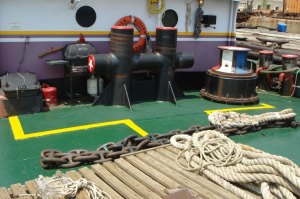
Having seen some of the basics, let’s stop on deck for a few minutes to talk about what goes on there. Here is a photo of the foredeck, directly below the front of the wheelhouse.

The H bit is used to make lines fast. They can be led through the bull ring at the very bow of the boat or off to either side through the single bits that stand against the gunwale. The ropes lying there will be tidied up. Harry’s crew was sorting through things, figuring out what’s good and what’s not, otherwise they would be hanging on pegs or stowed in lockers. The work of a deckhand is truly the case of hurry up and wait. He has to be ready to catch a line, toss one to someone else, or loose one at the command of the captain. The lines aren’t heavy until you’ve hauled them around for a couple of hours straight or pulled with all your might to get that last turn around a bit. (Well, actually they are quite heavy but you don’t notice that right away.) You also have to know when to let go. If you hold onto the line and it starts to run, it will pull you through the bit, twisting your arm and whatever other body part follows through the bit. This is not pretty and you’ll be lucky if you only go to the hospital.
Here’s a look at the stern deck.
Surprise! There stands another H bit. Beside it, painted red, white, and blue, is the capstan. This capstan is hydraulically powered. It is used to wind in the towing rope, which the deck hands must then “flake” or lay out in a neat pile atop a pallet that would normally be here, but was taken up to allow for painting of the deck. That rope which is used to tow barges is called a hawser and the High Roller carries one that’s more than a thousand feet long. It is slowly let out through the stern H bit until the captain thinks he has enough out to allow for safe towing. Then it is made fast as describe earlier. The hawser takes up the shock created by the difference in movement between the tug and the barge (or whatever else is being towed). One vessel may be riding up a wave while the other is on its way down. The hawser stretches between the two. It also moves from side to side and you don’t want to get caught between it and the gunwale or a bit or anything else. It will crush you. Again, a good deckhand has to anticipate what’s going to happen, be ready, and act accordingly.
Here’s a view over the stern.
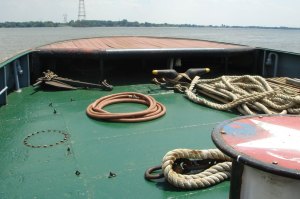
That steel fixture in the middle is called a cleat. You can tie off to that or use it to lead a rope, again depending on the operation. When this photo was taken, the boat was sitting in the Delaware River, so there isn’t much to see. Often times you’ll be looking at a ship coming up from astern or a sunset or a lighthouse, all of which have their own drama.
My character, Nathan Beck, and his crew do the jobs I described here. An Island Away is not a sailing adventure, but there are a few scenes which take place aboard tugboats, including one dramatic event in the Delaware River when another tug catches on fire. Beck and his men have to jump into the fray in order to rescue the other guys on the river. One thing I’d like the reader to take away from these photos is the compactness of the space on deck. There isn’t much room to do anything. Thus, everyone has to work together. One person out of synch creates a big problem that may be dangerous or make for back breaking extra work. However, when a crew works together, it is a choreographed operation that’s a thrill to be a part of. Remember, these objects are big an heavy. The High Roller weighs hundreds of tons. The barges it tows and pushes weigh thousands of tons. Ships weigh tens of thousands of tons. It is this type of work, and more importantly this type of responsibility for other men’s lives and equipment, that forms the character who is Captain Nathan Beck.
In Part III, we’ll go inside to see the engine room and living quarters. Want a job?
 This can be a tricky procedure, full of pitfalls if the weather changes, something goes wrong, or simple human error. However, the job went easily enough. The drydock was lifted, the crane pivoted around, and then the drydock was set into the water like a dozen eggs in the fridge. It takes copious amounts of cooperation between the people on the ground and the fellow operating the crane, who may not be able to see everything, including obstacles in the way.
 The guys are working to reattach the bow fender, which is no easy task given that it has to be bent and pulled fast to the shape of the hull. Here is a shot of stern:
 You can see the scale of the hull and that single propeller by comparing both to the man standing on the right. The propeller is about six feet in diameter, which may sound large, but is actually small as things go in these matters. This boat has an engine that develops a mere 850 horsepower. Here’s a closer look at that prop.
 It’s all shiny and clean for today. Won’t be long before this boat is back in the water, towing barges, nudging larger vessel to the dock, and roaming the harbor in search of work. The Thomas Brown is a handsome boat, one that features traditional lines that passed down from the earliest of vessels. It’s also the last of a breed. Single screw boats are simply not built anymore. So, when this one is finished, it’ll be lost to the scrapper’s torch. But not yet! There’s still work to be done.


 The Bent Page
You must be logged in to post a comment.