Creating Atmosphere, Part 3

In two earlier posts, I mentioned a few things about creating atmosphere in a story. This time, I’ll rely on the actual atmosphere for a bit of inspiration. Nature’s wonders have inspired countless artists, not to mention put the fear of the supernatural into any number of sailors. A sky like this might just do the trick.
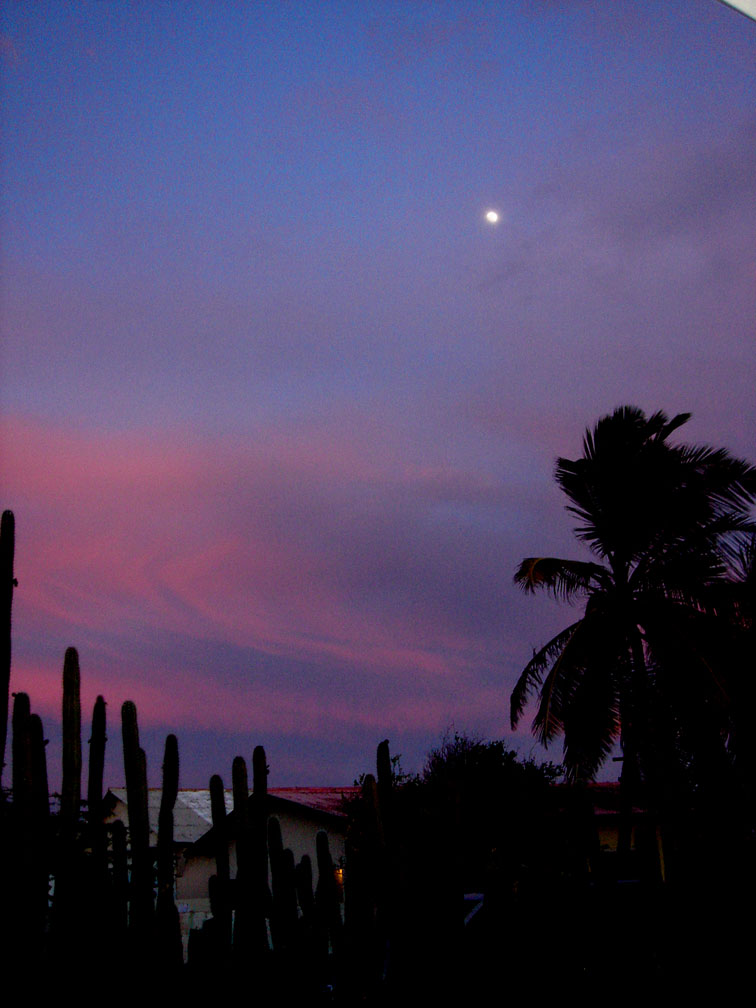
 My wife and I had just finished dinner and were going for a walk. Not two steps outside the house, she pointed at the moon and said, “Look at that.” Indeed, check out that hazy moon, rising over the sunset. The colors of the setting sun, cast upon the clouds provide brilliant color that is contrasted by the silhouetted palm trees. This is a technicolor backdrop for any scene, tropical or not. This one happens to be in Aruba, but it might just as easily been taken on the high plains. Some day I would like to go to far northern Alaska or Canada, a place where I can see the northern lights. Now there is atmosphere (BIG-TIME), the embodiment of the interaction between the sun and the earth. If that doesn’t pop a few goose bumps I’m not sure what will. And then, after seeing these kind of natural phenomena, the mind has to be ready to incorporate them into a good story. Various belief systems have passed down through the generations the idea that the sky portends things to come. This may or may not be true. Do the stars predict the future? Do they reveal the past? I don’t know, but it’s a fantastic story convention to use such things. Perhaps there is a deep memory buried in human DNA that tells our minds to believe such things. Or, maybe it is true and you just have to be sensitive to the omens. Here’s another sky, this one taken just after dawn.

This is another after-the-storm shot. The clouds are breaking up, blue sky peeking through, sunlight poking out. Normally we think of sunlight shining “down.” However, here, the rays appear to be shooting up. Different.

Whether you’re a storyteller or not, it’s one of life’s pleasures to check out the sky from time to time. Don’t be afraid to look up, or down for that matter. It may not be doom you find. It could be a sign of good things to come. You simply have to be ready for whatever may come your way.

Published in: on July 15, 2008 at 11:32 am  Comments (1)  
Tags: , , , , , , , ,

Stories in Glass

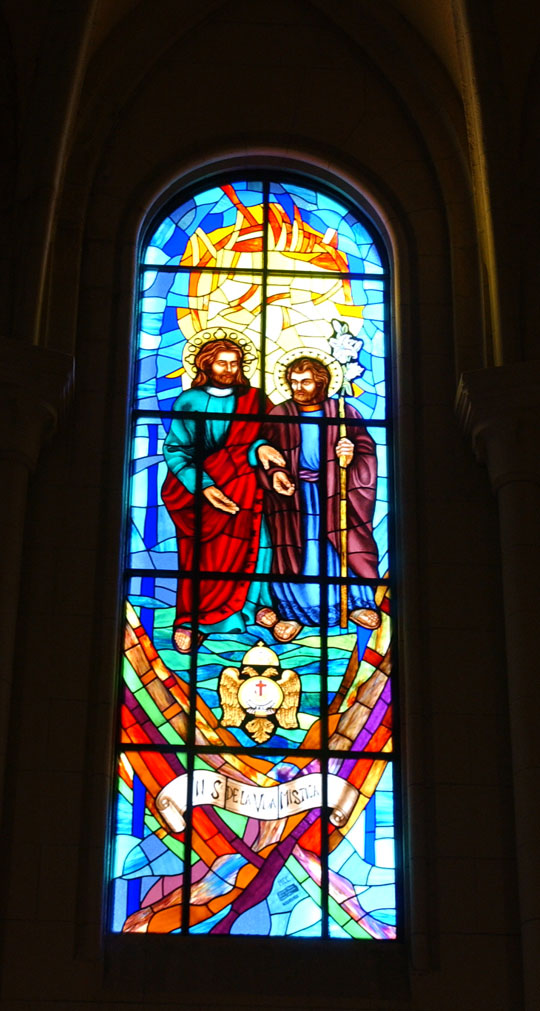
There are many ways to tell a story. There are books, movies, and songs to name a few. There’s also the sculptures and reliefs found in plazas and on the facades of various buildings. And then there is the stained glass of churches. I’m particularly fond of this last one. As mentioned in an earlier post, the right atmosphere greatly enhances a story. Stained glass windows create all sorts of atmosphere from both the inside and the outside. The windows pictured below are from the Cathedral of Almudena, Madrid, Spain.

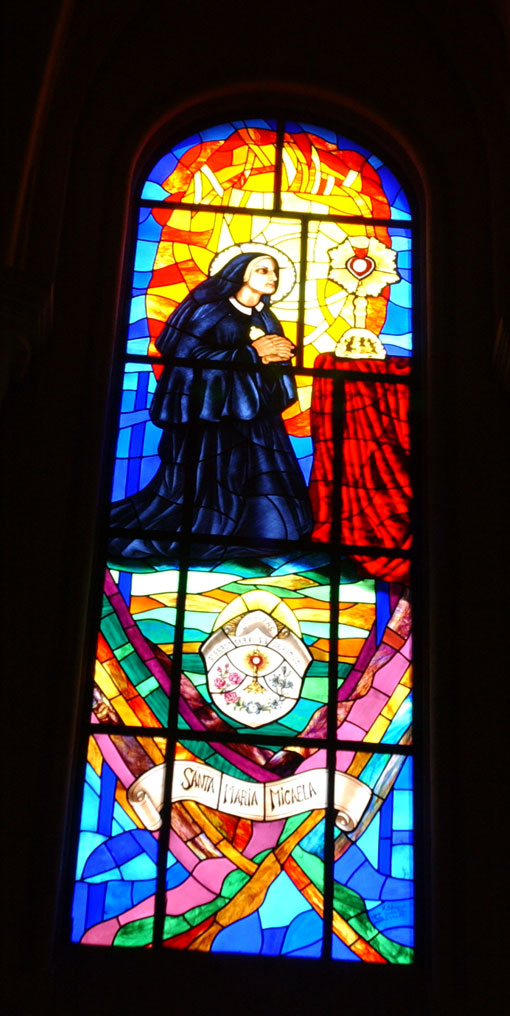
These windows are more modern than those found in say the Cathedral of Seville. The colors are more vivid, the individual pieces larger. Naturally, more light comes through. This colored light pools on the floor, spreads over the walls, and is unable to be avoided when inside the building. Then, at night, the windows shine outward so that a passerby sees the same scene from the other side thanks to internal illumination. Here’s another window:

 Of course, each window illustrates a scene from a Biblical story, informing the congregation about their faith. It may be hard to imagine a largely illiterate population relying on scenes such as this to access ecclesiastical knowledge. Nonetheless, this method was largely employed and can still be effective.

I’ve also seen stained glass windows with elaborate script at the base mentioning the particular person or organization who sponsored it. Thus, an opportunity to support the church and attain a sort of immortality.

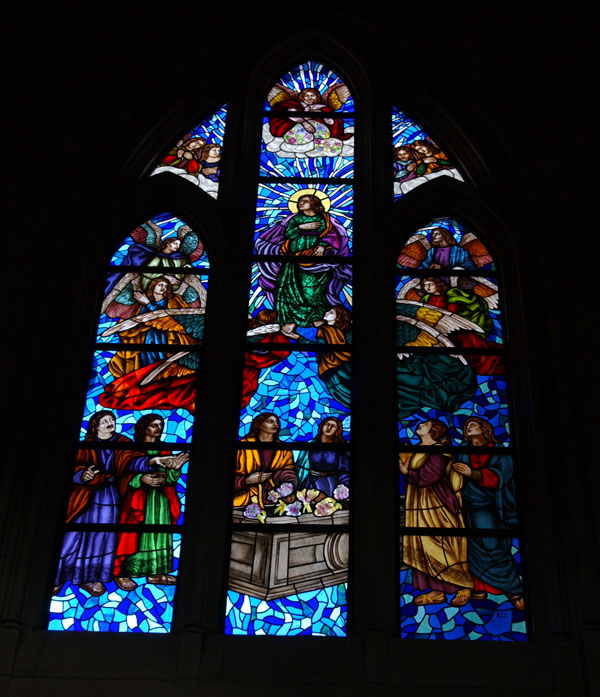
One more window to gaze upon in this post:

While in Cordoba, Spain, I came across a school of the practical arts. Sorry, but I can’t remember the exact name. One of the trades taught at this school was the making of stained glass windows. Fortunately there are people who study and practice this art, going on to become master craftsmen who not only provide a barrier between the elements and us, but also a beautiful cultural expression that lasts for generations if not centuries.

So, when you find yourself on a travel adventure, don’t forget to slow down and let the different elements come to you one at a time. Your experience will be that much more interesting and fulfilling.

Published in: on July 6, 2008 at 12:18 pm  Leave a Comment  
Tags: , , , , , , , , , , ,

Postcards for All!

Something I’ve done for years is send postcards to a long list of people. In the days of email and blogs, it seems the postcard may be on its way out. Nonetheless, I maintain the tradition. In the first place, it’s good to support the postman. He has to deliver all that junk mail and I’d prefer to give him a more noble document to carry to its intended destination. Hence the search for the right card, the postage, the mail box or post office. This is also part of the fun. Then there is the issue of what to write.

That’s me in the photo above. Not in England, however, but in Gibraltar. I double check the message on my cards in case there are any last minute second thoughts or additions I’d like to put there. In my notebook, I keep a running list of addresses. This is also part of the fun because every time I scan the list I’m reminded of the people who are important in my life.

Another part of the thrill is hearing from those to whom the postcards were sent. They issue an email, a call, a “you lucky bastard” comment. My favorite responses are the ones that go something like, “I’m going with you next time.” To these I reply, “The more the merrier.” For me travel is about exploration and experience, a pursuit best enjoyed with others.

Published in: on July 5, 2008 at 2:15 pm  Comments (1)  
Tags: , , , , , , , , ,

Privateers and Pirates

As mentioned earlier, I’ve been researching a novel tentatively titled MacMillan Judge, Privateer. The course of this research has taken me through many volumes, a few trips, and into places that I normally wouldn’t go. It has been quite an education into a subject I knew very little about. I’ve examined the circumstances surrounding privateer activity during the American Revolution and the War of 1812. Originally this story was going to be something akin to a swashbuckler. However, I came to believe that the people who performed heroically during these two wars deserved better. They are entitled to a representative character who upholds the ideals of the new nation as well as his own private convictions as to what it means to command a vessel of war. I say vessel of war as opposed to warship because the privateer typically used a converted merchant ship or one built for speed rather than brute force. Below is a photo courtesy of the United States Federal Government of the Pride of Baltimore, the type of Balitmore Clipper on which MacMillan, Judge will sail.

This is a tricky subject because privateers operate under a letter of marque granted by the government under which they sail. Their activities would normally be considered piracy, but the letter of marque gives them privileges normally reserved for standing navies. A privateer raids merchant ships, attacks other nations’ warships, and shells their land forces. However, in the course of these dangerous forays, any salable goods or vessels captured are subsequently sold and the proceeds go to the privateer. Therein lies the rub: the privateer is a money-making venture as much as it is a military affair.

Of course, when the United States declared independence (and later in the War of 1812), they didn’t have much in the way of a navy. They faced the most powerful naval forces the world had ever seen, those of the British Empire. The solution was to empower private individuals to take great risks in order to create some semblance of a marine force. According to some of the books I’ve read, this was a very effective method. Benjamin Franklin was an investor in a privateer ship during the revolution, as were many others of all walks of life. The privateers racked up a string of victories that would be amazing even by today’s standards. One particular ship captured six vessels in six days right under Britain’s nose in the English Channel. Another privateer sent a letter to Lloyd’s of London, bravely stating that the the British Isles were under his blockade. That’s a bold statement from a man aboard one ship. But the letter was posted at Lloyd’s and insurance rates skyrocketed.

But what about that sticky question of outright profit in the course of the war? Are these people really just pirates by another name? From what I’ve learned I would have to say, no, they are not pirates. Pirates, despite our Disney version of them today, were not the happy go lucky bunch looking for treasure and a cute place to drink rum. Pirates murdered their way around the world until allied forces hunted them down. The American privateers caused their share of casualties and made their profits, but they did not indiscriminately attack neutral ships. At the same time, when the war was over, they ceased their activities and resorted to non-combatant trading.

One way to look at the privateers is to think of their prizes as a method of payment. Instead of receiving a salary, they collected money from successfully attacking the enemies resources. It saved the United States Treasury a bundle and created a number of highly successful businessmen in the process. Many of these people invested their money in the growing economy of the United States, which only furthered progress in a place that was still a backwater when compared to Europe.

I’m looking forward to writing MacMillan Judge, Privateer. Our Mr. Judge is going to be the thinking man’s warrior, not a Disney-fied hero who dodges grapeshot and dances about the deck. First I have to finish Under A Blue Flag, which is the sequel to An Island Away, but that’s another story that I’ll be talking about soon.

Published in: on July 3, 2008 at 4:02 pm  Leave a Comment  
Tags: , , , , , , , , ,