This airplane goes by the name of the Piper “Cub.” It’s signature shape is recognizable after more than fifty years in the air. Countless pilots first took to the air in this machine, which William Piper developed to satisfy his own desire to take to the air.
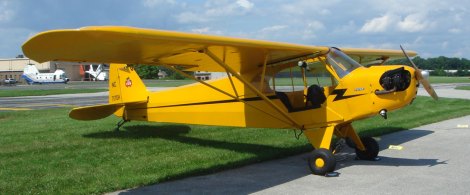 The proven design still flies, which is testament to Piper’s philosophy. Today, most people refer to planes of this configuration as “tail draggers,” meaning that there is a small wheel at the tail which sits lower than the nose. Truthfully, the correct term is “conventional” gear as opposed to “tricycle” gear. Well, this may be an esoteric digression here at The Bent Page, but I just wanted to set the record straight. And here’s a look at the power plant that pulls this craft through the sky.
 It only takes four, air-cooled cylinders to do the job as this is a very light airplane. The cylinders are exposed from the cowling to promote cooling. These engines typically operate for about 2000 hours before requiring an overhaul. Then there is the cockpit.
 As you can see, only the basics are here. You have an airspeed indicator and an altimeter, a tachometer for the engines along with oil temp and pressure. There’s a compass to point the way and a turn and slip indicator which is that curved, clear tube in the center with the black ball in it. The turn and slip indicator lets the pilot know that he’s flying in a coordinated fashion (or not) and this is an important concept in flight. If the aircraft is uncoordinated, it is slipping or skidding just like a car on ice. The problem is, in certain adverse conditions a slip or skid can lead to a spin and spins can end in tragedy. Hence the simple yet highly effective device.
Note that placard on the panel that says solo flight from the rear seat. This is to improve the balance of the plane when only one person is aboard. So if you ever see just one guy in the back you’ll know why.
At any rate, airplanes like this are fading from sight. It’s not cheap to fly and the interest among young people has declined a bit. I can’t imagine a computer game is ten percent as thrilling as flying a Piper Cub but tastes do change. I’d rather be the one doing something than among the others talking about someone doing something. Ah, well, to each his own.
 It was a beautiful day for flying, crystal blue sky, light westerly breeze, and this 182 headed out to enjoy it. Stop by your local airport and watch the planes. It’s fun!
 Too bad this one will never take to the air again. I checked on some facts about the DC-3 and discovered that it was the first airplane to enable the airlines to make a profit on passenger service only. American Airlines used it on the New York to Chicago route in 1936, and the air travel business was off to the races. More than 10,500 DC-3’s were built, and according to my research, about 1000 of them are still flying. Not bad when you consider they were built between 1935 and 1947. Here are a few other tidbits: It had a cruising speed of just over 200mph, carried up to 28 passengers, had two engines developing 1,200hp each, could travel about 2,000 miles with maximum fuel, and way back when you could buy one for about $138,000.
 The Bent Page
You must be logged in to post a comment.