John Irving’s A Widow For One Year

John Irving’s novel, A Widow For One Year, takes readers on a life-long journey through the lives of several characters. What struck me about this book was the story’s common threads of psychological dysfunction and how one person’s damage profoundly affects others.

In the first part of the book, a sixteen-year-old aspiring writer named Eddie gets his dream job of working with a famous writer, Ted Cole. Upon arriving at the Cole residence, Eddie is soon seduced by Cole’s wife, Marion, who has retreated from life due to the death of her own teenage sons some years earlier. Marion has had almost nothing to do with her four-year-old daughter, Ruth, at this point. Finally, Marion abandons her family, leaving Eddie and Ruth wrecked.

The story then shifts forward in time and focuses on Eddie and Ruth, both of whom have become writers. Eddie struggles with his craft as much as he does with being abandoned by Marion. Ruth is more accomplished but finds herself in Amsterdam’s red-light district working out her own demons. This part of the story was a bit strained but in the context of the first part makes sense.

Finally, Irving brings it all together in the last part. Marion returns after her long absence. The ripples she created come home to roost but in an articulate way for all involved.

What I enjoyed most about this book was Irving’s ability to relate the cause and effect of a tragedy’s consequences. The Marion character is not a sympathetic one, yet she earns respect along the way. At the same time, the other characters plow through life carrying burdens that were placed upon them by others only to realize that at some point they can put them down. There’s a lesson there, one that sadly many people learn too late.

Published in: on August 22, 2008 at 10:19 am  Leave a Comment  
Tags: , , , , , , ,

Dawn at the Anchor

There are those places that make you think. For some people it may be a church, for others a cemetery. Maybe it’s in your car, parked in a quiet spot with a view. Perhaps sitting on a bench along a quiet street.

For me, it is this place on the southern tip of Aruba. There is the anchor standing there as a memorial. But there’s also the infinity of the sea beyond. The breeze can be brisk at this spot. The white noise hushes away distractions. For the half hour before and after dawn, I have the place to myself. Here I reflect on what I’ve been doing, on the people in my life, as well as a little about the past, present, and future. I’m a firm believer in quiet reflection, just letting the mind wander through it’s own convoluted passages. It doesn’t take long for a sense of peace to settle in. The perspective gained from this exercise refreshes the soul.

Published in: on August 21, 2008 at 10:38 am  Comments (1)  
Tags: , , , , , , , , , , ,

Thomas Kelly’s Empire Rising

Author Thomas Kelly brings New York City to the front and center is his novel, Empire Rising. From the start, let me say that Kelly is on par with Steinbeck when it comes to capturing not only the essence but also the sweep of an era.

This is a story that takes place in the shadow of the construction of the Emprie State Building. The main characters are recent Irish immigrants. One, Michael Briody, has a terrorist past, and he struggles to put that behind him as he works as an ironworker. Grace Masterson has her own crooked dealings, including her relationship with a Tammany Hall boss. Then there are the other characters, from Mayor Jimmy Walker to union bosses and thugs galore, including the hint that the Italian mafia may be growing more powerful than the Irish gangs. The pot boils as these people claw their way through the depression and the struggles of a corrupted political system that may work better than anyone realizes. However, the price paid is not always denominated in dollars.

The best part about this book is Kelly’s ability to put the reader into the City, into the jobs these people do, and into the mood of the time. You’re right there, praying it works out. Like reality, Kelly gives the good with the bad, something I always enjoy about great fiction. As I mentioned earlier, this story is on par with some of Steinbeck’s work. Kelly doesn’t pass political judgment either, which too many recent authors seem unable to resist. He simply lets the story run its course in the context of the time in which it is set.

Thomas Kelly has written two other books, Payback, and The Rackets. I haven’t read Payback, but I did enjoy The Rackets. I’m looking forward to another book by Kelly soon.

Published in: on August 19, 2008 at 9:34 pm  Leave a Comment  
Tags: , , , , , , , ,

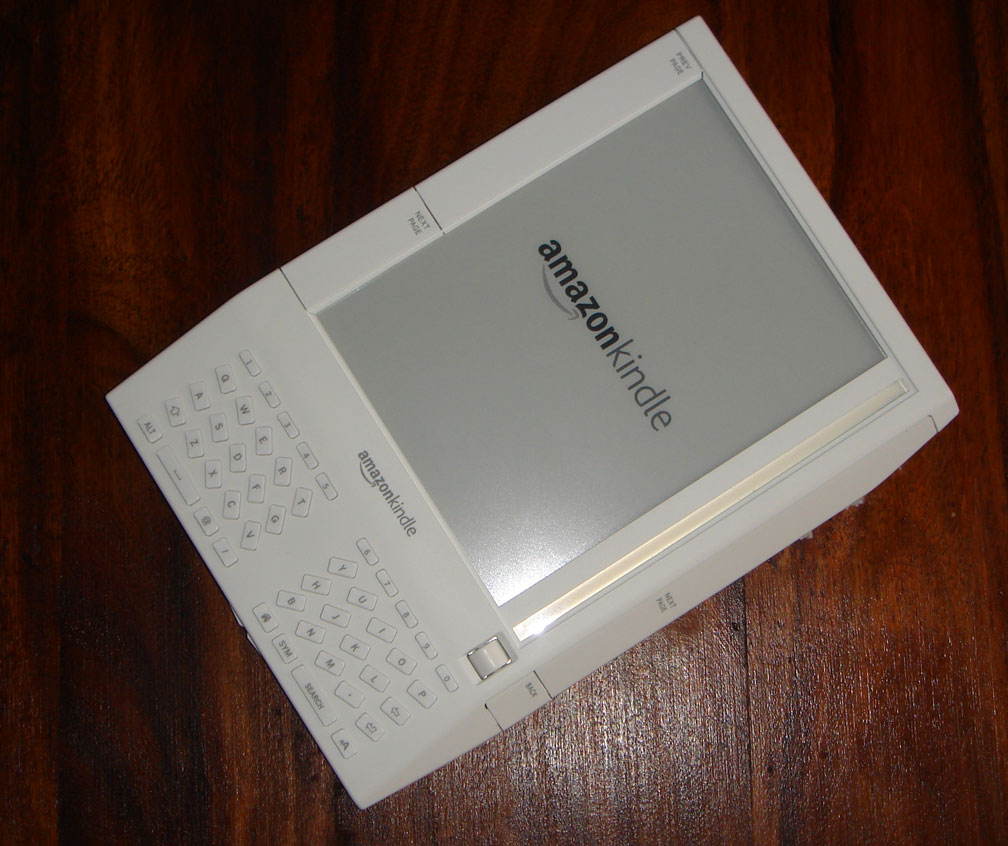
Kindle Reading Device

Amazon’s Kindle has turned out to be a great device, at least for me. Let me say from the beginning, I love paper books. All shapes, configurations, sizes, types, etc. are welcome. At the same time, I travel constantly and toting books is not the easiest thing to do.

Hence, the Kindle. I’ve been using it for several months now and find reading from it to be easier than a paper book because it is possible to turn the page and hold it with the same hand. You simply press the paddle on whichever side is right for your style. Rarely do I experience glare on the screen. Enlarging and reducing the type is a feature I don’t use much, but it is there for people who strain with smaller type.

I’ve downloaded numerous books to the device using the “whisper net” service that functions just about flawlessly. My Amazon account was charged and the books arrived in about 30 seconds each. Switching from one book to the other is easy using the interface. When you turn the device off it remembers where you were. So, if you fall asleep with it in your lap, you don’t have to worry about losing your place. When I get on an airplane, I know I have a large selection of reading material all packed into the form of one lightweight device.

What about all those paper books? I’m not giving them up. I use the Kindle for my entertainment reading. That is books I enjoy for leisure. The ones I expect to refer back to time and again will be purchased in solid form and placed upon a noble shelf where they belong. In a worst case, I may have to buy a book twice. Or, I might just buy several more memory cards and keep them loaded with the books I like. Takes the romance out of a grand old library, but the price of Kindle books is about 2/3’s to 1/2 the price of paper books. Some classics can be had for $1. Something to be said for that. Frees up cash for those great books and fine woodwork to contain them.

Published in: on August 18, 2008 at 11:18 am  Comments (1)  
Tags: , , , , , ,