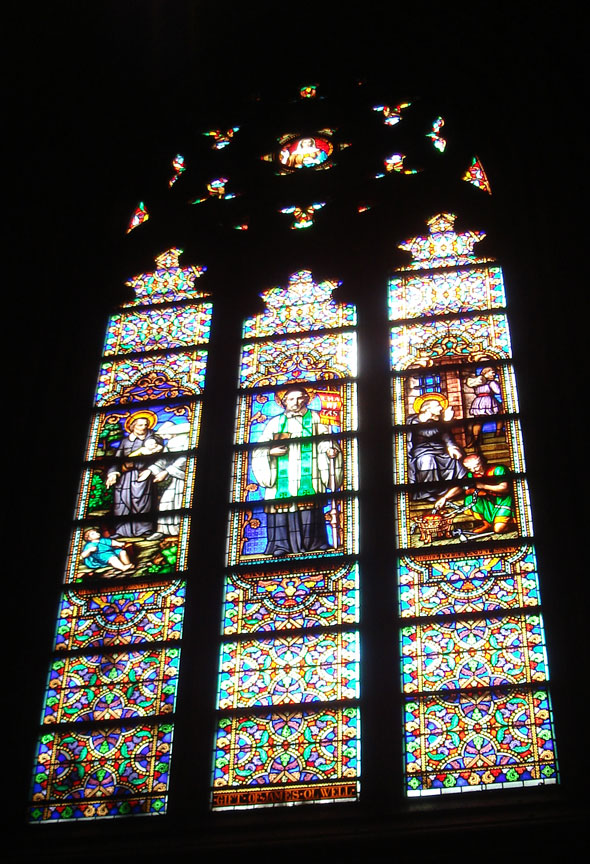
St. Patrick’s Cathedral in New York City is one place where you can step out of the hustle and bustle of the Big Apple. Within its walls, you’ll find a modicum of peace and quiet. Just like the photographs of the stained glass windows I took in Spain, I always try to get a few shots of the ones in St. Patrick’s.
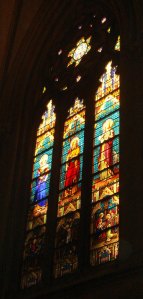 Years ago, when I was in film school, I took a number of black and white shots inside the cathedral. This was in the days before the digital darkroom. There were chemicals, enlargers, and actual film. I enjoyed that kind of work. Hours spent in the darkroom helped improve my photography in the field. Today, I use a consumer digital camera, snapping shots for this blog and other general documentary purposes. It serves the purpose and the quality of the output is actually good when considering the cost, time, and effort put into it. It truly is “easy.”

The shots of these stained glass windows came out good considering the cathedral is dark compared to the brightness of the sun shining through the window. This is a challenge for an automatic camera. Of course, you’re not able to correct the perspective or expose as well as you could with a manual camera. Nonetheless, the images are bright and clear, especially on a computer monitor. Another advantage is weight; my old manual cameras are heavy and cumbersome. Whenever I would set them up, people get intimidated or think you’re out to make a fortune on their image. Sorry, not quite, just an advance hobbyist having some fun. With the consumer cameras, I rarely encounter that problem.
 Anyway, we were in St. Patrick’s. In here I always show proper respect for people praying or a service that may be in progress. After all, this is an important place of worship. I’m impressed by the devotion of the people who come here. I’ve seen everyone among the pews, from business people at lunch time to tourists from around the world. Some people light a candle for someone in need, or say a quick prayer before their saint of choice. Either way, it is interesting to observe.
One final note, at the time of this writing, the exterior of St. Patrick’s is undergoing some work. There is scaffolding set up around the main entrance on 5th Avenue. The cathedral is open, but the exterior photos may not be as pleasant as you would like.





You must be logged in to post a comment.