MacMillan Judge and Fort Zoutman

Going back through my story notes this morning, I stumbled on some scenes for the end of a novel I mentioned earlier, MacMillan Judge, Privateer. Without ruining the story, I can tell you that our man, Captain MacMillan Judge, ends up heading to that favorite island of mine, namely Aruba. (Don’t worry, this story will be a long time coming. It’s third in line right now.) Well, in Oranjestaad there is Fort Zoutman, which today is more or less dwarfed by nearby commercial structures. However, back in the day, it was enough to keep the island under control.
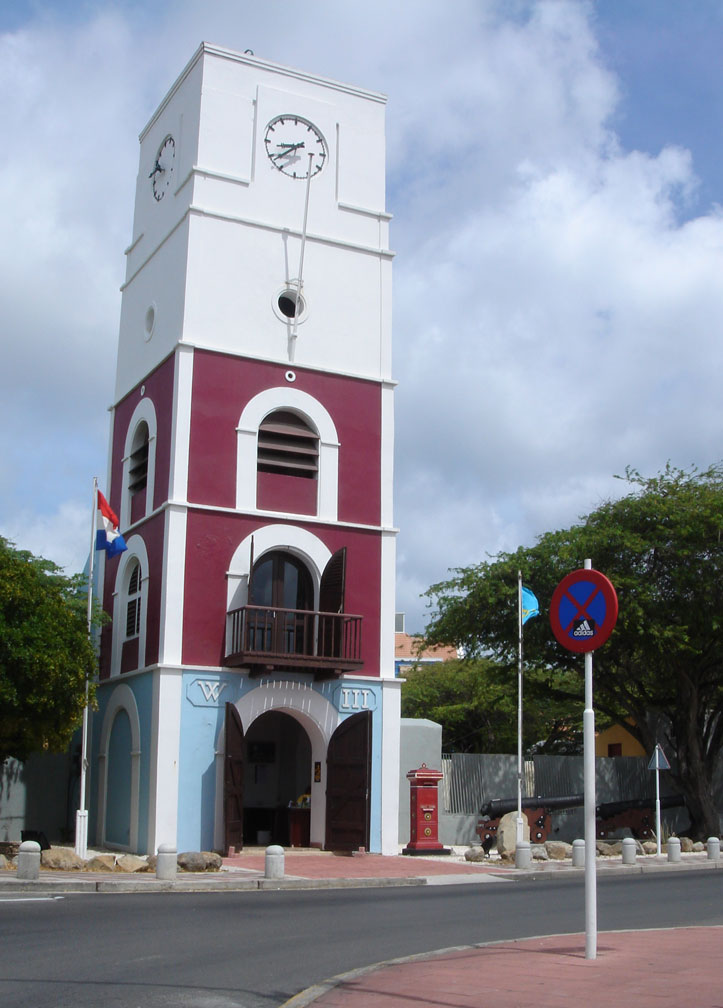
The photo to the right is of the Willem III tower. It served as a general lookout for the soldiers in the fort that sits below and behind it. Judge spots this tower as he cruises the coast in search of a decent anchorage. In case I forgot to mention it, MacMillan Judge, Privateer is set in 1815-1816. I’ve been brushing up on my history of this period, not only of Aruba, but also the Mediterranean area around southern Spain and the so-called Barbary Coast. This was a wild time in the history of the known world. The United States was a new country. Britain and France had been at war (yes, again) for quite a while. Spain, although not a superpower, still had some fangs. Through these tricky times MacMillan Judge and his crew of the privateer-built, topsail schooner Fletcher pick their way to fortune and glory. Actually that makes light of the serious themes in the story, but it sounded like the blurb you might find on the back of a sailing novel and I’m a firm believer in some excitement now and then.

It’s had to imagine a time when the canon pictured below was a key component to military domination.

Nonetheless, they did the job. In the course of the story, MacMillan Judge receives two long guns from Don Francisco, a Spanish aristocrat whose family has been harassed by the Barbary Pirates for generations. Those two long guns figure into MacMillan’s strategy as he beats back an attack by two corsairs. There I go again, telling too much of the story. Well, let’s leave it at that. For now.

Published in: on September 5, 2008 at 11:10 am  Leave a Comment  
Tags: , , , , , , , ,

Thomas Kelly’s Empire Rising

Author Thomas Kelly brings New York City to the front and center is his novel, Empire Rising. From the start, let me say that Kelly is on par with Steinbeck when it comes to capturing not only the essence but also the sweep of an era.

This is a story that takes place in the shadow of the construction of the Emprie State Building. The main characters are recent Irish immigrants. One, Michael Briody, has a terrorist past, and he struggles to put that behind him as he works as an ironworker. Grace Masterson has her own crooked dealings, including her relationship with a Tammany Hall boss. Then there are the other characters, from Mayor Jimmy Walker to union bosses and thugs galore, including the hint that the Italian mafia may be growing more powerful than the Irish gangs. The pot boils as these people claw their way through the depression and the struggles of a corrupted political system that may work better than anyone realizes. However, the price paid is not always denominated in dollars.

The best part about this book is Kelly’s ability to put the reader into the City, into the jobs these people do, and into the mood of the time. You’re right there, praying it works out. Like reality, Kelly gives the good with the bad, something I always enjoy about great fiction. As I mentioned earlier, this story is on par with some of Steinbeck’s work. Kelly doesn’t pass political judgment either, which too many recent authors seem unable to resist. He simply lets the story run its course in the context of the time in which it is set.

Thomas Kelly has written two other books, Payback, and The Rackets. I haven’t read Payback, but I did enjoy The Rackets. I’m looking forward to another book by Kelly soon.

Published in: on August 19, 2008 at 9:34 pm  Leave a Comment  
Tags: , , , , , , , ,

Some James Ellroy Novels

James Ellroy began his career writing detective fiction. His “LA Quartet” series is perhaps the best well known and includes The Black Dahlia, The Big Nowhere, LA Confidential, and White Jazz. The first book by Ellroy that I read was The Big Nowhere. This book hooked me on Ellroy’s writing. His work is not pretty, nor is it neat the way some crime fiction is. In fact, the mess of Los Angeles corruption is Ellroy’s fodder. He chews it up and spits it out like no other writer I know. His characters stand head and shoulders above the lame, hand-wringing ninnies of some series. He’s not afraid to have bad cops do good things, evil politicians stoop lower than a snake in the sand, and civilians get whacked in the cross fire. The plots are more convoluted than the frieze on a Hindu temple, and yet as believable as the reality they reflect.

But (and there’s always a ‘but’ in these posts of mine) Ellroy’s work grew beyond detective fiction to include a book that stands out among my top five books of all time, and that would be AMERICAN TABLOID. I put it in all capitals because this book will not only make the hair on the back of your neck stand up, it’ll cause you to break into a cold sweat and the occasional shaking fit. This one takes place in the run up to and aftermath of the Cuban Revolution. It features real-life characters salted in among two CIA agents gone off the reservation. One is Kemper Boyd. The other is Ward Little. These guys are on a collision course with history and each other, not to mention J. Edgar Hoover, Joe Kennedy, Sam Giancana, and a few movie stars in between. Ellroy winds his plot through the minefield of historical drama, giving the reader almost no rest between crooked and kinky deals that ultimately bring Boyd and Little face to face with what they’ve done.

Over the years, Ellroy’s style has evolved into a clipped, almost machine gun fire blitz of language. At times this can wear on me. Nonetheless, I think he is one of America’s great writers in this field. He holds nothing back and that’s what impresses me the most in an age of politically correct sterilization.

Published in: on August 17, 2008 at 8:21 pm  Leave a Comment  
Tags: , , , , , , ,

An Island Away, Excerpt 4

Below is the 4th Excerpt from my novel, An Island Away. Captain Beck has survived the sinking of his tug, Patricia, and has been adrift for several days… page 45 …

When he first saw land, Beck had thought it was an illusion. It was dawn, and a mile or two in the distance he perceived what seemed to be cliffs. They stood above the sea, brown blotches with streaks of black among them. He stared with his itchy eyeballs for what felt like hours. When the cliffs grew bigger, he realized they were real.

He felt a smile crack the skin of his lips. He was close enough to swim for land. His muscles cramped, but he couldn’t scream through his parched throat. Thankfully, his life preserver kept him afloat, or he would have sunk to the bottom like a rag-covered stone.

The wind lent him its assistance. It pushed him in the general direction of the cliffs. The waves steepened as they approached more shallow waters that led to dry land. As his body hopped along with the waves, he did his best to steer toward shore. 

Late in the afternoon, he was close enough to see the surf pour over the rocks. Whether it was a blessing or a curse, he wasn’t sure, but the currents pushed him parallel to the boulders. He heard the noise of rocks blunting the ocean. He saw birds playing in the updrafts at the edge of the cliffs. What he did not see was an appealing beach on which he could land safely. Those rocks would have shredded a man in excellent condition. After a week at sea, he would have felt only the first blow.

In the final light of the day, he realized he was passing by the tip of an island. It had to be Aruba because Curaçao had a lighthouse at its southern tip and Aruba did not. There was a beach in the distance, but it was tucked behind that fringe of nasty rocks. He drifted along, unable to swim against the current. Salvation had come and now it was going. The devil was laughing into the wind. He could hear his cackle echoing over the deserted beach.