Carnival Freedom, Aruba

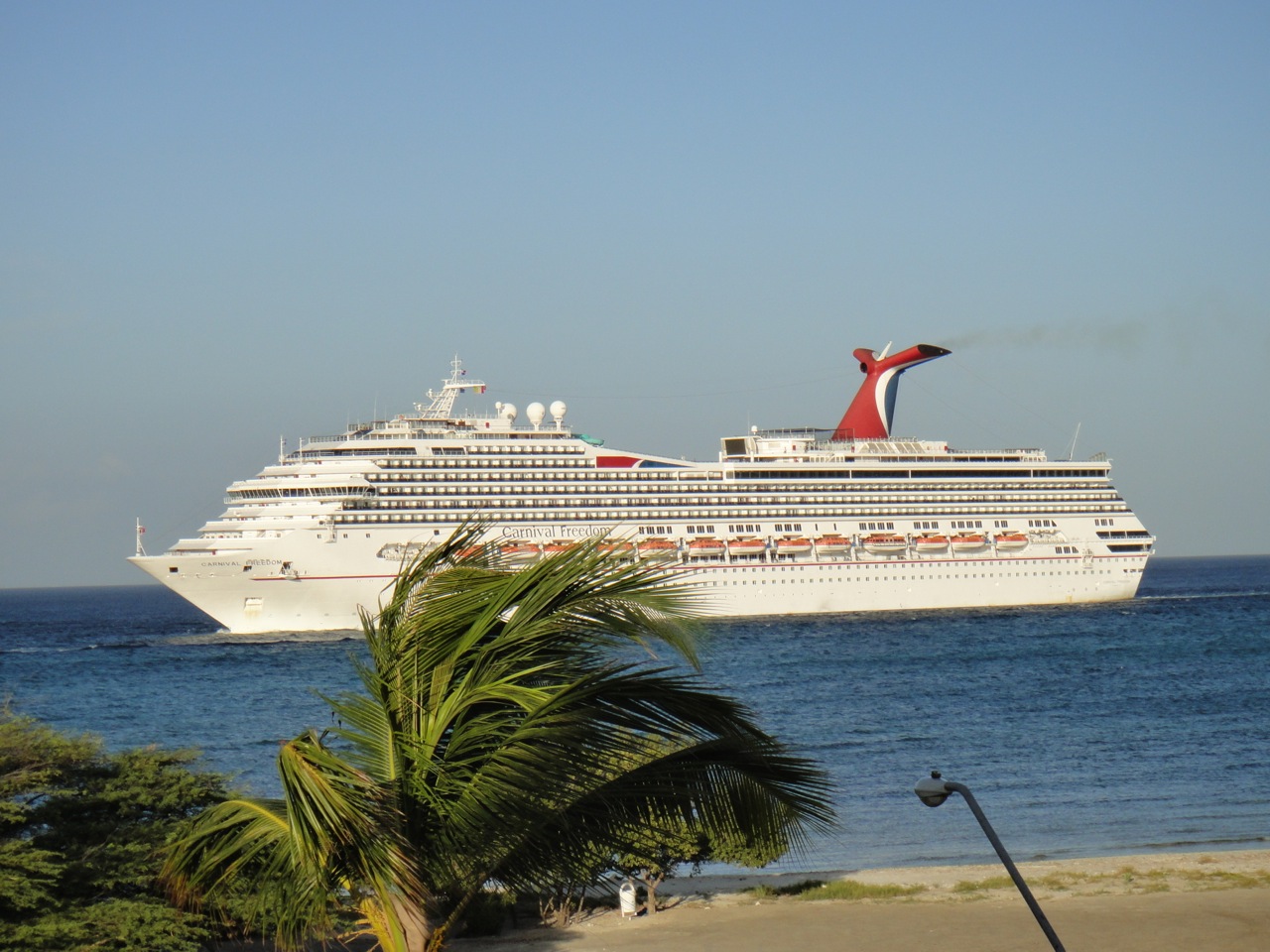
Carnival’s Freedom called at Aruba this week. Cruise ship passengers enjoyed an “off-season” visit to the island. Here’s a photo of the ship approaching the harbor at Oranjestaad.

Carnival Freedom approaches Aruba.

Freedom was the only ship in port on this day, which meant easy access to tours, shops, and the beaches which are not very crowded at present. Either way, Aruba is one happy island with plenty to offer the cruise passenger, including shopping, water activities, even sky diving. Enjoy your visit.

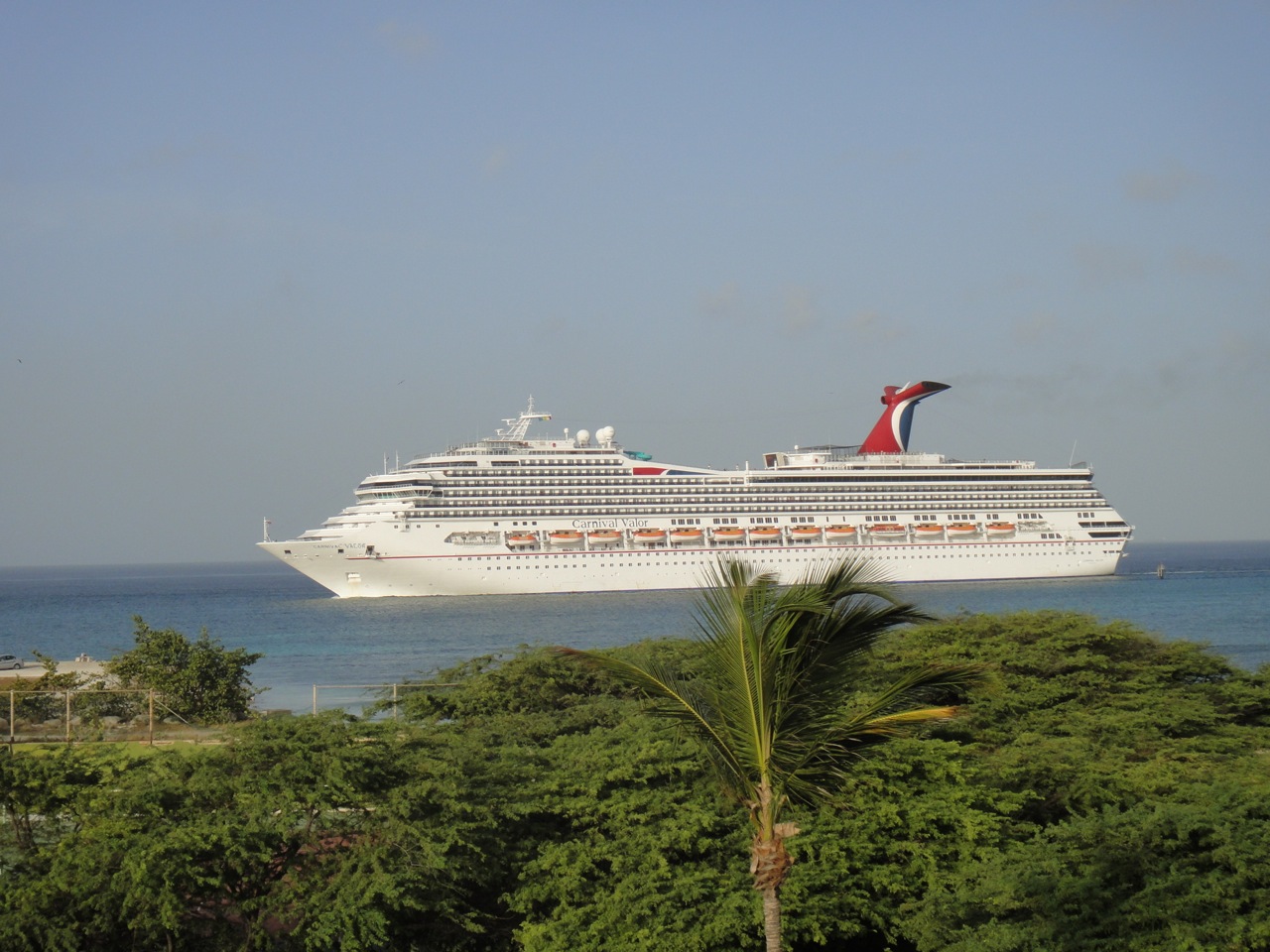
Carnival Valor, arrives Aruba

From the gym yesterday, I noticed an approaching cruise ship. It turned out to be the Carnival Valor. Snapped this pic:

Aruba is “one happy island.” I’m sure the passengers arriving were a happy bunch as well. What’s your favorite cruise line and port of call? Bon dia.

Privateers and Pirates

As mentioned earlier, I’ve been researching a novel tentatively titled MacMillan Judge, Privateer. The course of this research has taken me through many volumes, a few trips, and into places that I normally wouldn’t go. It has been quite an education into a subject I knew very little about. I’ve examined the circumstances surrounding privateer activity during the American Revolution and the War of 1812. Originally this story was going to be something akin to a swashbuckler. However, I came to believe that the people who performed heroically during these two wars deserved better. They are entitled to a representative character who upholds the ideals of the new nation as well as his own private convictions as to what it means to command a vessel of war. I say vessel of war as opposed to warship because the privateer typically used a converted merchant ship or one built for speed rather than brute force. Below is a photo courtesy of the United States Federal Government of the Pride of Baltimore, the type of Balitmore Clipper on which MacMillan, Judge will sail.

This is a tricky subject because privateers operate under a letter of marque granted by the government under which they sail. Their activities would normally be considered piracy, but the letter of marque gives them privileges normally reserved for standing navies. A privateer raids merchant ships, attacks other nations’ warships, and shells their land forces. However, in the course of these dangerous forays, any salable goods or vessels captured are subsequently sold and the proceeds go to the privateer. Therein lies the rub: the privateer is a money-making venture as much as it is a military affair.

Of course, when the United States declared independence (and later in the War of 1812), they didn’t have much in the way of a navy. They faced the most powerful naval forces the world had ever seen, those of the British Empire. The solution was to empower private individuals to take great risks in order to create some semblance of a marine force. According to some of the books I’ve read, this was a very effective method. Benjamin Franklin was an investor in a privateer ship during the revolution, as were many others of all walks of life. The privateers racked up a string of victories that would be amazing even by today’s standards. One particular ship captured six vessels in six days right under Britain’s nose in the English Channel. Another privateer sent a letter to Lloyd’s of London, bravely stating that the the British Isles were under his blockade. That’s a bold statement from a man aboard one ship. But the letter was posted at Lloyd’s and insurance rates skyrocketed.

But what about that sticky question of outright profit in the course of the war? Are these people really just pirates by another name? From what I’ve learned I would have to say, no, they are not pirates. Pirates, despite our Disney version of them today, were not the happy go lucky bunch looking for treasure and a cute place to drink rum. Pirates murdered their way around the world until allied forces hunted them down. The American privateers caused their share of casualties and made their profits, but they did not indiscriminately attack neutral ships. At the same time, when the war was over, they ceased their activities and resorted to non-combatant trading.

One way to look at the privateers is to think of their prizes as a method of payment. Instead of receiving a salary, they collected money from successfully attacking the enemies resources. It saved the United States Treasury a bundle and created a number of highly successful businessmen in the process. Many of these people invested their money in the growing economy of the United States, which only furthered progress in a place that was still a backwater when compared to Europe.

I’m looking forward to writing MacMillan Judge, Privateer. Our Mr. Judge is going to be the thinking man’s warrior, not a Disney-fied hero who dodges grapeshot and dances about the deck. First I have to finish Under A Blue Flag, which is the sequel to An Island Away, but that’s another story that I’ll be talking about soon.

Published in: on July 3, 2008 at 4:02 pm  Leave a Comment  
Tags: , , , , , , , , ,

Numbered Days

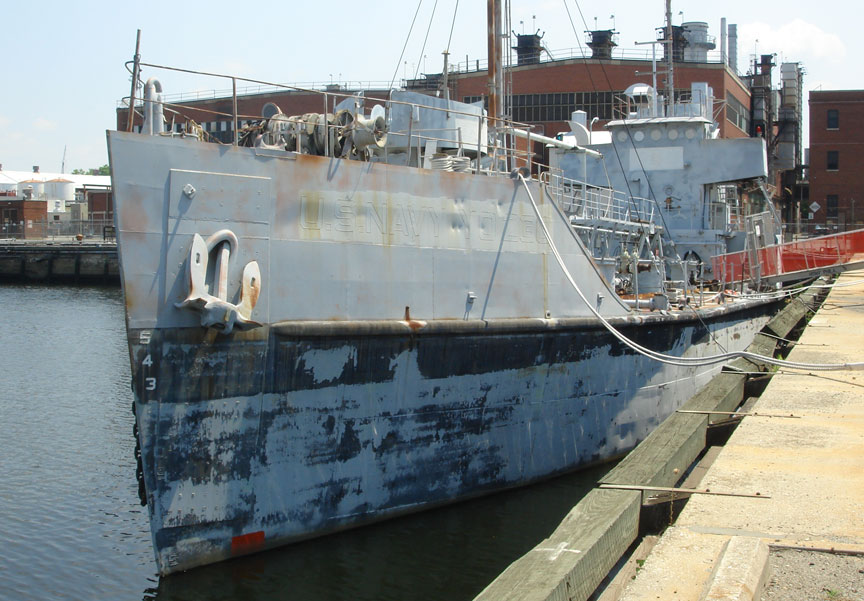
For the ships in the back basin at what remains of the Philadelphia Navy Yard, the days are numbered. These vessels are on the inactive list and subject to sale, scrapping, or another fate, that of an artificial reef. Before I became a novelist full time, I used to sink ships to build artificial reefs. Yes, it’s a long story from there to here. Anyway, I sank several small tankers like the one pictured below.

This little tanker is what the navy used to call a “yard oiler.” It carried fuel of various types to top off ships or other floating equipment. They were mostly built in 1944 and saw limited service until the end of World War II. In the end, they landed in places like this, moving no further than up and down with the tide. I sank three of these off the coast of New Jersey. They became great dive and fishing sites. However, it was a sad sight, watching them sink. Anyone who has lived and worked aboard a sea-going vessel knows that you become attached to your boat. You learn its foibles, the noises it makes, the noises it doesn’t make, and just where you fit in among its bulkheads. Thus, when you know all hope is lost and it’s destined for the bottom, you can’t help but feel a sadness others might not appreciate. Imagine your house, your job, your car, and all the times you’ve spent there, everything… disappearing in a matter of minutes, never to be seen again, except by the fish and the occasional scuba diver. There’s no rebuilding, as in the case of a hurricane or a tornado that knocked your house down. This was your boat, the specific one you knew. Gone.

Nonetheless, the fish need houses, too, and if the vessel is destined for nothing better than the scrappers, better it finds a home among the creatures of the sea.

And here is the demise of an old yard oiler, off the coast of Manasquan Inlet, New Jersey, USA. The first photo below shows the ship at anchor. I’ve just opened a series of valves and removed plates in the hull to let water in.
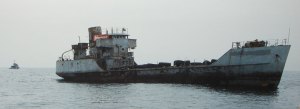
A local beer distributer helped pay for the cost of sinking this ship. Thus, the Budweiser sign. In the next photo the ship is well on its way to the bottom.

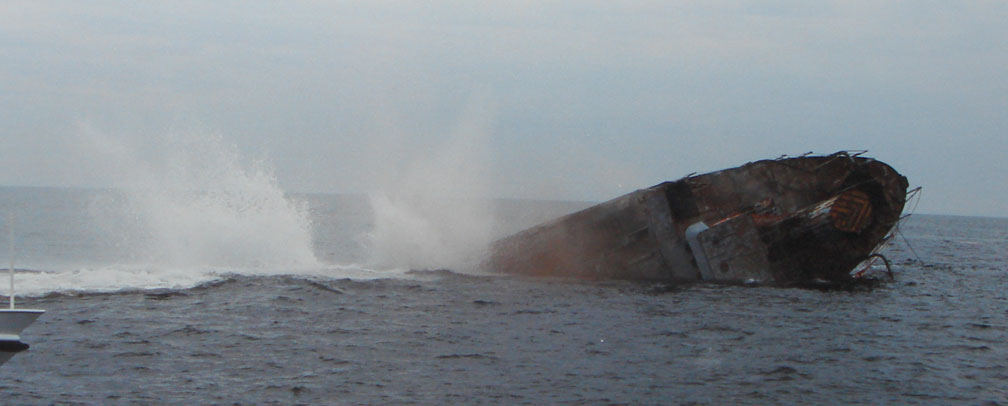
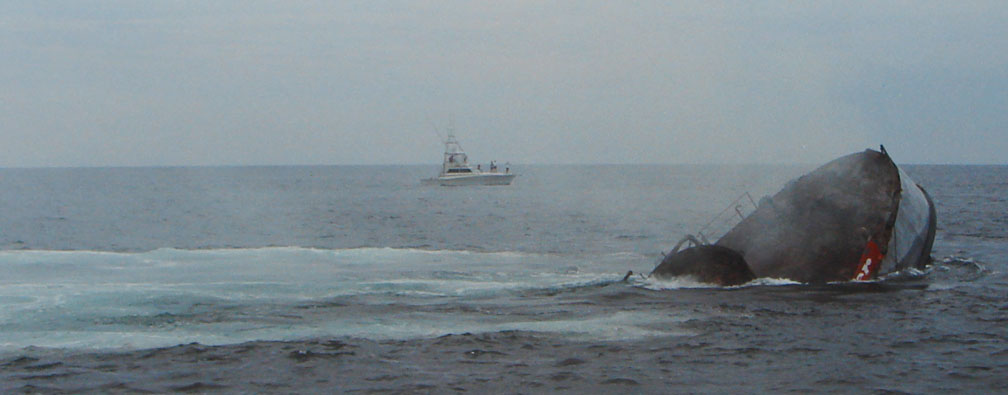
It rolled to the port side and took a nose dive toward Davy Jones’ locker. Finally, it’s all but under the surface, belching air as water finds its way into every space.
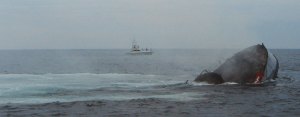
In the back of the last photo, you can see a fishing boat. Once the ship settled onto the bottom, he cruised over, logging the exact position on his GPS so that he can come back and reap the benefit. The States of New Jersey and Delaware promote reef construction as much as possible. It helps the environment and provides a renewable fishing resource for sport fisherman. These wrecks last about fifty to eighty years.

Still, it’s sad to put a good ship down. I’ll post one more separately, a former US Coast Guard buoy tender named the Red Oak.
Published in: on June 27, 2008 at 4:36 pm  Leave a Comment  
Tags: , , , , ,