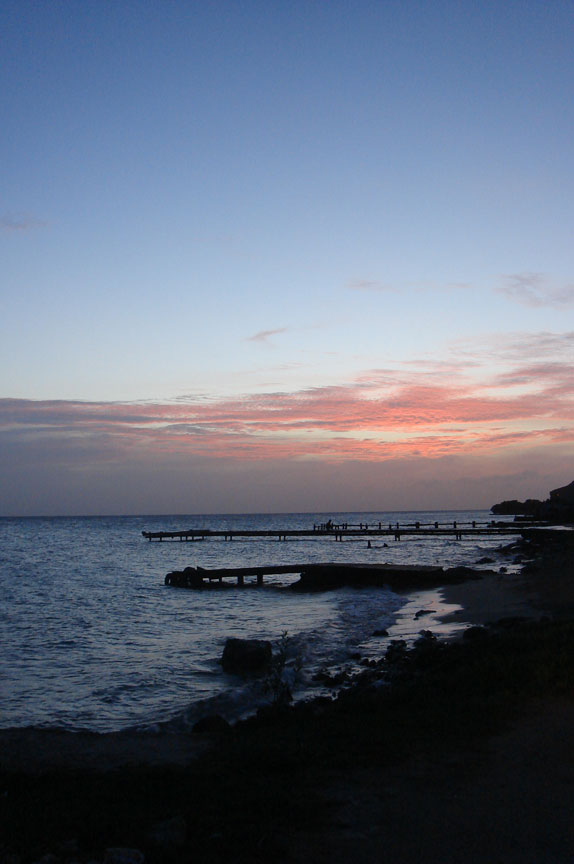
 I took this sunset photo looking west, northwest from Santa Cruz, Aruba. The church on the left is one that showed up in an earlier post.
Sunset from Santa Cruz

Island Energy Production
So in the last post, I said I needed to DELIVER 7,000 watts of power to keep my airco system working here in Aruba. The next logical question is how am I going to produce electricity in the first place. Well, here in Aruba we have copious supplies of both wind and sun. The trade winds blow across this island day and night, month after month, we few exceptions. My own observations show that the average wind speed on my property is in excess of 24 mph. As for the sun, it blazes at least 8 hours a day. Cloudy and rainy days do occur but not very often and rarely several in a row.
So, how do we get the wind to make electricity? With one of these:
 To the left is a Southwest Wind Power, Whisper 200, wind turbine. More commonly referred to as a “windmill.” The unit produces a maximum of 1,000 watts of power when a steady breeze of 27 mph is passing through its blades. But wait a minute, I said my average speed is only 24 mph. That’s right and at 24 mph this unit produces 800 watts. To keep it simple, this wind turbine could (theoretically) power an electrical device requiring 800 watts of power given the conditions I described.
In the real world, things are a bit different. Here’s where we all have to concentrate. Let’s say that at my house the wind blows at 24mph for 10 hours each day. That means the windmill would produce 800 watts times 10 hours for a total of 8,000 watts. What can 8,000 watts do? It could run that big airco of mine for a little more than 2 hours. Now, my on-site observations show that the wind blows MORE than 24 mph for approximately 20 hours per day (yes, it is that windy in Aruba). So, I can reasonably expect this unit to deliver 16,000 watts per day to the system.
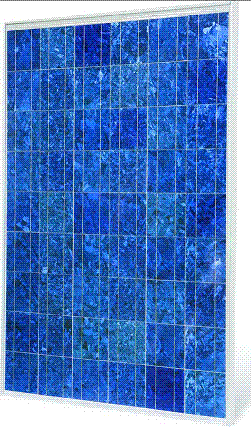 I did mention something about the sun. The example is much the same with different equipment. A solar panel like the one on the left does the job. Yeah, it’s one of those sort of shiny blue things that typically goes on the roof. My system will use 200 watt panels. Each one will produce 200 watts if operating at its maximum. I’m going to string 5 of them together to have the potential for 1,000 watts. Again, I’m going to de-rate the output to 800 watts and I’m going to say that it will produce that much 7 hours per day for a total of 5,600 watts per day.
Now it is time to combine these two sources. Together, I’m expecting them to produce a total of 21,500 watts per day. Let’s round DOWN again, to 21,000. Finally we get to the fun part. What can I do with the 21,000 watts and those airco units? Just divide the production by the demand. I could run them both for 3 hours since they require 7,000 watts together. I could run the larger one for about 6.5 hours, or the smaller one 7 hours, or some combination of both. Since I rounded demand UP and production DOWN, I should have some room to maneuver here.
Either way, I’m satisfied that this method of production will give me what I want, which is to run those air conditioners long enough to keep my cat, my wife, and myself comfortable here in Aruba. Next time I’ll talk about combining this power into a manageable form. In between, we’ll have some more fun on the island, writing books, and taking photos.
Beginning at the End
I keep a collection of short stories titled, A Rusting Sea. These were born (many years back) out of my frustration with not finishing a novel. I thought I would be satisfied creatively by completing a shorter work, sitting back, and thinking, “Well, there it is, the whole thing.” This worked for about six months, during which time I wrote eight stories varying in length from about 10 to 80 pages. Strangely enough, the ending of each story came to me first. I had the end in mind, then tripped back to the beginning and plotted a course to that destination.
Thus, Captain Quincy’s Near Death Experience (which was the second one I wrote) comes to mind just now because I’m here on the island of Aruba. Captain Quincy, a lifelong mariner, decides he’s had enough of retirement and wants to depart this earth before he becomes a decrepit old codger. He spends a couple of days doling out his considerable wealth and through this convention you learn the history of his life. Of course, his cat distracts him throughout this process, ultimately causing Quincy to head back to sea one more time. And here’s how the story ends…
…So Captain Quincy and his cat, Gimlet, hustled down the track on their way to the port.
Attorney Mickleson, that is the son of the Mickleson who defended Quincy in the Turkish courts, found Captain Quincy’s letters and log books on the desk where they had been left. This was some months later, after Mickleson tried more than thirty different times to reach the captain. He went to the house with a police escort to open the door. The door was not locked, and nothing in the house was disturbed. Nothing indicated foul play. The police determined Captain Quincy had gone missing of his own accord despite the odd circumstances. Mickleson sent the letters off to their intended recipients and used the remaining money to maintain Quincy’s home in the off chance he returned.
No one heard from Quincy again. No one claims to know what happened to him. Mickleson ultimately settled the estate, took a reasonable fee, and contributed the balance to a range of charities.
However, on the island of Aruba, in the village of Saveneta, fitted tightly in the dirt beneath a Divi tree, stands a small headstone. The stone reads, “Gimlet,” and beneath the name, “A small world, big enough for me.”
END.
IT WAS that last paragraph that came to me one day while I was looking out the window of a rental bungalow here in Aruba. The rest of the story came later. Would you like to read the rest? Let me know.
Ruins, Part 1
Ever wonder… what happened to the people who abandoned a house you’ve seen? Here in Aruba, I come across the ruins of old homes from time to time. Judging by the style of construction, they are at least 80 to 100 years old. And given the condition they’re in, they must have been forgotten for at least 30 years. Here is one particular example.

This old cunucu house has suffered it’s share of abuse. The roof is gone. The east wall is pitching outward. Even the wall of the cistern has a crumbling corner. Of course the windows have disappeared. But if you peek in, you’ll see remnants of life inside. Take a look through the wall.
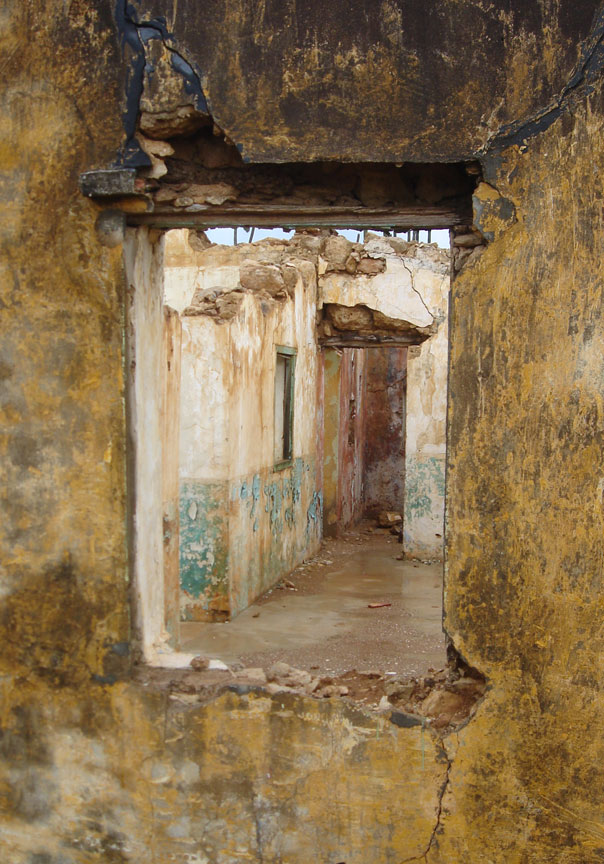 There are shades of paint on those walls. The lower portion featured a different color than the upper, indicating someone had a sense of style. Further on, in the distance is yet another color. Seeing these details leaves me wondering what happened to the people who lived here. They invested their lives into this house, chose the colors, ate their meals, slept under its roof. And yet, at some point, they left, never to return, never to leave the place in care of someone else.
It’s easy to think that hard times befell the former residents, or perhaps a tragedy. However, it’s also possible they inherited a fortune and left for some grand residence in another part of the world. Or, maybe they found somewhere new to live, one which provided them with so much more that their beginnings became irrelevant.
Either way, it is fascinating to think that someone would simply walk away from a perfectly serviceable dwelling, leaving the elements of nature to ultimately reclaim it. I have more photos like this and a few stories to tell about them. Keep checking for updates.
 The Bent Page
You must be logged in to post a comment.