One of the fascinating aspects of Spain is the contrasting styles of architecture (among other things). In my travels, I’ve noted the amalgamation and integration of styles in the various significant buildings. I’ve selected two old photographs (taken between 1860 and 1880) which demonstrate this reality. The first is a shot taken at the Mezquita in Cordoba.

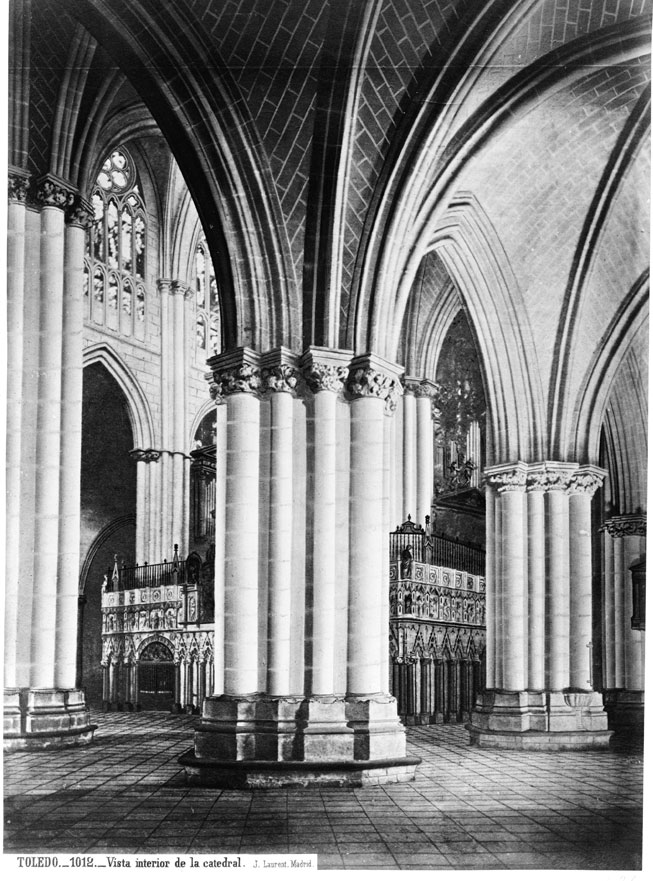
This old photo illustrates the “mudejar” arch, which was built by the Moors who controlled Spain for a time. After the unification of Spain by Ferdinand and Isabel, the mosque in Cordoba became a cathedral. Nonetheless, much of the original structure remained. In fact, when visiting the Mezquita, you’ll see that it appears as if a cathedral was inserted into the mosque. These arches stretch out in all directions giving an infinite feel to the space. On the other hand, if you travel to Toledo’s cathedral, you’ll see an example of high gothic construction like this:
 Here you see the massive columns, vaulted cielings, and pointed windows that are hallmarks of the style. Both of these cathedrals are used for religious services to this day, which testifies to the endurance of the Spanish in their faith. It also stands as a testament to the builders of these structures. There are exhibits which show the techniques employed, which while primitive by today’s standards, were state of the art at the time. A fascinating case contains several cut blocks bearing the initials and personal marks of the masons who shaped them. These letters speak for them, as if to say, “I was here. I helped to build this.”
A note about photography when traveling… these days I tote my little digital camera with me just about everywhere. I take a few shots here and there. However, I find those glossy books designed for tourists to contain some of the best photography of typical sites like cathedrals, palaces, cityscapes and so on. I purchase them frequently because the photography within is much better than the results that could be achieved in the short time of a typical visit. Don’t hesitate to buy them. They’re cheap compared to what it costs to get such great photos.



 The Bent Page
You must be logged in to post a comment.